Cutting thick branches can be tiring with standard loppers, especially when working overhead or tackling dense, dry wood. Ratcheting garden loppers use a geared or staged cutting action to multiply leverage and reduce the force needed at the handles.
This roundup compares 10 heavy-duty options, including bypass and anvil designs, adjustable handles, and cutting capacities up to 2 inches. Use the guide below to match the tool to your trees, pruning style, and available storage space.
Best 10 Ratcheting Garden Loppers Picks for 2026
Heavy-Duty Ratchet Pick
Spear & Jackson Telescopic Anvil Loppers

- Short-step ratchet action for thicker branches
- Handles extend from 28 to 40 1/2 inches
- 2-inch cutting width with PTFE-coated SK5 blade
Best For: Hard-to-reach, thick branch cutting
Leverage-Focused Bypass
Fiskars PowerGear2 32-Inch Loppers

- PowerGear2 technology multiplies cutting leverage
- 2-inch bypass capacity for tree branches
- Low-friction coated steel blade and lifetime warranty
Best For: Live branches and clean bypass cuts
Adjustable Gear-Bypass Choice
STEELHEAD Telescoping Gear-Bypass Lopper
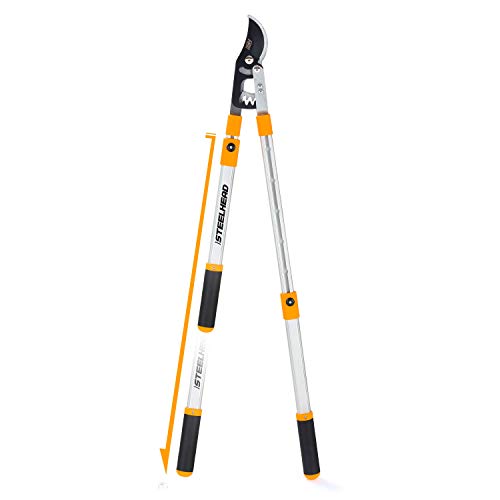
- Compound ratcheting design provides up to 3x cutting force
- Handles adjust from 27 to 40 inches
- 1 3/4-inch capacity with non-stick high-carbon steel blades
Best For: Stubborn limbs and adjustable-reach pruning
Dry-Branch Ratchet Pick
Fiskars 32-Inch Ratchet Anvil Loppers

- Ratchet drive compounds force through easy squeezes
- 2-inch capacity for thick, dry, dead branches
- Low-friction hardened steel blade resists gumming
Best For: Deadwood and thick dry branches
Heavy-Duty Reach Pick
Kings County Tools Double-Ratcheting Bypass Loppers

- Double-ratcheting design with a 2-inch cutting capacity
- Telescopes from 26 to 40 inches
- Bypass blade suits green wood and living branches
Best For: Long-reach pruning of green branches and tree limbs
Balanced Leverage Pick
Fiskars 28-Inch Power-Lever Bypass Loppers

- Compound Power-Lever design boosts cutting leverage
- Handles branches up to 1.75 inches thick
- Low-friction blade and SoftGrip handles aid control
Best For: Routine pruning and general yard maintenance
Dry-Wood Specialist
GARTOL Extendable Double-Ratcheting Anvil Loppers

- Four-step ratchet targets thick, dry branches
- Extends from 28 to 41 inches for added reach
- Anvil blade and high-carbon steel suit hard wood
Best For: Dead wood, hardwood, and dense branch cutting
Best with Extra Features
Kings County Double-Ratcheting Anvil Lopper
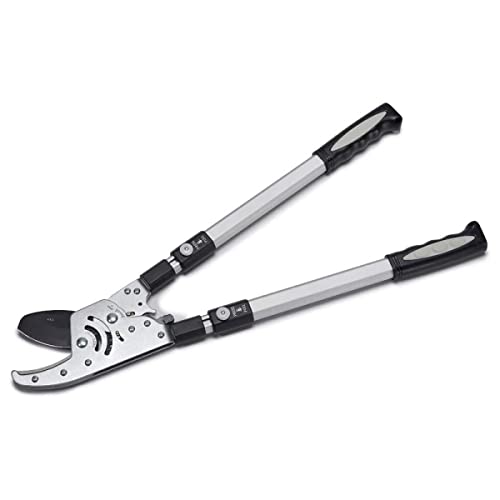
- Double-ratcheting mechanism for increased cutting force
- 26- to 40-inch telescoping handles
- Designed for dry branches up to 2.5 inches
Best For: Dry wood, dead limbs, and high-reach pruning
Lightweight Precision Pick
Kimura Pro Ratcheting Anvil Lopper

- Up to five-times stated ratcheting power
- Japanese SK5 blades with PTFE coating
- 25- to 37-inch lightweight telescoping handles
Best For: Moderate pruning, shrubs, hedges, and comfort-focused use
Maximum-Reach Pick
EZ Kut G2 42-Inch Ratcheting Lopper

- Six-stage ratcheting mechanism for thick branches
- Handles extend to 42 inches
- Ergonomic cushioning helps reduce hand fatigue
Best For: High branches, orchard cleanup, and extended pruning sessions
Heavy-Duty Ratchet Pick – Spear & Jackson Telescopic Anvil Loppers
These ratcheting garden loppers combine short-step ratchet action with telescopic aluminum handles, making them a practical choice for thicker branches and awkward, hard-to-reach growth. The anvil blade is suited to demanding cuts, while the adjustable length adds reach and leverage.
Best For: Cutting thicker, harder branches when extra reach and ratcheting assistance are useful.
Pros:
- Ratchet action helps make cuts in short, manageable steps.
- Telescopic handles extend from 28 to 40 1/2 inches.
- PTFE-coated SK5 carbon steel blade offers sharpness, rust resistance, and reduced sticking.
- Soft non-slip grips, a locking catch, and a 10-year guarantee add practical value.
Cons:
- The 4.2-pound weight may feel substantial during extended overhead use.
- Anvil-style blades are primarily suited to thicker, harder, or dry wood rather than general bypass pruning.
Choose this model if adjustable reach and ratcheting assistance matter more than having the lightest possible lopper. Its combination of a 2-inch stated cutting width and long handles makes it particularly oriented toward heavier garden work.
Leverage-Focused Bypass – Fiskars PowerGear2 32-Inch Loppers
Although not a ratcheting model, these ratcheting garden loppers alternatives use PowerGear2 technology to multiply leverage through the cut. The 32-inch bypass design is intended for live branches up to 2 inches thick, with a low-friction steel blade for smoother maintenance work.
Best For: Gardeners who want long handles and powered leverage for cutting live tree branches.
Pros:
- PowerGear2 gears and cam mechanism increase cutting power, especially through the middle of a branch.
- Bypass blade is designed to glide through branches up to 2 inches thick.
- Low-friction coating helps reduce sap buildup and improve rust resistance.
- SoftGrip handles support comfort and control, and the tool includes a lifetime warranty.
Cons:
- It does not use a ratcheting mechanism, so it may not suit shoppers specifically seeking repeated short-step cuts.
- The fixed 32-inch length offers less reach flexibility than telescoping alternatives.
This is a strong option when clean bypass cuts on live growth are the priority. Its leverage system offers effort reduction without the step-by-step ratchet operation found on the other models in this roundup.
Adjustable Gear-Bypass Choice – STEELHEAD Telescoping Gear-Bypass Lopper
For shoppers comparing ratcheting garden loppers, the STEELHEAD offers a gear-bypass jaw and adjustable handles in one compact package. Its compound mechanism is designed to reduce cutting effort and shock, while the telescoping arms extend from 27 to 40 inches for added leverage.
Best For: Cutting stubborn shrubs and limbs when adjustable reach and reduced hand strain are important.
Pros:
- Compound-ratcheting gear-bypass design provides up to three times the cutting force.
- Tool-less handles adjust from 27 to 40 inches.
- High-carbon steel blades have a non-stick, corrosion-resistant finish.
- DuraGrip overmolded handles and lifetime U.S.-based support add usability and service value.
Cons:
- The stated 1 3/4-inch cutting capacity is lower than the 2-inch capacity of some alternatives.
- Serrated bypass blades may require more attention to cleaning plant residue after use.
This model balances ratcheting assistance and reach adjustment well. It is a particularly practical fit for varied pruning positions, though its lower stated capacity makes it better suited to branches within the 1 3/4-inch limit.
Dry-Branch Ratchet Pick – Fiskars 32-Inch Ratchet Anvil Loppers
These ratcheting garden loppers use a series of easy squeezes to compound force, making them suited to thick, dry, and dead branches. The 32-inch ratchet anvil design has a stated 2-inch capacity, while the low-friction steel blade is intended to resist sap buildup and rust.
Best For: Removing thick, dry, or dead branches with repeated low-effort squeezes.
Pros:
- Ratchet drive compounds force for cutting with less effort.
- Anvil blade is specifically suited to thick, dry, and dead wood.
- Fully hardened, precision-ground steel blade is designed to stay sharp longer.
- Low-friction coating helps the blade glide and limits gumming from sap and debris.
Cons:
- The fixed 32-inch handles do not provide the adjustable reach of telescoping models.
- Anvil construction is less oriented toward clean cuts on live green branches than bypass designs.
This is the focused choice for heavier deadwood removal. Its ratchet operation and 2-inch capacity favor forceful cuts through dry material, while the fixed length keeps the design straightforward.
Heavy-Duty Reach Pick – Kings County Tools Double-Ratcheting Bypass Loppers
These ratcheting garden loppers are designed for cutting living, green wood where extra leverage and reach are useful. The double-ratcheting bypass mechanism, 2-inch capacity, and telescoping handles make this a substantial option for tree and shrub maintenance.
Best For: Trimming green branches and tree limbs, especially when additional reach is helpful.
Pros:
- Double-ratcheting mechanism helps generate cutting force for branches up to 2 inches thick.
- 26- to 40-inch telescoping handles provide useful reach without a ladder.
- Six pin-locked handle positions and rubber grips support adjustable, controlled use.
Cons:
- At roughly 3.8 to 3.99 pounds, it is relatively substantial for extended work.
- Its bypass design is intended for green wood rather than primarily dry branches.
The Kings County Tools model stands out when you want a long-reach ratcheting garden lopper for living wood. Its large cutting capacity and extendable design favor demanding pruning jobs, though the heavier build may not suit every gardener.
Balanced Leverage Pick – Fiskars 28-Inch Power-Lever Bypass Loppers
The Fiskars 28-inch Power-Lever is a practical choice among ratcheting garden loppers for routine branch trimming. Its compound lever increases cutting power, while the low-friction steel blade and cushioned grips help make repeated cuts more manageable.
Best For: General yard and garden pruning involving branches up to 1.75 inches thick.
Pros:
- Power-Lever compound design provides more leverage than traditional loppers.
- Bypass blade cuts branches up to 1.75 inches thick.
- Low-friction blade coating supports smoother cuts and resistance to gumming and rust.
- Rounded handles and SoftGrip touchpoints improve comfort and control.
Cons:
- Its 1.75-inch capacity is lower than the 2-inch or greater capacity of the other listed options.
- The fixed 28-inch length offers less reach flexibility than telescoping models.
This Fiskars model is a straightforward, comfortable option for regular pruning rather than the largest limbs. Choose it if dependable leverage, ergonomic handling, and a manageable fixed length matter more than maximum capacity or adjustable reach.
Dry-Wood Specialist – GARTOL Extendable Double-Ratcheting Anvil Loppers
For thick, dry branches, these ratcheting garden loppers combine a four-step ratchet with an anvil cutting action. The handles extend from 28 to 41 inches, and the high-carbon steel blade is designed for hard wood up to 2 to 2.5 inches in diameter.
Best For: Cutting dead wood, hardwood, and other dense branches where anvil action and extra leverage are useful.
Pros:
- Four-step ratchet system is designed to reduce hand strain on thick branches.
- Anvil configuration suits hard, dry, and dead wood.
- 28- to 41-inch aluminum handles provide adjustable reach.
- Soft TPR non-slip grips support comfort and control during longer jobs.
Cons:
- Anvil loppers are less specifically suited to clean cuts on living green wood than bypass models.
- The listed cutting claims vary between up to 2 and 2.5 inches, so actual capacity may depend on the wood.
GARTOL is the most specialized choice here for dry or dead branches. Its extended range and multi-step ratchet provide useful leverage, while the anvil blade and high-carbon steel construction target tougher cutting tasks.
Best with Extra Features – Kings County Double-Ratcheting Anvil Lopper
If you need ratcheting garden loppers for dry wood and substantial dead branches, this Kings County model emphasizes cutting force and reach. Its double-ratcheting mechanism, 2- to 2.5-inch jaw capacity, and telescoping 26- to 40-inch handles suit demanding pruning and kindling-preparation tasks.
Best For: Dry branches, dead limbs, and gardeners who want extended reach with high cutting force.
Pros:
- Double-ratcheting mechanism is designed to multiply cutting force.
- Six pin-locked handle positions extend reach from 26 to 40 inches.
- Steel construction, rubber grips, and a 2- to 2.5-inch stated jaw capacity.
Cons:
- At about 4.4 to 4.54 pounds, it is relatively heavy for extended overhead work.
- The product is specifically positioned for dry wood, so it may be less suitable for primarily green-branch pruning.
This is a force-oriented option for serious cleanup rather than lightweight trimming. Choose it when reach and leverage matter more than minimizing tool weight.
Lightweight Precision Pick – Kimura Pro Ratcheting Anvil Lopper
These ratcheting garden loppers combine a stated five-times power boost with lightweight telescoping handles. Japanese SK5 steel anvil blades, a PTFE coating, and twist-lock adjustment make this Kimura model a practical choice for controlled trimming of branches up to 2 inches thick.
Best For: Gardeners seeking a lighter telescoping lopper for routine tree, hedge, and shrub maintenance.
Pros:
- Advanced ratchet mechanism is designed to multiply force by up to five times.
- Japanese SK5 carbon steel blades and PTFE coating support precise, low-friction cuts.
- Lightweight aluminum handles extend from 25 to 37 inches and have soft TPR grips.
- Includes a stated lifetime warranty.
Cons:
- Its stated 40-millimeter capacity is lower than the largest loppers in this roundup.
- Twist-lock handles provide less reach than models extending to 40 or 42 inches.
The Kimura is a balanced option when maneuverability and comfort are priorities. Its 2-inch capacity and anvil design make it better suited to moderate pruning than oversized limbs.
Maximum-Reach Pick – EZ Kut G2 42-Inch Ratcheting Lopper
For hard-to-reach branches, the EZ Kut G2 is one of the longest ratcheting garden loppers here, with handles extending to 42 inches. Its six-stage ratcheting mechanism is intended for thick dry or green branches up to 1.5 inches, while cushioned grips and shock-absorbing pads help reduce hand and wrist strain.
Best For: High branches, intensive yard or orchard cleanup, and gardeners who value leverage and ergonomic support.
Pros:
- Six-stage ratcheting action multiplies force with each squeeze.
- Telescoping aluminum handles extend to 42 inches for elevated branches.
- Designed to cut dry or green branches up to 1.5 inches thick.
- Non-slip cushioning and shock-absorbing pads are intended to reduce fatigue.
Cons:
- Its stated 1.5-inch cutting capacity is lower than the other listed loppers.
- Long handles can be less convenient in tight spaces or dense shrubs.
This model stands out for reach and user comfort rather than maximum branch capacity. It is a strong fit when avoiding ladders and reducing repetitive hand strain are central to the job.
How We Picked the Best Ratcheting Garden Loppers
We focused on loppers designed for demanding garden and tree-maintenance work rather than light stem trimming. The selected models were compared by cutting capacity, ratchet or gear mechanism, blade style, handle adjustment, construction, and overall practicality.
We also considered whether each tool is better suited to live branches, dry wood, or a mixture of both. Extendable handles can improve reach and leverage, but they may add weight and require more room to store, so adjustability was treated as a useful feature rather than an automatic advantage.
Quick Comparison
- Best for versatile pruning: A bypass model such as the Fiskars PowerGear2 or STEELHEAD is suitable for cleaner cuts on living branches.
- Best for dry or dead wood: Anvil models, including the Spear & Jackson, Fiskars Ratchet Drive, and EZ Kut options, are built around crushing and cutting tougher material.
- Best for reach: Telescoping tools from Spear & Jackson, GARTOL, Kings County Tools, Kimura, and others can extend the working range.
- Best for compact handling: Fixed-length or shorter-reach designs are generally easier to control in dense shrubs and smaller yards.
Key Buying Factors for Ratcheting Garden Loppers
Bypass or Anvil Blade
Bypass blades pass one blade against another and usually leave a cleaner cut on fresh, living wood. Anvil loppers close against a flat surface, making them useful for dry, hard, or dead branches. Avoid using anvil models when clean cuts on live growth are your main priority.
Cutting Capacity
Rated capacities commonly range from about 1.75 to 2 inches among these tools. Treat those figures as upper limits, not everyday targets. Measure the branches you typically cut and choose a model with comfortable headroom; forcing an oversized branch can damage the tool or leave a poor cut.
Ratchet and Gear Action
Ratchets allow you to cut in stages by closing and reopening the handles, while geared systems multiply leverage through the cutting stroke. Both can reduce hand strain, but they may feel slower than conventional loppers on small branches. Look for smooth engagement and handles that open comfortably.
Handle Length and Weight
Longer handles increase leverage and reach, but they can be tiring during extended work or overhead pruning. Telescoping handles provide flexibility, though locking mechanisms should feel secure before cutting. Consider your strength, storage space, and how often you will carry the tool around the garden.
Who Should Buy Which Ratcheting Garden Loppers?
Choose a bypass ratcheting model if you mainly prune live fruitwood, shrubs, or green branches and want cleaner cuts. Choose an anvil model if your work centers on dead limbs, seasoned wood, or occasional storm cleanup. A telescoping lopper is worthwhile when branches are spread across varying heights, while a fixed-length tool may be preferable for better balance and faster handling in tight spaces.
For frequent heavy-duty work, prioritize sturdy construction, a comfortable grip, dependable locking points, and replacement-part availability over the longest advertised reach. For occasional household pruning, a lighter model with a moderate capacity may be easier to use and less tiring than an oversized professional-style tool.