Choosing the right loppers can make fruit-tree pruning faster, cleaner, and less tiring. The best tool depends on branch thickness, access, cutting style, and how much leverage you need.
We compared 10 capable options, from compact anvil loppers to long-reach bypass models, to help you find a practical match for routine orchard maintenance and heavier seasonal pruning.
Best 10 Garden Loppers for Fruit Trees Picks for 2026
Best Overall
Fiskars 28-Inch Bypass Loppers

- Cuts branches up to 1.5 inches
- Low-friction steel blades
- Comfort grips and lifetime warranty
Best For: General fruit-tree maintenance and durable everyday pruning
Best for Reach
KSEIBI 3.5-Foot Cut-and-Hold Pruner

- 3.5-foot reach for elevated growth
- Lightweight aluminum construction
- Cut-and-hold bypass mechanism
Best For: Small branches, fruit harvesting, and hard-to-reach areas
Best for Leverage
YRTSH Extendable Compound-Action Loppers

- Up to 1.6-inch cutting capacity
- Compound action boosts cutting power
- Handles adjust from 28 to 41 inches
Best For: Thicker green or dry branches and adjustable-reach pruning
Best Power Bypass
Fiskars 28-Inch Power-Lever Loppers

- Cuts branches up to 1.75 inches
- Power-Lever compound mechanism
- Comfortable non-slip handles
Best For: Larger live branches requiring bypass cuts and extra leverage
Best Adjustable Pick
YRTSH Compound-Action Extendable Loppers
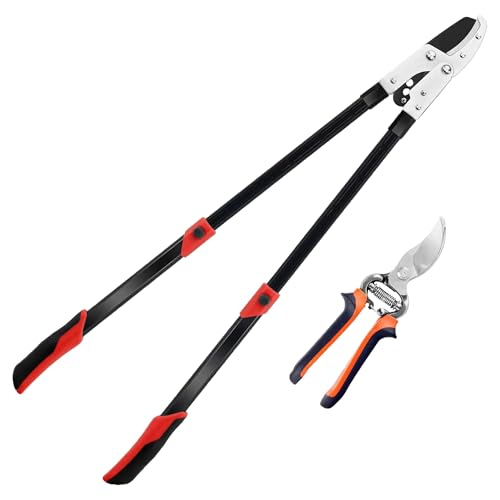
- 28–41-inch six-step adjustable handles
- Compound action for added cutting power
- 2-inch capacity with coated alloy-steel blade
Best For: Adjustable reach for fruit trees, shrubs, and thicker branches
Best for Clean Live-Branch Cuts
Fiskars PowerGear2 Bypass Loppers

- Bypass blade for live-branch pruning
- PowerGear2 mechanism multiplies leverage
- 32-inch handles and 2-inch cutting capacity
Best For: Fruit-tree pruning where bypass cutting and leverage are priorities
Best for Dry, Thick Branches
GARTOL Ratcheting Anvil Loppers

- Four-step ratchet helps reduce cutting strain
- 28–41-inch telescoping aluminum handles
- High-carbon steel anvil blade for dry wood
Best For: Dry, dead, and hardwood branches in dense tree canopies
Best Heavy-Duty Bypass Pick

- Cuts branches up to 2 inches
- Long handles add leverage
- Low-friction blade resists sap buildup
Best For: Thick live branches and demanding orchard pruning
Best for Dead Wood
30-Inch Compound-Action Anvil Lopper

- Compound action boosts cutting power
- Handles branches up to 2 inches
- Designed for dry and dead wood
Best For: Hard, dry, and woody branches
Best Compact Option
15-Inch PowerGear Anvil Loppers
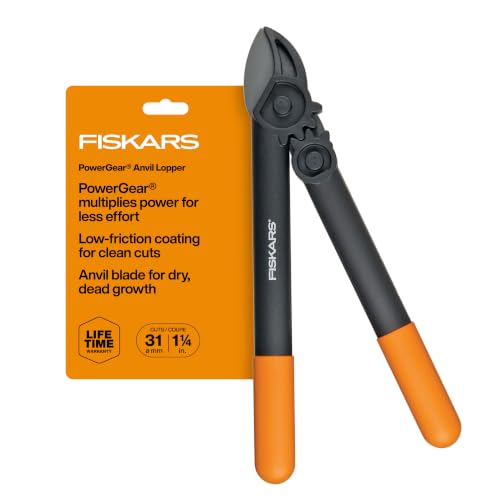
- Compact 15-inch design
- PowerGear multiplies leverage
- Cuts dry branches up to 1.25 inches
Best For: Light pruning and gardeners seeking lower weight
Best Overall – Fiskars 28-Inch Bypass Loppers
For gardeners comparing garden loppers for fruit trees, this 28-inch Fiskars bypass model offers a practical balance of reach, clean-cut performance, and comfort. Its low-friction steel blades handle branches up to 1.5 inches thick, while the non-slip grip and shock-absorbing bumpers help make routine pruning more manageable.
Best For: General fruit-tree maintenance and gardeners who want a durable, full-size bypass lopper.
Pros:
- Bypass blades cut branches up to 1.5 inches in diameter.
- Low-friction coating helps reduce gumming and improve rust resistance.
- SoftGrip handles and shock-absorbing bumpers support more comfortable use.
- Backed by a full lifetime warranty.
Cons:
- At 28 inches and 2.9 pounds, it may feel bulky for very light pruning.
- Its stated cutting capacity is lower than the Power-Lever Fiskars model below.
This is a strong all-purpose choice when clean bypass cuts and long-term durability matter more than maximum leverage or adjustable reach.
Best for Reach – KSEIBI 3.5-Foot Cut-and-Hold Pruner
When comparing garden loppers for fruit trees, the KSEIBI long-reach bypass pruner is designed for precision work above shoulder height or in dense growth. Its 3.5-foot aluminum shaft keeps the tool lightweight, while the cut-and-hold mechanism helps retain branches after cutting.
Best For: Harvesting fruit and trimming smaller branches in tall or hard-to-reach areas.
Pros:
- 3.5-foot length provides useful reach without a ladder for some tasks.
- Lightweight aluminum construction weighs about 500 grams.
- Cut-and-hold bypass mechanism helps prevent cut branches from falling.
- Revolving arm allows blade orientation adjustments in confined areas.
Cons:
- Maximum cutting capacity is only 1/4 inch, limiting it to smaller branches.
- Long reach may be less maneuverable in tight, low-growth areas.
This tool complements a standard lopper rather than replacing one, especially if reaching fruit or making delicate cuts is your priority.
Best for Leverage – YRTSH Extendable Compound-Action Loppers
For thicker limbs, these garden loppers for fruit trees combine compound action with adjustable reach. The YRTSH loppers are rated for cuts up to 1.6 inches and use a low-friction, non-stick alloy-steel blade, while the reinforced aluminum handles adjust through six steps.
Best For: Gardeners seeking extra leverage and adjustable reach for green or dry branches.
Pros:
- Compound action is designed to provide up to four times more cutting power.
- Adjustable handles extend from 28 to 41 inches.
- 1.6-inch cutting capacity suits relatively thick branches.
- Non-slip rubber grips support control and comfort.
Cons:
- Anvil blade design may be less suited to the cleanest cuts on live wood than bypass loppers.
- At about 1.25 kilograms, it is heavier than the KSEIBI pruner.
- The supplied size details list 21–26 inches, while the feature notes state adjustment from 28–41 inches.
Its leverage and handle adjustment make it appealing for demanding pruning, but gardeners focused mainly on live fruit-tree wood may prefer a dedicated bypass design.
Best Power Bypass – Fiskars 28-Inch Power-Lever Loppers
For gardeners comparing garden loppers for fruit trees and wanting more cutting power, this Fiskars Power-Lever model uses a compound lever to improve leverage over a traditional design. Its bypass blades cut branches up to 1.75 inches, with a low-friction coating for smoother operation.
Best For: Cutting larger branches when you want bypass action with added mechanical leverage.
Pros:
- 1.75-inch cutting capacity is the highest among these listed models.
- Power-Lever technology provides more cutting power than traditional designs.
- Low-friction blade coating helps reduce gumming and resist rust.
- SoftGrip touchpoints and non-slip handles improve handling comfort.
Cons:
- At 3.2 pounds, it is heavier than the standard Fiskars 28-inch lopper.
- Its fixed 28-inch length offers less reach flexibility than an extendable model.
This is a compelling option for heavier live-branch pruning when you want the cleaner action of bypass blades and more leverage than a conventional lopper provides.
Best Adjustable Pick – YRTSH Compound-Action Extendable Loppers
For gardeners comparing garden loppers for fruit trees, the YRTSH combines compound-action cutting with a 28- to 41-inch adjustable aluminum handle. Its 2-inch capacity and coated alloy-steel blade make it suited to a range of pruning and trimming tasks.
Best For: Gardeners who want adjustable reach and extra leverage for fruit trees, shrubs, bushes, and thicker branches.
Pros:
- Compound-action design helps provide more cutting power.
- Six-step handle adjustment extends from 28 to 41 inches.
- Teflon-coated alloy-steel blade is designed for smooth, low-friction cutting.
- Non-slip rubber grips improve comfort during longer pruning sessions.
Cons:
- Anvil-style blade is less suited than bypass blades to making exceptionally clean cuts on live wood.
- The listed 2-inch capacity may be limiting for branches beyond that size.
The YRTSH is a versatile choice when reach and leverage matter. Its adjustable handles can help with higher branches, while the compound mechanism is intended to reduce effort on demanding cuts.
Best for Clean Live-Branch Cuts – Fiskars PowerGear2 Bypass Loppers
The Fiskars PowerGear2 is a strong option among garden loppers for fruit trees when bypass-style cutting is a priority. Its 32-inch handles, 2-inch capacity, and geared mechanism are designed to provide leverage while maintaining control around branches.
Best For: Gardeners pruning live fruit-tree branches who want a fixed-length bypass lopper with a leverage-enhancing gear system.
Pros:
- Bypass blade design is well suited to pruning live branches.
- PowerGear2 technology multiplies leverage through the toughest part of the cut.
- Hardened steel blade has a low-friction coating for smoother cutting and reduced gumming.
- SoftGrip handles and a full lifetime warranty add comfort and reassurance.
Cons:
- Fixed 32-inch length does not offer the adjustable reach of telescoping models.
- Its listed 2-inch capacity may not handle larger limbs.
Choose this Fiskars model if you value a bypass cut and built-in mechanical advantage over telescoping flexibility. The 32-inch format offers useful reach without requiring a separate adjustment mechanism.
Best for Dry, Thick Branches – GARTOL Ratcheting Anvil Loppers
For garden loppers for fruit trees that also need to tackle dry or dead wood, the GARTOL offers a four-step ratcheting mechanism and telescoping 28- to 41-inch handles. Its anvil blade is designed for thick branches, with the supplied specifications listing a 2-inch capacity and product claims describing cuts up to 2.5 inches in suitable material.
Best For: Removing dry, dead, or hardwood branches and reaching dense canopies without a ladder.
Pros:
- Four-step ratchet mechanism is designed to reduce hand strain on thick, dry branches.
- Telescoping handles adjust from 28 to 41 inches for added reach.
- High-carbon 65Mn steel blade has a PTFE coating and anvil cutting design.
- Soft, non-slip TPR grips support control during extended use.
Cons:
- Anvil-style cutting is primarily suited to hard, dead, or dry wood rather than the cleanest cuts on live branches.
- The supplied specifications list a 2-inch cutting width, despite claims of cuts up to 2.5 inches.
- A 1-year warranty is shorter than the lifetime warranty listed for the Fiskars model.
The GARTOL stands out for difficult dry-wood work, especially when ratcheting assistance and adjustable reach are useful. For routine live-branch pruning, compare its anvil design with a bypass alternative.
Best Heavy-Duty Bypass Pick – 30-Inch Forged Bypass Loppers
For gardeners comparing garden loppers for fruit trees, these 30-inch Fiskars bypass loppers are built for thick, live branches. Their 2-inch capacity, long handles, and low-friction steel blade combine cutting reach with leverage for controlled pruning.
Best For: Thick live branches, orchard maintenance, and gardeners who want long handles for extra leverage.
Pros:
- Bypass blade is designed for controlled pruning cuts up to 2 inches.
- 30-inch handles provide increased leverage while trimming thick branches.
- Low-friction coating helps reduce sticking, sap buildup, and rust.
- Textured Softgrip touchpoints improve comfort and control.
Cons:
- At 3.5 pounds, it is heavier than the compact option in this roundup.
- The long handles may be less convenient in tight, crowded branches.
This is a strong all-purpose choice when fruit-tree pruning involves substantial live growth and you value reach, durability, and a clean bypass cutting action.
Best for Dead Wood – 30-Inch Compound-Action Anvil Lopper
These TABOR TOOLS garden loppers for fruit trees use compound action to increase cutting power on hard, dry, and woody branches. The 30-inch design and 2-inch capacity make them suited to preparatory cuts where extra leverage matters.
Best For: Dry, dead, and woody branches that require additional force to remove.
Pros:
- Compound action multiplies cutting power for thick branches.
- Anvil head is specifically suited to hard, dry, and dead wood.
- 30-inch handles provide extra leverage around higher limbs.
- Low-friction coating helps reduce gumming from sap.
Cons:
- Anvil loppers are less suitable as the primary tool for live green wood.
- The long 30-inch format may feel cumbersome in confined spaces.
Choose this model when deadwood is the main challenge. For live fruit-tree branches, pair its anvil action with a bypass lopper rather than relying on it as a single pruning tool.
Best Compact Option – 15-Inch PowerGear Anvil Loppers
If you want compact garden loppers for fruit trees, this 15-inch Fiskars model emphasizes low weight and mechanical leverage. Its PowerGear design is rated for branches up to 1.25 inches and is intended for dry, dead growth.
Best For: Smaller pruning jobs, dry branches, and gardeners who prefer a lightweight, compact tool.
Pros:
- PowerGear technology multiplies leverage for easier branch cutting.
- Lightweight 15-inch design helps reduce muscle strain.
- Anvil cutting head is suited to dry and dead growth up to 1.25 inches.
- Low-friction blade coating supports smoother cuts and rust resistance.
Cons:
- Its 1.25-inch capacity is lower than the two 30-inch loppers.
- Shorter handles provide less reach and leverage for thick branches.
This is the practical pick for routine, lighter-duty pruning where maneuverability and reduced weight matter more than maximum cutting capacity.
How We Picked the Best Garden Loppers for Fruit Trees
We focused on the features that matter most when pruning fruit trees: cutting capacity, blade design, leverage, reach, weight, handle comfort, and overall versatility. Bypass loppers are particularly useful for living branches because their scissor-like blades generally make clean cuts that support easier healing. Anvil models can be useful for harder, dry, or damaged wood, while compound and ratcheting mechanisms can reduce the effort required for thicker branches.
We also considered whether each tool suits close, controlled pruning or reaching branches without a ladder. Product specifications vary by model, so treat stated capacities as guidelines and avoid forcing any lopper beyond its intended limit.
Quick Comparison
| Best For | Recommended Style | What to Look For |
|---|---|---|
| Fresh, living branches | Bypass loppers | Sharp, low-friction blades and a clean cutting action |
| Dry or dead wood | Anvil loppers | Strong support surface and high leverage |
| Thick branches | Compound or ratcheting loppers | Mechanical advantage and sturdy construction |
| High or awkward branches | Long-reach or extendable loppers | Useful reach without excessive flex or weight |
| Light pruning and portability | Compact loppers | Lower weight, manageable handles, and moderate capacity |
Key Buying Factors for Garden Loppers for Fruit Trees
Bypass Versus Anvil Blades
For most healthy fruit-tree branches, bypass blades are the safer default because they can produce a cleaner cut when properly aligned. Anvil loppers are better suited to deadwood and tough, dry branches, although they may crush softer green growth if used incorrectly.
Cut Capacity and Leverage
Match the rated capacity to the branches you actually prune. Longer handles provide more leverage, while PowerGear, compound-action, and ratcheting systems can make large cuts easier. More capacity usually means more weight, so do not choose an oversized tool if most of your work involves small branches.
Reach, Weight, and Control
Extendable handles help with reach but can become tiring when fully extended. For ladder-free pruning, prioritize a rigid design with comfortable grips and a cutting head that remains easy to position. A lighter 15- or 21-inch tool may be more practical for frequent touch-ups than a large model.
Blade Quality and Maintenance
Look for hardened or forged steel blades, low-friction coatings, and replaceable or serviceable components where available. Clean sap from the blades after use, dry the tool, and apply a light lubricant to the pivot and cutting surfaces.
Who Should Buy Which Garden Loppers for Fruit Trees?
Choose a bypass model such as a Fiskars 28-inch or 32-inch option if you mainly prune living fruit-tree branches and want clean, controlled cuts. Consider an extendable YRTSH or GARTOL model when extra reach and thick-branch capability are priorities. A compound-action or ratcheting design is a strong choice for gardeners who need more mechanical advantage. For deadwood and compact pruning jobs, the TABOR TOOLS or compact Fiskars anvil model may be more suitable. Whichever style you choose, use a pruning saw for branches beyond the lopper’s comfortable capacity rather than forcing the handles.