Lawn care spending spans DIY supplies (seed, fertilizer, tools) and paid services (mowing, landscaping, cleanups). Below are the latest, data-backed benchmarks for what households spend and how large the lawn/landscaping economy is.
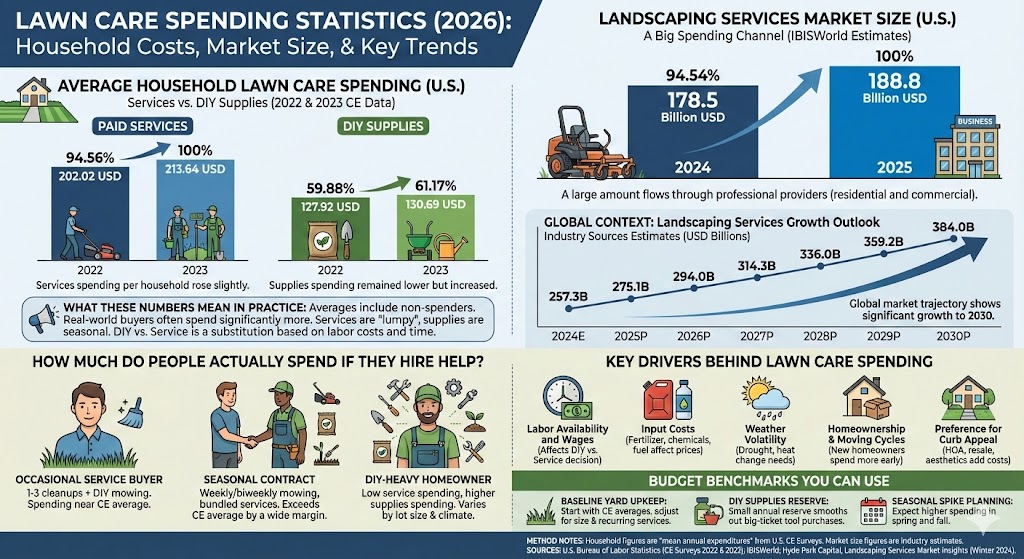
Average Household Lawn Care Spending (U.S.): Services vs. DIY Supplies
The U.S. Consumer Expenditure Surveys (CE) track what households spend annually across hundreds of categories. Two useful lawn-care line items are:
- Gardening and lawn care service (paid services such as mowing/maintenance)
- Lawn and garden supplies (DIY supplies and consumables)
In the latest annual CE tables available (2022 and 2023), service spending per household rose, while supplies spending remained lower but also increased slightly.
Chart: U.S. Average Annual Household Lawn Care Spend (2022 vs. 2023)
| Category / Year | Relative bar | Value (USD) | ||
|---|---|---|---|---|
| Services (2022) |
| 202.02 | ||
| Services (2023) |
| 213.64 | ||
| Supplies (2022) |
| 127.92 | ||
| Supplies (2023) |
| 130.69 |
Max = 213.64. Widths: Services (2022) 94.56%, Services (2023) 100.00%, Supplies (2022) 59.88%, Supplies (2023) 61.17%.
What These Household Numbers Mean in Practice
The CE figures are averages across all consumer units (households), including people who do not spend anything on lawn care in a given year. That’s why “average annual spending” can look modest even though many homeowners pay far more than $200/year for recurring mowing or seasonal work.
To interpret the benchmarks realistically:
- Services spending is often “lumpy.” Many households buy a few one-time cleanups, a single aeration, or occasional mowing rather than year-round contracts.
- Supplies spending is also seasonal. Seed, fertilizer, mulch, and pest control purchases cluster in spring/summer, and the category can vary sharply depending on climate and lot size.
- DIY vs. service is a substitution decision. When labor is expensive or hard to schedule, homeowners often buy more DIY supplies. When time is scarce, paid services can replace weekend yard work.
Landscaping Services Market Size (U.S.): A Big Spending Channel
Household outlays are only one lens. A large amount of lawn-related spending flows through professional landscaping and lawn service providers (residential and commercial). Industry market-size estimates help quantify how large this channel is in the U.S. economy.
IBISWorld market-size statistics for U.S. Landscaping Services show:
- $178.5B market size in 2024
- $188.8B market size in 2025
Chart: U.S. Landscaping Services Market Size (2024–2025)
| Year | Relative bar | Value (USD billions) | ||
|---|---|---|---|---|
| 2024 |
| 178.5 | ||
| 2025 |
| 188.8 |
Max = 188.8. Widths: 2024 94.54%, 2025 100.00%.
Global Context: Landscaping Services Growth Outlook
While this article focuses on spending and market sizing tied to lawn care, it’s helpful to see the broader landscaping services direction globally. A 2024 market insights deck (citing industry sources) shows a global landscaping services trajectory from $257.3B (2024E) to $384.0B (2030P).
Chart: Global Landscaping Services Market Size (2024E–2030P)
| Year | Relative bar | Value (USD billions) | ||
|---|---|---|---|---|
| 2024E |
| 257.3 | ||
| 2025P |
| 275.1 | ||
| 2026P |
| 294.0 | ||
| 2027P |
| 314.3 | ||
| 2028P |
| 336.0 | ||
| 2029P |
| 359.2 | ||
| 2030P |
| 384.0 |
Max = 384.0. Widths: 2024E 67.01%, 2025P 71.64%, 2026P 76.56%, 2027P 81.85%, 2028P 87.50%, 2029P 93.54%, 2030P 100.00%.
How Much Do People Actually Spend If They Hire Help?
National “average annual” statistics are great for benchmarking, but real-world lawn care budgets often look like one of these common patterns:
- Occasional service buyer: 1–3 cleanups per year + DIY mowing. Spending can sit near (or slightly above) the CE service average.
- Seasonal contract: Weekly/biweekly mowing for ~6–8 months, sometimes bundled with fertilization, edging, or leaf cleanup. This often exceeds the CE average by a wide margin.
- DIY-heavy homeowner: Low service spending but higher supplies spending (fertilizer, soil amendments, seed, irrigation parts, and tool replacement).
Lot size, local labor costs, irrigation needs, and climate length are the biggest drivers of why two households can differ by hundreds (or thousands) of dollars per year.
Key Drivers Behind Lawn Care Spending
Several forces push lawn care budgets up or down:
- Labor availability and wages: If contractors are fully booked, homeowners either pay more or switch to DIY.
- Input costs: Fertilizer, chemicals, fuel, and replacement parts can noticeably affect supply purchases and service pricing.
- Weather volatility: Hotter summers or drought restrictions can change mowing frequency and irrigation/repair spending.
- Homeownership and moving cycles: New homeowners often spend more early on (tools, sod/seed, landscaping upgrades).
- Preference for curb appeal: HOA standards, resale prep, and personal aesthetics can quickly add recurring costs.
Budget Benchmarks You Can Use
Here are practical ways to turn the statistics into planning ranges:
- “Baseline” yard upkeep: Start with the CE averages as a low-to-moderate benchmark, then adjust for your yard size and whether you hire recurring mowing.
- DIY supplies reserve: Many households don’t buy big-ticket tools every year; if you do, your “supplies” line can spike. A small annual reserve can smooth that out.
- Seasonal spike planning: Expect higher spending in spring (seed, mulch, fertilizer) and fall (leaf cleanup, aeration, overseeding) if you do seasonal work.
Method Notes
The household spending figures shown here are “mean annual expenditures” from the U.S. Consumer Expenditure Surveys (CE). Market size figures are industry estimates for landscaping services and represent broad economic activity beyond household-only spending.
Sources
- U.S. Bureau of Labor Statistics (BLS), Consumer Expenditure Surveys (CE): 2022 detailed expenditure means table (Gardening and lawn care service; Lawn and garden supplies).
- U.S. Bureau of Labor Statistics (BLS), Consumer Expenditure Surveys (CE): 2023 detailed expenditure means (spreadsheet table includes Gardening and lawn care service; Lawn and garden supplies).
- IBISWorld: Landscaping Services in the U.S. market size statistics (2024 and 2025 values).
- Hyde Park Capital, Landscaping Services Market Insights (Winter 2024): Global landscaping services market size series (2024E–2030P).