The right spreader can make fertilizer, grass seed, and ice-melt applications faster and more consistent. Drop models are especially useful when you need controlled coverage near garden beds, walkways, and property edges.
We compared compact handheld tools, walk-behind spreaders, and high-capacity tow-behind options to help you choose the best fit for your lawn size, material, and application routine.
Best 10 Drop Fertilizer Spreaders Picks for 2026
Best Overall
Scotts Turf Builder EdgeGuard DLX

- Pre-calibrated, no assembly required
- Covers up to 15,000 square feet
- EdgeGuard limits product overspray
Best For: Large, year-round lawn-care jobs
Best Heavy-Duty Drop Model

- 75-pound product capacity
- Covers up to 10,000 square feet
- Steel agitators and never-flat tires
Best For: Large, controlled lawn applications
Best Value Broadcast
Amazon Basics Fertilizer Spreader

- Multi-gear precision control
- Covers up to 5,000 square feet
- Handles fertilizer, seed, salt, and ice melt
Best For: Moderate-size, all-season yard care
Best Handheld Option
Scotts Whirl Hand-Powered Spreader

- Compact design for small yards
- Holds up to 1,500 square feet
- Adjustable arm support for comfort
Best For: Small lawns and spot applications
Large-Capacity Tow-Behind Pick
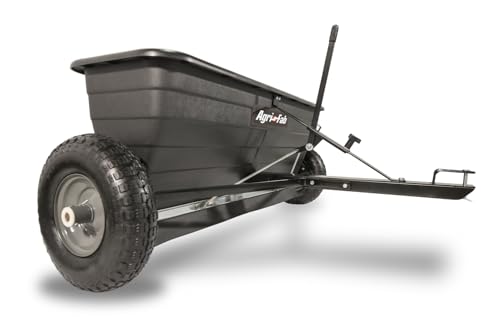
- 175-lb hopper for large projects
- 42-in controlled spread width
- Tow-behind design for lawn tractors
Best For: Large yards and acreage
Balanced Walk-Behind Option

- 60-lb-capacity composite hopper
- Adjustable flow control
- 22-in pattern with never-flat tires
Best For: Medium-size residential lawns
Compact Handheld Choice
Zenport S205 Adjustable Spreader

- 1.5-liter clear container
- Four adjustable flow settings
- Handles seed, fertilizer, salt, and ice melt
Best For: Small gardens and spot applications
Best Large-Capacity Pick
VINGLI 70lb Adjustable Drop Spreader

- 70-pound hopper reduces refills
- 15 adjustable speeds for controlled spreading
- 9-inch wheels suit multiple terrains
Best For: Larger residential lawns and year-round spreading
Best Portable Option
Handheld 2.5L Multi-Use Spreader

- Three flow settings for varied materials
- 2.5-liter hopper for fewer refills
- Lightweight design with ergonomic grip
Best For: Small lawns, gardens, patios, and pathways
Best All-Terrain Choice

- 50-pound hopper for longer sessions
- 18-inch spreading width covers efficiently
- 30 settings and 10-inch all-terrain tires
Best For: Home lawns and small farms with varied terrain
Best Overall – Scotts Turf Builder EdgeGuard DLX
For homeowners comparing drop fertilizer spreaders and broadcast models, the Scotts Turf Builder EdgeGuard DLX offers a ready-to-use option with a large 15,000-square-foot capacity. Its pre-calibrated design and EdgeGuard feature make it practical for fertilizer, seed, salt, and ice melt.
Best For: Year-round lawn care on medium to large areas where directional control matters.
Pros:
- Pre-calibrated and requires no assembly.
- Holds enough product for up to 15,000 square feet.
- EdgeGuard helps keep product off landscaping, driveways, and sidewalks.
- Hopper and agitator support smooth, consistent coverage.
Cons:
- Its broadcast design may be less suitable than a true drop spreader for narrow, highly controlled strips.
- At 10.9 pounds, it is heavier than a handheld spreader.
This is a versatile choice if you want one spreader for fertilizer, grass seed, salt, and ice melt. The side-shield feature adds useful control around hardscaping and garden borders.
Best Heavy-Duty Drop Model – At Home 75 lb. Drop Spreader
Among drop fertilizer spreaders, the At Home 75 lb. model stands out for its substantial capacity and steel construction. It combines maintenance-free flow control, galvanized agitators, and never-flat tires for dependable handling across larger lawn-care jobs.
Best For: Users who want a high-capacity drop spreader with durable components and comfortable handles.
Pros:
- Large 75-pound capacity.
- Holds product for up to 10,000 square feet.
- Galvanized steel agitators help break up lumps.
- 10-inch never-flat tires and foam-padded handles improve convenience.
Cons:
- At 29.1 pounds, it is notably heavier than the other listed spreaders.
- The supplied notes do not specify pre-calibration or assembly status.
This model is a strong fit when capacity and drop-style placement are priorities. Its heavier build may be worthwhile for larger applications, though it is less convenient to move than lighter alternatives.
Best Value Broadcast – Amazon Basics Fertilizer Spreader
If you are comparing drop fertilizer spreaders with more flexible broadcast options, this Amazon Basics model provides multi-gear operation and precision control in an all-season design. It can distribute fertilizer, seed, salt, and ice melt across up to 5,000 square feet per load.
Best For: Homeowners seeking an adaptable spreader for moderate-size outdoor areas.
Pros:
- Multi-gear system supports adjustable operation and control.
- Covers up to 5,000 square feet per load.
- Works with fertilizer, grass seed, salt, and ice melt.
- Steel frame and plastic bin are designed for all-season use.
Cons:
- Easy assembly is required, although the release cable comes pre-installed.
- Its stated capacity is smaller than the larger Scotts and At Home models.
This is a practical middle-ground option for routine lawn maintenance. The multi-gear design and multiple-use hopper give it flexibility, while the 5,000-square-foot coverage suits many residential applications.
Best Handheld Option – Scotts Whirl Hand-Powered Spreader
For small yards, handheld drop fertilizer spreaders can be easier to maneuver than full-size wheeled units. The Scotts Whirl is designed for smooth, even coverage and holds enough Scotts lawn product for up to 1,500 square feet.
Best For: Small yards, spot applications, and users who prefer a compact hand-powered spreader.
Pros:
- Compact handheld design is suited to small yards.
- Adjustable arm support helps improve comfort.
- Handles grass seed, fertilizer, salt, and ice melt.
- Engineered for smooth, even coverage.
Cons:
- Its 1,500-square-foot capacity is limited for larger properties.
- Hand-powered operation requires carrying the spreader during use.
The Whirl is the most portable choice in this group and makes sense when storage space and maneuverability matter more than capacity. It is particularly useful for small lawns and occasional spot treatment.
Large-Capacity Tow-Behind Pick – Agri-Fab 175-Lb Drop Spreader
For larger properties, this Agri-Fab is one of the more capable drop fertilizer spreaders in the group. Its tow-behind design, 42-inch controlled spread width, and 175-pound hopper are suited to covering substantial lawn areas with fewer refills.
Best For: Large yards and acreage maintained with a lawn or garden tractor.
Pros:
- Large 175-pound capacity and coverage of approximately 40,000 square feet or up to one acre.
- 42-inch controlled spread width supports consistent application.
- Works with seed, fertilizer, weed-control products, salt, and ice melt.
- Rustproof poly hopper and weather-resistant construction are designed for outdoor use.
Cons:
- Requires a compatible lawn or garden tractor for towing.
- At 50.5 pounds, it is substantially heavier than the walk-behind options here.
This is the strongest choice when capacity and property coverage matter more than portability. The tow-behind format and universal hitch make it practical for tractor-based lawn maintenance.
Balanced Walk-Behind Option – 60-Lb Push Drop Spreader
This 60-pound walk-behind model offers a practical middle ground among drop fertilizer spreaders. Its adjustable flow control, 22-inch spread pattern, and composite hopper are aimed at accurate lawn applications without requiring a towing vehicle.
Best For: Homeowners who want a push spreader for lawns up to about 15,000 square feet.
Pros:
- Holds up to 60 pounds of product, depending on material type.
- Adjustable flow control helps tailor the application rate.
- Composite hopper resists corrosion and is easy to clean.
- 12-inch never-flat tires and a powder-coated steel frame support regular outdoor use.
Cons:
- Its stated coverage is limited to approximately 15,000 square feet.
- It has a narrower 22-inch spread pattern than the Agri-Fab model.
Choose this model for straightforward push-behind lawn care and adjustable application control. It combines useful capacity with a compact, self-contained design and includes a one-year limited warranty.
Compact Handheld Choice – Zenport S205 Adjustable Spreader
For small jobs and tight storage spaces, the Zenport S205 is a compact alternative to larger drop fertilizer spreaders. Its 1.5-liter clear container and four-position adjustable lid provide simple control when applying seed, fertilizer, salt, or ice-melt materials by hand.
Best For: Small gardens, spot applications, and homeowners who prefer a handheld tool.
Pros:
- Compact handheld design is easy to store and carry.
- Clear 1.5-liter container allows material levels to be monitored.
- Four lid settings provide closed, small, medium, and wide flow options.
- Suitable for grass seed, fertilizer, salt, and ice control across seasons.
Cons:
- Its 1.5-liter capacity is much smaller than the wheeled spreaders.
- Handheld operation is better suited to smaller areas than broad lawn coverage.
The S205 makes sense when portability and storage convenience are priorities. Its adjustable opening helps manage different materials, while the ergonomic handle is designed to make extended hand use more comfortable.
Best Large-Capacity Pick – VINGLI 70lb Adjustable Drop Spreader
If you want fewer refills while covering a lawn, the VINGLI is a practical choice among drop fertilizer spreaders. Its 70-pound hopper, 15 adjustable speeds, and large wheels are designed for steady, controlled spreading across multiple surfaces.
Best For: Homeowners who need a high-capacity walk-behind spreader for fertilizer, seed, and year-round lawn-care tasks.
Pros:
- Large 70-pound capacity reduces refill frequency.
- 15 adjustable speeds support more precise application.
- 9-inch wheels and a cover help with multi-terrain use.
- Mostly pre-assembled with hand-tightening screws.
Cons:
- Its walk-behind design is less portable than a handheld spreader.
- The listed dimensions may require more storage space.
The VINGLI stands out when capacity and walk-behind stability matter most. It is a strong fit for larger residential lawns, especially if you value quick setup and adjustable distribution.
Best Portable Option – Handheld 2.5L Multi-Use Spreader
For smaller areas and quick applications, this handheld model offers a compact alternative to full-size drop fertilizer spreaders. Its 2.5-liter hopper, three flow settings, and lightweight crank design make it easy to use for lawn, garden, and winter maintenance.
Best For: Gardeners and homeowners who want a portable spreader for fertilizer, grass seed, salt, or ice melt.
Pros:
- Wide, medium, and fine settings accommodate different materials.
- 2.5-liter capacity helps limit frequent refills for a handheld tool.
- Soft, non-slip handle is designed to reduce hand strain.
- Suitable for lawn care and snow-removal tasks.
Cons:
- Its handheld capacity is much smaller than walk-behind models.
- Requires carrying and cranking during use.
This spreader is best when portability matters more than coverage capacity. It can be a convenient choice for targeted applications around smaller lawns, gardens, patios, and pathways.
Best All-Terrain Choice – VEVOR 50lb Broadcast Spreader
The VEVOR combines a 50-pound hopper with an 18-inch spreading width, making it a practical option for covering residential lawns and small growing areas. As one of these drop fertilizer spreaders, it also provides 30 adjustable settings and all-terrain tires for more controlled, versatile use.
Best For: Home lawns and small farms needing a durable push spreader for seed, fertilizer, and ice melt.
Pros:
- 50-pound hopper accommodates full bags of seed or fertilizer.
- 18-inch spreading width supports efficient coverage.
- 30 adjustable settings provide extensive application control.
- 10-inch pneumatic wheels are suited to grass, gravel, and snow-covered terrain.
Cons:
- At 15.75 pounds, it is heavier than the handheld alternative.
- Its larger push-spreader footprint may need dedicated storage space.
The VEVOR is a balanced choice for users who want substantial capacity without moving to a much larger machine. Its adjustment range and all-terrain wheels make it especially useful for varied outdoor surfaces.
How We Picked the Best Drop Fertilizer Spreaders
We focused on the features that affect real-world application: hopper capacity, coverage area, adjustment control, spread width, maneuverability, and compatibility with fertilizer, seed, salt, or ice melt. We also considered the type of user each spreader suits, from occasional homeowners to those maintaining large lawns or acreage.
Because listed capacities and coverage claims can vary by material and setting, treat them as useful benchmarks rather than guarantees. Calibration and walking speed still have a major effect on results.
Quick Comparison
| Spreader Type | Best For | Main Advantage | Key Limitation |
|---|---|---|---|
| Handheld | Small lawns, borders, spot treatments | Compact and easy to store | Small capacity and more frequent refills |
| Walk-behind drop | Small to medium lawns | Controlled, edge-friendly application | Requires manual pushing |
| Broadcast | Open lawn areas | Faster, wider coverage | Less precise near boundaries |
| Tow-behind | Large properties and acreage | High capacity with less physical effort | Needs a compatible towing vehicle |
Key Buying Factors for Drop Fertilizer Spreaders
Capacity and Coverage
Choose a hopper large enough to finish your usual job without constant refilling. Smaller units are lighter and easier to maneuver, while 60- to 75-pound walk-behind models balance capacity with homeowner-friendly handling. Tow-behind spreaders make more sense for expansive lawns.
Application Control
Look for an adjustable rate system that matches the product label. Multiple settings are helpful, but consistent results depend on calibrating the spreader, maintaining a steady pace, and overlapping passes correctly.
Drop Versus Broadcast Design
Drop Fertilizer Spreaders release material directly beneath the hopper, making them a strong choice for straight, predictable rows and precise edges. Broadcast models cover more ground quickly but require greater attention around flower beds, driveways, and neighboring property.
Build and Terrain
Check wheel size, frame stability, hopper construction, and handle comfort. Larger or pneumatic-style wheels generally handle uneven ground better, while compact wheels are adequate for smooth residential lawns. Confirm that the spreader is rated for the material you plan to use.
Who Should Buy Which Drop Fertilizer Spreaders?
Choose a handheld spreader for small yards, narrow sections, garden borders, and occasional spot applications. It is the easiest option to store and carry.
Choose a walk-behind drop spreader if accuracy and edge control matter most on a typical residential lawn. These are practical for fertilizer and grass seed when you want predictable rows.
Choose a broadcast model when speed and broad coverage are more important than tight boundaries. It is often the better choice for large, open lawn areas.
Choose a tow-behind spreader for large properties, frequent applications, or users who already own a compatible riding mower, lawn tractor, or ATV. Whichever model you select, read the product label, calibrate before applying, and clean the hopper and mechanism after every use.