The right bench vise can hold brackets, fittings, pipe, and small automotive parts securely while you drill, cut, bend, press, or repair them. For car work, stability and usable jaw capacity matter more than compact size alone.
We compared 10 bench vises across clamping strength, jaw design, swivel range, mounting style, portability, and workshop versatility to help you choose a dependable fit for your garage.
Best 10 Bench Vises for Car Repair Picks for 2026
Best All-Around Bench Vise
WORKPRO 4-1/2-Inch Swivel Combination Vise

- Multi-jaw design holds flat materials and pipes
- 240-degree swivel base improves positioning
- Large anvil area with stated 2,204-lb clamping force
Best For: Home garages and small workshops
Best Portable Automotive Vise
Yost RHV-6 Receiver Hitch Vise

- Mounts to standard 2-inch trailer-hitch receivers
- Large 5.90-inch jaws and 5.81-inch opening
- Also supports bolted workbench installation
Best For: Mobile automotive and trailer repairs
Best Compact Swivel Vise
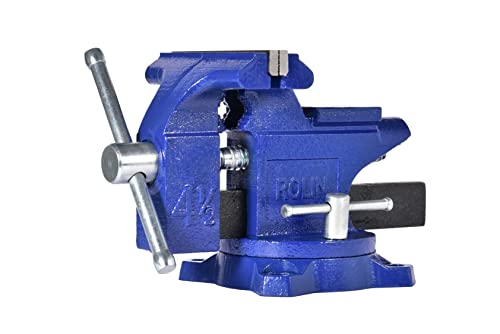
- 240-degree base locks at multiple angles
- Built-in jaws hold small pipes and tubes
- Compact design suits home workshops
Best For: Small automotive and general workshop tasks
Best Mobile Mounting Platform
Mount Vise and Grinder Multi-Purpose Mount

- Mounts on walls, tabletops, or car rears
- Supports vises, grinders, shears, and shrinkers
- Steel platform suits mobile work setups
Best For: Mounting compatible tools near a vehicle
Compact Precision Pick
Yakamoz Mini Suction Bench Vise

- 360-degree swivel for angled access
- Suction base needs no drilling on smooth surfaces
- Compact hardened-steel-jaw design
Best For: Small parts, soldering, and light-duty portable work
Flexible Workshop Choice

- Clamp-on or four-screw installation
- Pipe and flat jaws handle varied shapes
- 270-degree swivel with cast-iron construction
Best For: Home garages and mixed repair or DIY tasks
Heavy-Duty Clamping Pick
4.5-Inch Swivel Cast-Iron Vise

- Up to 3,306 pounds of stated clamping force
- Multi-jaw grip for flat and round materials
- Large anvil and 210-degree swivel base
Best For: Heavy workshop repairs and pipe or tube work
Best Versatile Pick

- 2.5-inch serrated and 1.5-inch smooth jaws
- 360-degree swivel positioning
- Clamp-on or bolt-down installation
Best For: Portable general maintenance and light automotive tasks
Best Lightweight Clamp-On

- 3.2-inch maximum base clamping range
- 360-degree swivel base
- 3.8-pound cast-iron construction
Best For: Light-duty repairs and temporary workbench setups
Best for Precision Mini Work
Universal Mini Suction-Cup Vise

- 360-degree rotating suction-cup base
- 0-to-1-inch clamping range
- Lightweight aluminum and rubber construction
Best For: Tiny components and detail work on smooth surfaces
Best All-Around Bench Vise – WORKPRO 4-1/2-Inch Swivel Combination Vise
For shoppers comparing bench vises for car repair, the WORKPRO 4-1/2-inch model offers a practical combination of flat and pipe-holding jaws. Its gray-iron construction, 240-degree swivel base, and broad anvil area suit general garage and small-workshop tasks.
Best For: Home garages and light-to-moderate automotive work involving flat stock, pipes, and tubes.
Pros:
- Multi-jaw design grips flat materials and pipes or tubes.
- 240-degree swivel base supports flexible positioning.
- Includes a large anvil area and up to 2,204 pounds of stated clamping force.
- Designed for relatively easy installation on a workbench.
Cons:
- Its 4-1/2-inch jaw width and 4-1/4-inch opening may limit larger repair jobs.
- Intended for home use or small workshops rather than the heaviest professional applications.
The WORKPRO is a balanced choice when you want one compact vise for varied garage tasks. Its swivel movement and pipe jaws add useful flexibility, while the size keeps it suited to a standard home workbench.
Best Portable Automotive Vise – Yost RHV-6 Receiver Hitch Vise
Among bench vises for car repair, the Yost RHV-6 stands out for mobile work. It mounts directly into a standard 2-inch trailer-hitch receiver, includes the hitch pin, and can also be bolted to a workbench for fixed use.
Best For: Mobile automotive technicians, trailer work, and repair jobs performed at a vehicle or roadside location.
Pros:
- Fits standard 2-inch receivers and includes a 5/8-inch pin and cotter pin.
- Offers a 5.90-inch jaw width, 5.81-inch maximum opening, and 4.96-inch throat depth.
- Built from QT450-12 ductile iron with a stated minimum strength of 60,000 psi.
- Can be bolted down for stationary workbench use.
Cons:
- At 29.9 pounds, it is less convenient to carry than a smaller bench vise.
- Requires a compatible 2-inch receiver for vehicle mounting.
- Proper setup and use require following the safety instructions in the manual.
The RHV-6 is the strongest fit here for repairs away from a conventional shop. Its receiver mounting gives a vehicle a temporary work surface, while the large jaws and ductile-iron body provide substantial capacity for automotive tasks.
Best Compact Swivel Vise – Rolin 4-1/2-Inch Bench Vise
Rolin Vise Bench Vise 4-1/2 Inch With 240 Degree Swivel Base Clamp Tools Home Vises Rotation Base
Check Price On AmazonThe Rolin 4-1/2-inch vise is a compact option for shoppers seeking bench vises for car repair in a home workshop. Its 240-degree rotation base, built-in pipe jaws, and flat anvil support positioning, holding, and light fabrication tasks.
Best For: Home users who need a flexible vise for small automotive, woodworking, and metalworking projects.
Pros:
- 240-degree swivel base locks at different working angles.
- Built-in pipe jaws hold tubes from approximately 0.6 to 1.85 inches in diameter.
- Provides a 4.5-inch jaw width, 4.3-inch maximum opening, and 3-inch throat depth.
- Compact design is intended for easier installation and removal.
Cons:
- Its compact dimensions may not suit large automotive components.
- Designed around home-workshop use rather than explicitly heavy-duty professional service.
The Rolin makes sense when workspace and budget favor a smaller vise with useful positioning range. The pipe jaws and anvil expand its capabilities beyond simple flat-stock clamping, though its overall size remains best suited to smaller jobs.
Best Mobile Mounting Platform – Mount Vise and Grinder Multi-Purpose Mount
This steel mounting platform offers a different approach to bench vises for car repair: instead of being a vise itself, it provides a support point for compatible vises and other tools. It can mount to a wall, tabletop, or car rear, making it useful for stationary and mobile setups.
Best For: Mobile professionals who need to mount a compatible vise, grinder, shear, or related tool near a vehicle or work area.
Pros:
- Supports wall, tabletop, and car-rear mounting configurations.
- Compatible with notchers, grinders, vises, shears, and shrinkers.
- Steel construction is designed for demanding conditions.
- Provides a portable tool-support option for work on the road.
Cons:
- It is a mounting platform, not a complete bench vise.
- Requires a compatible vise or other tool for clamping workpieces.
- The supplied notes do not specify jaw capacity or detailed mounting dimensions.
Choose this mount when portability and installation flexibility matter more than having an all-in-one vise. It can help create a vehicle-side or temporary workstation, but buyers should confirm that their existing tool fits the mount before ordering.
Compact Precision Pick – Yakamoz Mini Suction Bench Vise
For small, delicate tasks, this Yakamoz mini vise is a portable option among bench vises for car repair, particularly for holding tiny components during soldering, watch work, or light DIY jobs. Its suction base is designed for smooth, non-porous surfaces, while the swivel design improves access from different angles.
Best For: Small parts, light-duty repairs, soldering, and portable workshop use.
Pros:
- 360-degree swivel helps provide access from multiple angles.
- Suction base attaches to smooth, non-porous surfaces without permanent installation.
- Compact, lightweight design is easy to carry and store.
- Hardened-steel jaws provide a firm grip for small workpieces.
Cons:
- Miniature design is intended for small objects rather than large automotive components.
- Suction mounting is limited to suitable smooth surfaces.
This is best viewed as a precision helper rather than a heavy-duty automotive vise. Choose it when portability and fine control matter more than high clamping capacity.
Flexible Workshop Choice – 4-1/2-Inch 2-in-1 Table Vise
This 4-1/2-inch vise is a practical choice among bench vises for car repair when you want adaptable mounting and jaws suited to both flat and round workpieces. It can clamp to a workbench without drilling or be secured with four screws, making it useful for home garages and changing work areas.
Best For: Home workshops, light automotive repairs, tubing, pipes, and mixed flat or irregular workpieces.
Pros:
- Two installation options allow clamp-on or screw-mounted use.
- Pipe and flat jaw design accommodates circular, irregular, and flat materials.
- 270-degree swivel base helps reposition the workpiece without releasing it.
- Cast-iron construction, hardened jaws, and a polished anvil support regular workshop use.
Cons:
- Its 14.4-pound weight makes it less convenient to move frequently.
- Clamp mounting is limited to workbenches within the stated 2.3-inch base range.
With its combination of drill-free mounting, pipe handling, and swivel adjustment, this is the most versatile option here for a home garage. Its 4-1/2-inch jaws offer useful capacity without requiring a permanent installation.
Heavy-Duty Clamping Pick – 4.5-Inch Swivel Cast-Iron Vise
For demanding bench vises for car repair, this heavy-duty cast-iron model emphasizes clamping force, broad material compatibility, and a substantial anvil. Its 4.5-inch jaws and 210-degree swivel base make it suited to securely holding pipes, tubes, flat stock, and other repair materials.
Best For: Workshop repairs, pipe and tube work, hammering, drilling, and general heavy-duty DIY use.
Pros:
- Provides up to 3,306 pounds of stated clamping force.
- Multi-jaw design grips flat and round materials from 0.25 to 2 inches.
- Large anvil area supports hammering, shaping, drilling, sawing, and gluing.
- 210-degree swivel base allows adjustment to different working angles.
Cons:
- At 8.4 kilograms, it is less portable than a compact table vise.
- The swivel range is 210 degrees rather than a full 360 degrees.
This model is the strongest fit for users who prioritize holding power and anvil space over portability. Its cast-iron build and multi-jaw layout make it a capable general-purpose fixture for a garage or workshop.
Best Versatile Pick – WORKPRO Dual-Jaw Table Vise
For shoppers comparing bench vises for car repair, the WORKPRO Dual Jaws Table Vise stands out for its flexible gripping options and portable design. It combines 2.5-inch serrated jaws, 1.5-inch smooth jaws, 360-degree swivel positioning, and clamp-on or bolt-down installation.
Best For: General maintenance, light automotive tasks, metalworking, and DIY users who need a portable vise with multiple jaw styles.
Pros:
- Dual serrated and smooth jaws accommodate different workpieces, including pipes and tubes.
- 360-degree swivel base and head allow repositioning from multiple angles.
- Compact 7.7-pound design supports portable use and saves workbench space.
- Ductile-iron construction and hardened carbon-steel jaws provide up to 660 pounds of clamping force.
Cons:
- Bolts for bolt-down installation are not included.
- The compact size may be less suitable for large, heavy-duty automotive components.
This is a strong all-around choice when car repair projects vary from holding small metal parts to securing tubing. Its dual jaws and swivel adjustment add versatility, while the compact footprint keeps it practical for smaller garages or mobile work areas.
Best Lightweight Clamp-On – 3-Inch Swivel Table Vise
Among bench vises for car repair, this 3-inch table vise is a convenient option for light-duty jobs where quick installation matters. Its clamp-on base attaches to desktops, workbenches, or countertops, while the 360-degree swivel helps position parts for drilling, filing, or cutting.
Best For: Light automotive maintenance, drilling, conduit cutting, woodworking, and DIY work on portable or shared work surfaces.
Pros:
- Cast-iron construction is designed to provide stability during sawing, filing, and drilling.
- 360-degree swivel base makes it easy to adjust the working angle.
- Clamp-on base fits surfaces with an attachment range up to 3.2 inches.
- At 3.8 pounds, it is relatively easy to move and store.
Cons:
- Its maximum jaw opening is 2.5 inches, limiting the size of parts it can hold.
- It is intended for light-duty, general-purpose use rather than demanding heavy automotive work.
This vise makes sense for smaller repair jobs and occasional garage use, especially when you do not want to permanently mount a vise. The clamp-on design is convenient, but the modest jaw opening and light-duty positioning favor smaller components.
Best for Precision Mini Work – Universal Mini Suction-Cup Vise
For very small repair or detail tasks, this mini table vise offers a compact alternative among bench vises for car repair. Its suction-cup base rotates 360 degrees and handles objects up to 1 inch, making it better suited to precision work than full-size automotive clamping.
Best For: Small components, electronics, jewelry, model work, precision carving, and limited-detail tasks on smooth surfaces.
Pros:
- Lightweight aluminum-and-rubber construction is easy to carry.
- 360-degree rotation supports flexible positioning of small objects.
- Suction base can adhere to glass and other smooth surfaces.
- Accommodates round, square, and irregular objects within a 0-to-1-inch clamping range.
Cons:
- The 1-inch clamping range is too small for many standard automotive parts.
- The suction base requires a smooth surface and is not a substitute for a permanently mounted bench vise.
- Its intended applications focus on crafts, jewelry, models, and electronics rather than heavy repair.
This is a niche choice for holding tiny parts during precision work, not for securing larger car components or applying substantial force. Consider it only if your repair needs involve small pieces and you value portability over clamping capacity.
How We Picked These Bench Vises for Car Repair
We focused on the features that affect real garage work: jaw width and opening, throat depth, base stability, swivel range, mounting method, and the ability to hold irregular automotive parts. Models with pipe jaws, built-in anvils, multi-jaw designs, or heavy cast-iron construction received extra attention because they can handle more than flat stock.
We also included compact clamp-on and suction-base vises for light-duty repairs, mobile work, and smaller benches. These are useful when permanent installation is not practical, but they should not be treated as substitutes for a firmly bolted heavy-duty vise.
Quick Comparison
- Best for heavy work: Choose a large cast-iron vise with a broad base, deep throat, and strong mounting points.
- Best for portability: A receiver-mounted or clamp-on vise is easier to move between vehicles and work areas.
- Best for pipe and fittings: Look for built-in pipe jaws or a multi-jaw design.
- Best for limited space: A compact swivel vise provides useful positioning without taking over the bench.
- Best for precision tasks: Mini vises suit small parts, electrical work, watch repair, and delicate components.
Key Buying Factors for Bench Vises for Car Repair
Jaw Capacity and Throat Depth
Measure the largest parts you expect to hold. A wider jaw and larger maximum opening help with brackets, hubs, exhaust components, and fabrication stock, while throat depth determines how far a part can extend into the vise.
Construction and Clamping Force
Cast iron offers useful rigidity and vibration resistance for general automotive work. Check the claimed clamping force, but also consider how securely the vise mounts. A high-force vise can still shift if attached to a weak or thin work surface.
Base and Mounting Style
A swivel base makes it easier to position parts and access fasteners from different angles. Bolt-down models are generally the most stable; clamp-on, receiver, and suction-base designs trade some rigidity for portability.
Jaw and Surface Protection
Replaceable or textured jaws improve grip, while smooth or padded jaw faces help protect finished parts. Pipe jaws and additional jaw configurations increase versatility for automotive repair and fabrication.
Who Should Buy Which Bench Vises for Car Repair?
Choose a heavy-duty fixed or swivel vise if you regularly remove seized fasteners, bend metal, work on suspension parts, or fabricate brackets. Choose a portable receiver or clamp-on vise if you work outdoors, share a workspace, or need to bring the vise to different vehicles. Choose a compact 3- to 4.5-inch model for routine household repairs, light automotive jobs, and smaller benches. Choose a mini table vise only for delicate, low-force tasks such as wiring, soldering, or handling small components.
Before buying, confirm the bench thickness, available mounting space, jaw opening, and expected workload. For serious car repair, prioritize a rigid mounting surface and stable base over extra portability.