Choosing the right combination sander can simplify edge shaping, surface smoothing, contour work, and detail sanding in one compact machine. The best option depends on whether you prioritize oscillating spindle performance, belt-and-disc versatility, variable speed, or bench stability.
We compare 10 combination belt spindle sanders and belt-disc models across motor power, sanding capacity, adjustment range, worktable design, dust collection, and workshop practicality so you can choose with confidence.
Best 10 Combination Belt Spindle Sanders Picks for 2026
Versatile Oscillating Pick
WEN 6524 Belt and Spindle Sander
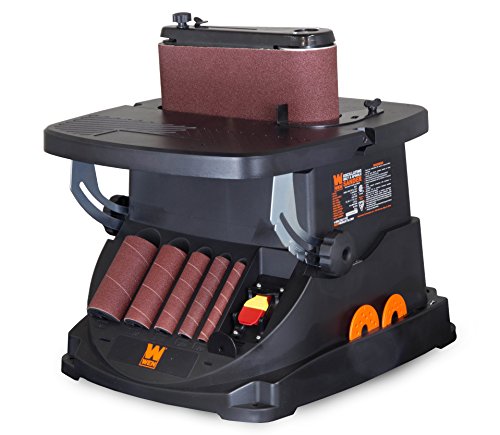
- Five spindle sizes plus a 4 x 24-inch belt
- 58 OPM oscillation with up to 2,000 RPM spindle speed
- Onboard storage and beveling work table
Best For: DIY woodworkers needing flexible curved- and flat-sanding options
Heavy-Duty Bench Option
BUCKTOOL BD4603A Belt Disc Sander
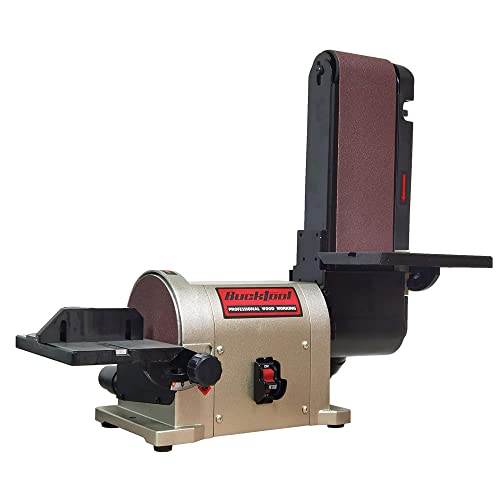
- 4 x 36-inch belt and 6-inch disc
- 3/4-horsepower direct-drive induction motor
- Belt adjusts from 0 to 90 degrees
Best For: Bench sanding, bevels, contours, and broad stock removal
Variable-Speed Choice
Woodskil Oscillating Belt and Spindle Sander

- 1,000–1,800 RPM and 29–58 OPM adjustment
- 4 x 24-inch belt with five spindle sleeves
- Storage and dust-collection belt cover included
Best For: Detailed edge work, refinishing, and varied sanding speeds
Stable Belt-and-Disc Pick
WEN 6502T Benchtop Belt and Disc Sander
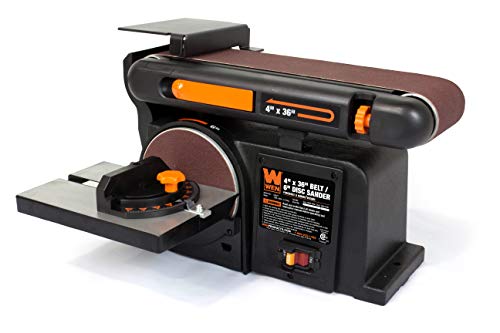
- 4 x 36-inch belt and 6-inch disc
- Belt tilts from 0 to 90 degrees
- Cast iron base helps limit vibration
Best For: Stable general-purpose bench sanding and beveling
Versatile Workshop Pick
Woodskil 4.3A 4x36-Inch Belt and 6-Inch Disc Sander

- 3/4 HP motor with 3,570 RPM disc speed
- 0–90° adjustable belt and 0–45° work table
- Separate belt and disc dust ports
Best For: General woodworking, contour sanding, and bevel work
Speed-Control Specialist
Variable-Speed 1x30-Inch Belt and 6-Inch Disc Sander

- Variable belt and disc speeds for varied materials
- 3/4 HP direct-drive motor
- Removable belt cover for round-corner sanding
Best For: Detail work, sharpening, metalworking, and controlled shaping
Heavy-Duty Direct-Drive Pick
Woodskil 4.5A 4x36-Inch Belt and 6-Inch Disc Sander

- 3/4 HP direct-drive motor with 3,590 RPM disc speed
- Horizontal-to-vertical belt adjustment
- Quick belt replacement and 0–45° table tilt
Best For: Stable workshop sanding, edge work, and contour shaping
Best with Extra Features
VEVOR 6" Disc & 4" x 36" Belt Sander
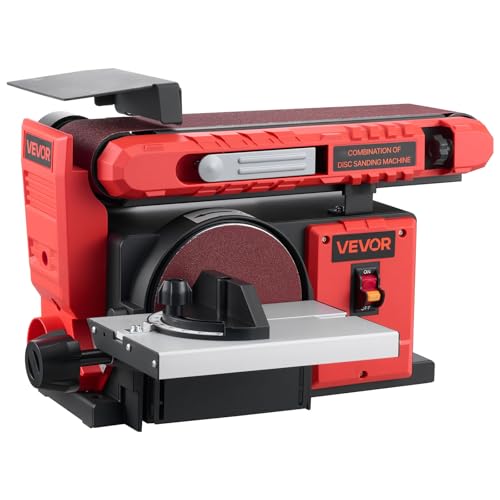
- 400W motor with 3550 RPM disc and 600 RPM belt
- Adjustable belt and tilting disc worktable
- Dust port, miter gauge, and compact benchtop design
Best For: DIY woodworking, refinishing, and knife sharpening
Control-Focused Choice
Woodskil Variable-Speed Belt Disc Sander

- Adjustable disc speed from 2000 to 4000 RPM
- 1060 to 2110 FPM belt-speed range
- Higher work stop and horizontal/vertical belt operation
Best For: Home workshops needing flexible sanding speeds
Stable Heavy-Duty Pick
VEVOR 6" Disc & 2" x 42" Belt Sander

- 420W motor with 3590 RPM disc and 1250 RPM belt
- Multi-angle belt arm and tilting worktables
- Metal base, rubber feet, and dust collection port
Best For: Stable edge sanding, refinishing, and knife sharpening
Versatile Oscillating Pick – WEN 6524 Belt and Spindle Sander
The WEN 6524 is a practical choice among combination belt spindle sanders when you need both curved-edge spindle sanding and flat-surface belt sanding. Its 3.5-amp motor oscillates at 58 times per minute, while the belt reaches up to 1,575 FPM and the spindle up to 2,000 RPM.
Best For: DIY woodworkers who want multiple sanding drum sizes, onboard storage, and a beveling work table in one compact machine.
Pros:
- Includes five spindle sizes from 1/2 to 2 inches plus a 4 x 24-inch belt.
- Oscillating action helps support smoother sanding on edges and curves.
- Onboard storage keeps accessories and sandpaper organized.
- Includes a beveling table, throat plates, drums, belt attachment, and 80-grit sandpaper.
Cons:
- The 3.5-amp motor is less powerful than the 5-amp motors in some alternatives.
- Supplied sanding material is limited to 80 grit.
Choose this model if versatility and accessory storage matter more than maximum motor output. It is a well-equipped option for general-purpose curved and flat sanding.
Heavy-Duty Bench Option – BUCKTOOL BD4603A Belt Disc Sander
The BUCKTOOL BD4603A is a two-in-one bench sander for projects that call for a long belt and a disc rather than a spindle. Its direct-drive 3/4-horsepower induction motor delivers quiet, powerful operation, while the tilting belt supports horizontal and vertical sanding.
Best For: Woodworkers who need a sturdy bench machine for broad surfaces, bevels, contours, and general stock removal.
Pros:
- Combines a 4 x 36-inch belt with a 6-inch disc.
- Belt tilts from 0 to 90 degrees for multiple sanding positions.
- Direct-drive design avoids routine belt-tension adjustment.
- Cast aluminum tables and base help provide stable sanding.
Cons:
- It does not include an oscillating spindle-sanding mode.
- The larger bench format may require more workspace.
- Dust collection works best with the suggested Y-fitting hose.
This is not a true combination belt spindle sander, but it is a compelling alternative when a long sanding belt and disc are more useful than spindle drums. Its adjustable belt and miter-gauge setup suit larger bench projects.
Variable-Speed Choice – Woodskil Oscillating Belt and Spindle Sander
The Woodskil OSM-2V stands out among combination belt spindle sanders for adjustable speed control. It pairs a 4 x 24-inch belt with oscillating spindle sanding, offering speeds from 1,000 to 1,800 RPM and oscillation from 29 to 58 OPM for different finishing tasks.
Best For: Users who want variable-speed control for detailed edge work, furniture refinishing, and sanding both curves and flat surfaces.
Pros:
- Offers adjustable spindle speed from 1,000 to 1,800 RPM.
- Includes a 4 x 24-inch belt and five drum sleeves from 1/2 to 2 inches.
- Provides adjustable oscillation from 29 to 58 OPM.
- Integrated storage and a dust-collection belt cover help with organization and cleanup.
Cons:
- It is corded, so placement is limited by access to a 120-volt outlet.
- The supplied sanding grit is listed as 80, limiting included finishing choices.
The Woodskil is a strong fit when control is the priority. Its variable speed and oscillation settings give it more flexibility for delicate finishing and intricate edge work than a fixed-speed design.
Stable Belt-and-Disc Pick – WEN 6502T Benchtop Belt and Disc Sander
WEN Benchtop Belt and Disc Sander with 4 x 36 in. Belt, 6 in. Disc and Cast Iron Base (6502T)
Check Price On AmazonThe WEN 6502T is a straightforward two-in-one bench sander for users comparing combination belt spindle sanders with belt-and-disc machines. It combines a 4 x 36-inch belt with a 6-inch disc, and its belt tilts from 0 to 90 degrees for horizontal, vertical, and angled sanding.
Best For: Workshop users who need a stable belt-and-disc setup for general sanding, beveling, and stock shaping.
Pros:
- Combines a long 4 x 36-inch belt with a 6-inch disc.
- Tilting belt supports sanding from 0 to 90 degrees.
- Cast iron base helps reduce heavy vibrations.
- Tension-release lever simplifies abrasive changes.
Cons:
- It does not provide spindle sanding or oscillating action.
- The 4.3-amp motor is less powerful than the 5-amp BUCKTOOL alternative.
- Its included configuration is geared toward coarse sanding rather than varied grits.
Pick the 6502T when stability and a long belt are more important than spindle capability. The cast iron base and adjustable belt make it a sensible general-purpose bench sander.
Versatile Workshop Pick – Woodskil 4.3A 4×36-Inch Belt and 6-Inch Disc Sander
For shoppers comparing combination belt spindle sanders, this Woodskil model offers a practical belt-and-disc setup for general woodworking. Its 4×36-inch belt can tilt from horizontal to vertical, while the 6-inch disc and adjustable table support varied sanding angles.
Best For: Woodworkers who want a versatile benchtop machine for contour sanding, shaping, beveling, and general stock removal.
Pros:
- 3/4 HP motor delivers up to 3,570 RPM and 1,732 FPM.
- Belt adjusts from 0 to 90 degrees for horizontal or vertical sanding.
- Adjustable 0-to-45-degree work table includes a miter gauge.
- Separate dust ports for the belt and disc, plus a two-year warranty.
Cons:
- At 25 pounds, it is a substantial benchtop tool rather than a portable sander.
- The supplied specifications identify a 36-grit abrasive, which may require additional grits for finishing work.
Its adjustable belt position, solid steel base, and dual dust extraction make this a well-rounded option for a workshop that needs one machine for several sanding tasks.
Speed-Control Specialist – Variable-Speed 1×30-Inch Belt and 6-Inch Disc Sander
Among combination belt spindle sanders, this variable-speed benchtop unit stands out for users who need more control over sanding speed. Its 1×30-inch belt handles detail and edge work, while the 6-inch disc provides a stable surface for squaring, beveling, and finishing.
Best For: Woodworkers, metalworkers, knife makers, and DIY users who need adjustable speed for shaping, sharpening, or heat-sensitive materials.
Pros:
- Variable speed ranges from 2,000 to 3,400 RPM on the disc and 1,909 to 3,248 SFPM on the belt.
- 3/4 HP direct-drive motor provides consistent torque with less belt-drive maintenance.
- Adjustable work tables support accurate sanding, and the disc table includes a miter gauge.
- Removable belt cover allows round-corner and contour sanding.
Cons:
- The 1×30-inch belt offers less sanding area than the 4×36-inch designs in this comparison.
- Its listed 1-amp capacity provides less electrical detail than the other supplied models.
The variable-speed control is the main advantage here, making this a flexible choice when one fixed speed is not suitable for every material or task.
Heavy-Duty Direct-Drive Pick – Woodskil 4.5A 4×36-Inch Belt and 6-Inch Disc Sander
This Woodskil is a strong contender for buyers comparing combination belt spindle sanders with larger sanding surfaces. The direct-drive 3/4 HP motor powers a 4×36-inch belt and 6-inch disc, while the belt tilts through 90 degrees for different workpiece shapes and positions.
Best For: Woodworkers who prioritize a larger belt, direct-drive power, adjustable sanding positions, and quick belt replacement.
Pros:
- Direct-drive 3/4 HP motor reaches 3,590 RPM disc speed and 1,900 FPM belt speed.
- 4×36-inch belt adjusts from horizontal to vertical positions.
- Work table tilts from 0 to 45 degrees and includes a miter gauge.
- Quick belt-change process and 39.6-pound weight support stable benchtop use.
Cons:
- Its 39.6-pound weight makes it the least portable option of the three.
- The notes do not specify separate dust ports or a warranty length.
With its larger belt, direct-drive motor, and sturdy weight, this model favors stability and capacity over portability, making it suitable for repeated workshop sanding.
Best with Extra Features – VEVOR 6" Disc & 4" x 36" Belt Sander
For shoppers comparing combination belt spindle sanders, this VEVOR model offers a practical belt-and-disc setup for general woodworking, refinishing, and DIY tasks. Its 400W motor, adjustable belt position, tilting disc table, and dust port provide useful flexibility in a compact benchtop design.
Best For: DIYers and home workshops handling wood shaping, edge sanding, furniture work, and knife sharpening.
Pros:
- Combines a 4 x 36-inch belt with a 6-inch disc.
- Belt adjusts from horizontal to vertical positions.
- Disc table tilts from 0 to 45 degrees and includes a miter gauge.
- Dust collection port supports connection to a vacuum.
Cons:
- Uses a fixed-speed motor rather than variable speed.
- The included coarse 60-grit setup may require additional abrasives for finer finishing.
With a 3550 RPM disc and 600 RPM belt, this is a straightforward option for routine sanding where adjustability and compact size matter more than speed control.
Control-Focused Choice – Woodskil Variable-Speed Belt Disc Sander
Among combination belt spindle sanders, the Woodskil stands out for variable-speed control. Its 4 x 36-inch belt and 6-inch disc can support different sanding stages, while horizontal or vertical belt operation adds flexibility for home workshop projects.
Best For: Home woodworkers who want adjustable speeds for edge shaping, stock removal, and surface finishing.
Pros:
- Variable disc speed ranges from 2000 to 4000 RPM.
- Belt speed adjusts from 1060 to 2110 FPM.
- 4 x 36-inch belt and 6-inch disc handle multiple sanding tasks.
- Higher work stop supports steadier workpiece control.
Cons:
- Its 3A motor is specified for home workshop use rather than heavy-duty production.
- The supplied notes do not list a dust collection port.
The main buying advantage is speed adjustment, which can make it easier to match the tool to the material and project stage. A two-year limited warranty adds useful ownership support.
Stable Heavy-Duty Pick – VEVOR 6" Disc & 2" x 42" Belt Sander
This VEVOR is a strong candidate for combination belt spindle sanders when stability and multi-angle operation are priorities. It pairs a 420W motor with a narrower, longer 2 x 42-inch belt, adjustable worktables, and a heavy-duty base for woodworking and refinishing tasks.
Best For: Users who want a stable benchtop machine for furniture refinishing, wood sanding, and knife sharpening.
Pros:
- 420W motor delivers a 3590 RPM disc and 1250 RPM belt.
- Belt arm adjusts from horizontal to vertical positions.
- Belt and disc worktables tilt from 0 to 45 degrees.
- Metal base, rubber feet, miter gauge, and dust port support controlled operation.
Cons:
- The 2-inch belt is narrower than the 4-inch belts on the other listed models.
- Its supplied 80-grit setup is geared toward coarse work rather than final polishing.
Heavy-duty construction and vibration-reducing feet make this model appealing for users who value a steady platform. The 2 x 42-inch belt favors focused edge and shaping work, while the tilting tables add setup flexibility.
How We Picked the Best Combination Belt Spindle Sanders
We focused on machines that combine multiple sanding functions in a benchtop format, including oscillating belt-and-spindle designs and belt-disc combinations. Our comparison considered motor output, sanding dimensions, speed control, table adjustability, included accessories, dust-port compatibility, footprint, and the stability needed for controlled woodworking.
Because these tools serve different jobs, we did not treat a larger belt as automatically better. A 4 x 36-inch belt offers useful surface area for general work, while narrower belts and oscillating spindles can provide better access for curves, profiles, and smaller parts.
Quick Comparison
- Best for belt-and-spindle versatility: Choose an oscillating model such as the WEN 6524 or Woodskil variable-speed option.
- Best for general benchtop sanding: A 4 x 36-inch belt with a 6-inch disc handles edges, faces, bevels, and end grain.
- Best for speed control: Variable-speed models provide more control when working with delicate wood, small parts, or different abrasive grits.
- Best for compact projects: Smaller belt formats can save space while still handling hobby and DIY tasks.
Key Buying Factors for Combination Belt Spindle Sanders
Function and Sanding Capacity
Decide whether you need a true oscillating spindle function or primarily want a belt-disc combination. Spindle sanding is especially useful for inside curves and contours, while a belt and disc setup is more suitable for straight edges, bevels, and broader surfaces.
Motor Power and Speed
Higher power can help maintain sanding speed under load, but usable performance also depends on belt size, pulley design, and build quality. Variable speed is valuable when switching between aggressive stock removal and controlled finishing.
Tables, Angles, and Stability
Look for a rigid base, a dependable belt platen, and a worktable that locks securely at useful angles. Cast-iron or reinforced bases generally reduce vibration, which improves accuracy and finish quality.
Dust Collection and Maintenance
Dust ports can help connect the sander to a shop vacuum, but their effectiveness depends on the machine’s enclosure and your collector’s airflow. Keep abrasive surfaces clean, replace worn belts promptly, and check tracking and fasteners regularly.
Who Should Buy Which Combination Belt Spindle Sanders?
Buy an oscillating belt-and-spindle model if curved profiles and interior contours are central to your projects. Choose a belt-disc sander if you need a broadly useful machine for furniture parts, shop fixtures, repairs, and general edge work. A variable-speed model suits users who work with varied materials or want finer control, while a compact lower-power unit is often enough for light DIY and hobby use.
Before ordering, confirm available bench space, power requirements, replacement-abrasive availability, and the machine’s dust-port size. The best Combination Belt Spindle Sanders are not simply the most powerful; they are the ones whose sanding functions, capacity, and adjustments match the work you do most often.