A small workshop does not need a massive central collection system to control sawdust, chips, and fine airborne particles. The right dust extractor can improve cleanup, protect filters, and make everyday cutting, sanding, routing, and carving more comfortable.
These 10 options cover compact benchtop units, mobile wet-dry extractors, woodworking collectors, and supplemental air-filtration machines. Use the buying guide below to match capacity, filtration, portability, and tool compatibility to your workspace.
Best 10 Dust Extractors for Small Workshops Picks for 2026
Best Integrated Dust Control

- 150 CFM airflow with 97-inch static water lift
- Power-tool activation and adjustable suction control
- Automatic cleaning plus HEPA filtration
Best For: Small workshops using compatible power tools and needing fine dust control
Best Wall-Mount Workshop Collector

- 560 CFM airflow for sawdust and sanding dust
- 21-gallon collection bag with bottom zipper
- Wall-mount design saves workshop floor space
Best For: Small and medium woodworking shops prioritizing airflow and capacity
Best for Reduced Filter Loading
Dual-Cyclone 9-Gallon Extractor

- Dual cyclone stages protect the HEPA filter
- 1400W motor delivers up to 19 kPa suction
- Wet/dry 9-gallon collection with 8.2-foot hose
Best For: Wood shops handling chips, shavings, and mixed wet/dry debris
Best High-Capacity Woodshop Collector

- 1,300 CFM airflow from a 14-amp motor
- 50-gallon collection bag for fewer emptying breaks
- Dual 4-inch inlets and mobile swivel-caster base
Best For: Workshops with multiple machines and high-volume dust collection needs
Best Air Scrubber

- Three-stage MERV-10, carbon, and HEPA filtration
- 270–550 CFM adjustable airflow
- Stackable and daisy-chainable design
Best For: Portable workshop air cleaning and odor reduction
Best Traditional Collector
Mobile 12-Gallon Dust Collector
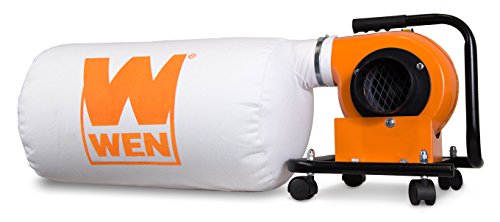
- 660 CFM motor with a 4-inch dust port
- 12-gallon, 5-micron collection bag
- Rolling base with optional wall mount
Best For: Tool-connected woodworking dust collection
Best Benchtop Option

- 725 CFM airflow with HEPA and carbon filtration
- Compact tabletop design for small work areas
- Variable speed and dual grounded outlets
Best For: Bench-based carving, turning, and sawing
Top Portable Extractor
DYNAVEX 12-Gallon HEPA Dust Extractor

- 142 CFM airflow from a 1.5 HP motor
- 12-gallon tank with 0.5-micron HEPA filtration
- Auto-start socket for tools up to 550 watts
Best For: Woodworkers needing mobile, high-capacity dust collection
Best Air Filtration
Abestorm 1350 CFM Workshop Air Filter

- 1,050–1,350 CFM airflow for rooms up to 1,700 sq. ft.
- MERV-11 filtration with built-in ionizer
- Ceiling, workbench, or direct-mount installation
Best For: Supplementary airborne dust filtration in workshops and garages
Most Versatile Cleanup Tool

- Blower and dust-collection modes in one handheld tool
- 177 MPH airflow with six-speed adjustment
- Includes hose and dust collection bag
Best For: Quick garage, workshop, and jobsite debris cleanup
Best Integrated Dust Control – Bosch VAC090AH
For small workshops that need dust extractors for small workshops with power-tool integration, the Bosch VAC090AH combines wet/dry collection, HEPA filtration, and automatic filter cleaning in a portable 9-gallon unit. Its power activation and adjustable Power Broker dial make it especially practical for matching suction to different applications.
Best For: Small workshops using grinders and other compatible power tools where integrated activation and fine dust control matter.
Pros:
- Delivers up to 150 CFM and 97 inches of static water lift.
- Power-tool activation turns the extractor on and off with the connected tool.
- Automatic filter cleaning runs every 15 seconds to help maintain suction.
- HEPA filter captures 99.97% of particles at 0.3 microns or larger.
Cons:
- The 9-gallon capacity is smaller than that of workshop-scale dust collectors.
- It is corded and weighs 28 pounds, which may limit placement flexibility.
The VAC090AH is a strong fit when clean air and tool-triggered operation are priorities. Its compact canister design and wet/dry capability add versatility, while the automatic cleaning system helps reduce interruptions during dusty work.
Best Wall-Mount Workshop Collector – VEVOR 1 HP 560 CFM
The VEVOR wall-mount collector is one of the more workshop-focused dust extractors for small workshops, pairing 560 CFM airflow with a 21-gallon collection bag. Its wall-mounted format can help preserve floor space while the zipper-equipped bag simplifies emptying.
Best For: Small or medium woodworking shops that want high airflow, a large collection bag, and a space-saving installation.
Pros:
- 560 CFM airflow provides strong suction for coarse sawdust and fine sanding dust.
- 21-gallon non-woven bag supports longer work periods between emptying.
- 2.5-micron filtration helps reduce airborne wood dust.
- Bottom zipper allows debris removal without detaching the bag.
Cons:
- The 2.5-micron filtration rating is not the same as HEPA filtration.
- At up to 90 dB, it may be noticeable during extended sessions.
- Wall mounting is less flexible than a mobile collector.
This VEVOR model makes sense when airflow and capacity are more important than compact portability. The 1 HP induction motor, large bag, and quick-cleaning design support regular woodworking cleanup without taking up as much floor space.
Best for Reduced Filter Loading – Dual-Cyclone 9-Gallon Extractor
For woodworkers comparing dust extractors for small workshops, this 9-gallon wet/dry model stands out for its dual-cyclone pre-separator. The system directs larger chips and shavings away from the HEPA filter, helping preserve airflow during extended cleanup and extraction tasks.
Best For: Wood shops handling chips, shavings, coarse sawdust, and mixed wet/dry cleanup where reduced filter loading is useful.
Pros:
- Dual-stage cyclone separation collects larger debris before it reaches the HEPA filter.
- 1400W motor provides up to 19 kPa of suction.
- 9-gallon, 35-liter tank supports both dry debris and non-corrosive liquid spills.
- Includes an 8.2-foot anti-static hose for workshop equipment and cleanup.
Cons:
- Its 80 dB noise level may be high for prolonged use in a small enclosed shop.
- The 35.5-pound body is heavier than the Bosch canister in this roundup.
- It has one power level and manual push-button control.
The dual-cyclone layout is the key advantage here, particularly for shops that generate substantial chips and shavings. It is a practical heavy-cleanup option, though its larger weight and louder operation may matter in a compact workspace.
Best High-Capacity Woodshop Collector – WEN DC1300
The WEN DC1300 is a high-capacity choice among dust extractors for small workshops, with 1,300 CFM airflow and a 50-gallon collection bag. Its dual 4-inch inlets can connect two tools at once, while the included mobile base makes this large collector easier to reposition.
Best For: Workshops with multiple woodworking machines that need high airflow, substantial collection capacity, and mobile placement.
Pros:
- Moves up to 1,300 CFM of air for high-volume dust collection.
- Dual 4-inch inlets allow attachment to two tools at the same time.
- 50-gallon vertical bag reduces the frequency of emptying.
- Four swivel casters support mobility around the workshop.
Cons:
- Its 50-gallon size may be excessive for very compact workshops.
- The 5-micron filtration rating is less fine than HEPA filtration.
- The single-speed design offers less adjustment than a variable-control extractor.
The DC1300 is best viewed as a centralized woodworking dust collector rather than a compact jobsite vacuum. It is a compelling option when airflow and capacity outweigh the need for a small footprint or fine filtration.
Best Air Scrubber – Stackable HEPA Air Cleaner
For small workshops that need more than basic chip collection, this air scrubber adds three-stage filtration to the dust-control setup. Its MERV-10 prefilter, activated carbon layer, and HEPA filter target larger particles, odors, fumes, and particles down to 0.3 microns, while adjustable airflow runs from 270 to 550 CFM.
Best For: Small repair areas, print shops, salons, and workshops needing portable air cleaning and odor reduction.
Pros:
- Three-stage filtration includes MERV-10, activated carbon, and HEPA media.
- Portable handle and plug-and-play operation support easy repositioning.
- Stackable design can be daisy-chained with up to three units for a combined 1,650 CFM.
- Adjustable airflow and filter-replacement indicator simplify operation.
Cons:
- It is an ambient air cleaner rather than a dedicated tool-connected dust collector.
- Removing the black cover is required before initial operation.
- The listed dimensions and stacking capability may be more than some compact benches need.
This is a versatile choice when airborne fine dust, smoke, and fumes are the priority. For direct collection at a saw or planer, pair it with a dedicated extractor.
Best Traditional Collector – Mobile 12-Gallon Dust Collector
The WEN DC3401 is a straightforward option for small workshops that want a rolling dust collector for compatible woodworking tools. Its 5.7-amp motor and 6-inch impeller move up to 660 CFM through a 4-inch dust port, while the 12-gallon, 5-micron bag collects shop debris.
Best For: Woodworkers who want a mobile collector with a standard 4-inch tool connection and generous bag capacity.
Pros:
- 660 CFM airflow and a 4-inch dust port suit many woodworking-tool connections.
- 12-gallon zippered collection bag reduces the frequency of emptying.
- Lockable swivel casters make the unit mobile while keeping it in place during use.
- Can be used as a rolling collector or optionally wall-mounted.
Cons:
- The supplied 5-micron bag is not a HEPA filter for fine airborne dust.
- Its single-speed design offers less airflow control than variable-speed models.
- It may require adapters or suitable ducting for tools without a 4-inch port.
Choose this model for practical chip and sawdust collection at woodworking tools rather than fine-particle air purification. The rolling base and wall-mount option give small shops useful installation flexibility.
Best Benchtop Option – 725 CFM HEPA Dust Collector
This tabletop system is designed for compact work areas where floor space is limited. It delivers up to 725 CFM through a three-fan system, uses HEPA and activated-carbon filtration, and provides variable speed control plus dual grounded 110V outlets for a nearby sander or lathe.
Best For: Wood carving, turning, sawing, and other bench-based tasks in workshops up to 300 square feet.
Pros:
- 725 CFM maximum airflow targets sawdust, chips, and 0.3-micron particles.
- HEPA and activated-carbon filtration helps capture fine dust and reduce odors.
- Compact 23.2-by-8-inch footprint and 22-pound weight support repositioning.
- Variable speed, dual outlets, and stated noise level of 65 dB add convenience.
Cons:
- Its tabletop format is less suited to large stationary machines or extensive ducting.
- The filter is listed for replacement approximately every four months.
- The supplied notes do not specify a standard tool-connection port or collection-bag capacity.
Among dust extractors for small workshops, this model stands out when bench space and fine filtration matter most. Its compact footprint and integrated outlets make it convenient for a dedicated carving or turning station.
Top Portable Extractor – DYNAVEX 12-Gallon HEPA Dust Extractor
For small workshops needing a dedicated solution, the DYNAVEX combines a 1.5 HP motor, 142 CFM airflow, and a 12-gallon steel tank. Its HEPA filter and mobile design make it a practical choice for collecting dust from sawing, sanding, and routing.
Best For: Woodworkers who want a wheeled extractor with substantial capacity and tool-linked startup.
Pros:
- 0.5-micron HEPA filter helps capture fine particles.
- 12-gallon tank reduces the need for frequent emptying.
- Auto mode starts the extractor when a connected tool runs.
- Includes hose, adapters, clamps, and replacement paper filters.
Cons:
- The linked tool socket supports tools up to 550 watts.
- Continuous linked use is limited to one hour.
- Wheel installation is optional rather than preinstalled.
This is one of the more capable dust extractors for small workshops when tank capacity and fine-particle filtration matter. Check the linked-socket limits if you plan to use it with power-hungry tools.
Best Air Filtration – Abestorm 1350 CFM Workshop Air Filter
The Abestorm is an overhead air-filtration unit rather than a hose-connected extractor. With 1,050–1,350 CFM airflow, a MERV-11 filter, and a built-in ionizer, it can help improve air circulation across workshops and garages up to 1,700 square feet.
Best For: Workshops that need room-wide airborne dust and odor filtration alongside source capture.
Pros:
- 360-degree intake supports broad air circulation.
- Can be hung, placed on a workbench, or screwed directly to the ceiling.
- Touch controls and remote operation add convenience.
- Includes four replaceable MERV-11 filters and mounting hardware.
Cons:
- It does not collect debris directly from a power tool.
- Noise is rated at 60–69 dBA.
- Cannot be shipped to California under the stated product restriction.
For dust extractors for small workshops, this model works best as a supplementary air cleaner rather than a replacement for a tool-connected collector. Its installation flexibility is useful where floor space is limited.
Most Versatile Cleanup Tool – 11-Amp 2-in-1 Blower Vacuum
This handheld 2-in-1 unit gives small workshops both concentrated blowing and dust collection in one corded tool. Its 177 MPH airflow, six-speed control, hose, and dust bag suit quick cleanup of sawdust, concrete dust, chips, and debris in garages or on jobsites.
Best For: Users who prioritize compact, maneuverable cleanup and occasional source dust collection.
Pros:
- Switches between blower and dust-extractor modes.
- Six speeds allow adjustment for lighter or heavier cleanup.
- 177 MPH airflow reaches corners, cracks, and tight spaces.
- Includes a flexible hose and dust collection bag.
Cons:
- It is a handheld tool rather than a wheeled, high-capacity collector.
- The supplied notes do not specify dust-bag capacity or filtration rating.
- Corded operation requires access to 110V power.
Among dust extractors for small workshops, this is the most flexible for fast cleanup and hard-to-reach areas. Choose a larger dedicated collector if you regularly produce substantial volumes of fine woodworking dust.
How We Picked These Dust Extractors for Small Workshops
We selected products across the main categories used in compact shops: tool-activated extractors, wet-dry vacuums, chip collectors, wall-mounted systems, benchtop units, and ambient air cleaners. We compared practical specifications such as airflow, suction, motor power, filtration, collection capacity, hose compatibility, mobility, and controls.
Because no single machine handles every type of dust equally well, the roundup includes both source-capture systems and air-filtration equipment. A collector connected directly to a saw or sander usually provides better control at the tool, while an air scrubber or hanging filter helps capture fine particles that remain suspended.
Quick Comparison
| Best For | Look For | Typical Advantage |
|---|---|---|
| Power tools | High suction, tool activation, fine filtration | Captures dust at the source |
| Table saws and planers | High CFM, larger bags, broad inlets | Moves chips efficiently |
| Benchtop carving and sanding | Compact footprint, adjustable airflow | Fits close to the work surface |
| Ambient shop air | HEPA or multi-stage filtration, timer controls | Reduces lingering airborne dust |
| Mixed cleanup | Wet-dry operation, durable hose, sealed filter | Handles debris and occasional liquids |
Key Buying Factors for Dust Extractors for Small Workshops
Airflow Versus Suction
Airflow, measured in CFM, matters when moving larger chips through a duct or hose. Suction or sealed pressure matters more for sanders, routers, and other tools that create fine dust. Choose based on the tool you use most, rather than relying on motor amperage alone.
Filtration and Dust Type
For fine wood dust, prioritize a HEPA-rated or highly efficient cartridge filter and a well-sealed collection path. Coarser bags may work for chips but should not be treated as complete protection against respirable particles. An air cleaner can supplement source capture, not replace it.
Capacity, Footprint, and Noise
Larger bags reduce emptying frequency but take more floor space. Compact extractors are easier to store and move, while wall-mounted units preserve floor area. Check noise ratings when available, especially if the machine will run continuously.
Connections and Automatic Controls
Verify hose diameter, adapters, outlet compatibility, and whether the extractor supports automatic tool activation. Anti-static hoses and grounded connections can improve convenience when collecting dry dust. Make sure the available power circuit can support the motor and connected tool.
Who Should Buy Which Dust Extractors for Small Workshops?
Choose a portable HEPA wet-dry extractor if your shop uses several handheld tools or you need flexible cleanup. A high-CFM woodworking collector is a better fit for stationary machines that produce large chips, such as table saws, planers, and jointers. Wall-mounted and smaller bag collectors suit shops where floor space is limited.
For carving, turning, and benchtop sanding, a compact tabletop collector can place filtration close to the work. If your main problem is fine dust that remains in the room after cutting, add a dedicated air scrubber or hanging filtration unit. Finally, choose a blower-style tool only for suitable outdoor or coarse-debris tasks; it is not a substitute for sealed source extraction or respiratory protection.