Choosing the right spreader can make grass-seed application faster, more even, and less wasteful. The best model depends on your lawn size, seed type, terrain, and how much control you need over the spread rate.
This roundup compares 10 fertilizer spreaders for grass seed, from compact handheld tools for spot repairs to high-capacity broadcast and tow-behind spreaders for larger properties.
Best 10 Fertilizer Spreaders for Grass Seed Picks for 2026
Best All-Around Broadcast Option
Scotts Turf Builder EdgeGuard DLX

- Pre-calibrated and ready to use
- Covers up to 15,000 square feet
- EdgeGuard helps protect nearby surfaces
Best For: Large lawns and year-round lawn treatments
Best Chest-Mount Design

- 20-pound hopper capacity
- Hands-free cross-shoulder strap
- Adjustable flow and direction controls
Best For: Portable spreading across lawns, gardens, and landscapes
Best Value Push Spreader
Amazon Basics Broadcast Spreader

- Covers up to 5,000 square feet per load
- Multi-gear precision control
- Handles seed, fertilizer, salt, and ice melt
Best For: Routine lawn care with push-style operation
Best for Small Yards
Scotts Whirl Hand-Powered Spreader

- Compact handheld format
- Covers up to 1,500 square feet
- Adjustable arm support for comfort
Best For: Small lawns and spot applications
Adjustable Coverage Pick
VEVOR 60 lb Walk-Behind Spreader

- 18 adjustable settings for controlled application
- 60 lb hopper reduces refill frequency
- Pneumatic tires suit varied terrain
Best For: Home lawns and small farms needing adjustable seed or fertilizer coverage
Portable Handheld Pick

- Lightweight two-pound handheld design
- 25 lb water-resistant nylon bag
- Agitator and shutoff support controlled flow
Best For: Targeted lawn, garden, farm, and food plot applications
Large-Property Pick
Agri-Fab 130 lb Tow-Behind Spreader

- 130 lb hopper covers up to 25,000 sq ft
- 10–12 ft spread width reduces passes
- Universal hitch fits many lawn tractors
Best For: Large lawns and property managers using a riding mower or tractor
Best Handheld Shaker
PERSZEN 80 Oz Adjustable Seed Spreader

- Three opening sizes for different materials
- 80-ounce capacity reduces refills
- Useful for seed, fertilizer, salt, and ice melt
Best For: Small lawns, gardens, and spot-spreading tasks
Best Push Spreader
VEVOR 50-Lb Broadcast Spreader
- 50-pound hopper for fewer refills
- 18-inch width with 10 adjustable settings
- 10-inch pneumatic wheels handle varied terrain
Best For: Larger lawns, gardens, and small farms
Best Compact Multi-Use Spreader
PERSZEN 84 Oz Handheld Spreader
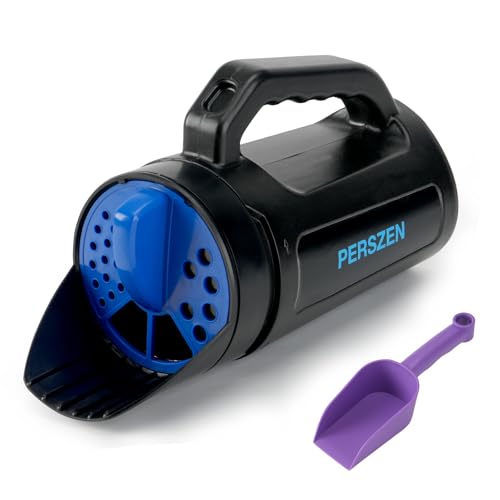
- Three flow settings suit varied granule sizes
- 84-ounce capacity limits refill interruptions
- Includes a scoop and comfortable non-slip handle
Best For: Lightweight, year-round home lawn and driveway care
Best All-Around Broadcast Option – Scotts Turf Builder EdgeGuard DLX
For homeowners comparing fertilizer spreaders for grass seed, the Scotts Turf Builder EdgeGuard DLX is a convenient broadcast model that arrives pre-calibrated and ready to use. Its 15,000-square-foot capacity and EdgeGuard feature make it suitable for broad lawn coverage while helping keep product off nearby hardscapes and landscaping.
Best For: Large residential lawns and year-round spreading of seed, fertilizer, salt, or ice melt.
Pros:
- Comes pre-calibrated with no assembly required.
- Holds enough Scotts lawn product for up to 15,000 square feet.
- EdgeGuard technology helps limit product spread onto driveways, sidewalks, and landscaping.
- Hopper and agitator are designed for smooth funneling and consistent coverage.
Cons:
- Its 10.9-pound body and broadcast design may be more than needed for very small areas.
- Coverage and calibration are described specifically around Scotts lawn products.
This is a strong choice when you want a ready-to-use spreader with generous capacity and added control near lawn edges. It also offers useful seasonal flexibility beyond grass seed and fertilizer.
Best Chest-Mount Design – SOLO 421 Portable Spreader
The SOLO 421 is a portable alternative for shoppers seeking fertilizer spreaders for grass seed without pushing a wheeled unit. Its chest-mounted design, adjustable strap, and 20-pound hopper support hands-free broadcasting across lawns, gardens, and commercial landscapes.
Best For: Users who want a portable spreader with a large hopper for seed, fertilizer, or ice melt.
Pros:
- 20-pound capacity supports treating larger areas between refills.
- Cross-shoulder strap enables hands-free operation.
- Adjustable flow control and direction fan provide control over placement and spread width.
- Chemical-resistant construction is designed for varied weather conditions.
Cons:
- Carrying a full 20-pound hopper may be less comfortable than using a wheeled spreader.
- Chest-mount operation requires the user to manage the unit while walking.
Choose this model when portability and a high-capacity hopper matter more than a push-cart format. The adjustable controls also make it a flexible option for different spreading materials.
Best Value Push Spreader – Amazon Basics Broadcast Spreader
The Amazon Basics Broadcast Fertilizer Spreader offers a practical push-style format for anyone comparing fertilizer spreaders for grass seed. Its multi-gear system and precision control are paired with a 33-pound, 0.5-cubic-foot bin rated to cover up to 5,000 square feet per load.
Best For: Routine lawn applications where push operation, multi-purpose use, and moderate coverage are priorities.
Pros:
- Can spread grass seed, fertilizer, salt, and ice melt.
- Covers up to 5,000 square feet per load.
- Multi-gear operation provides precision control.
- Steel frame and plastic bin are intended for all-season outdoor use.
Cons:
- Requires assembly, although the release cable comes pre-installed.
- Its stated coverage is lower than larger-capacity spreaders in this roundup.
This model fits homeowners who prefer a conventional wheeled spreader and do not need maximum lawn coverage per load. Its multi-purpose design makes it useful across several seasons.
Best for Small Yards – Scotts Whirl Hand-Powered Spreader
For small lawns, the Scotts Whirl provides a compact handheld solution among fertilizer spreaders for grass seed. Its adjustable arm support is designed for comfort, while the unit delivers smooth, even coverage for up to 1,500 square feet of Scotts lawn products.
Best For: Small yards and spot applications of grass seed, fertilizer, salt, or ice melt.
Pros:
- Compact handheld design is suited to small yards.
- Holds enough Scotts product for up to 1,500 square feet.
- Adjustable arm support helps improve comfort during use.
- Designed for smooth, even coverage and year-round applications.
Cons:
- Its 1,500-square-foot capacity is limited for larger lawns.
- Handheld operation requires the user to carry and manually operate the spreader.
This is the most convenient fit for smaller spaces or targeted lawn work. Larger properties will likely benefit from a broadcast model with a bigger hopper and wider coverage capacity.
Adjustable Coverage Pick – VEVOR 60 lb Walk-Behind Spreader
For homeowners comparing fertilizer spreaders for grass seed, this VEVOR walk-behind model offers a sizable 60-pound hopper, pneumatic all-terrain tires, and 18 adjustable settings. Its broadcast design is suited to lawn and garden work where consistent coverage and fewer refills matter.
Best For: Home lawns and small farms needing adjustable, year-round seed or fertilizer distribution.
Pros:
- 18 settings and a disc pellet controller support controlled application.
- 60-pound capacity helps reduce refill frequency.
- Eight-inch pneumatic tires handle grass, gravel, and snow.
- Powder-coated steel and impact-resistant plastic construction support outdoor use.
Cons:
- The 16.53-pound spreader is larger and heavier than a handheld model.
- Its stated spreading width reaches up to 9.8 feet, so larger properties may require more passes.
Choose this model when adjustability and hopper capacity are more important than the compact portability of a hand spreader. Its no-tool assembly and compact storage design add practical convenience for seasonal lawn care.
Portable Handheld Pick – EarthWay 2750 Bag Seeder
Among fertilizer spreaders for grass seed, the EarthWay 2750 stands out as a lightweight bag-style option for targeted jobs. Its 25-pound nylon hopper, shoulder strap, agitator, and spring-close shutoff are designed for controlled handheld spreading.
Best For: Hunters, gardeners, farmers, and lawn owners who want a portable spreader for smaller or targeted applications.
Pros:
- Two-pound design and cross-shoulder strap make transport easier.
- Integrated agitator and spring-close shutoff help control seed flow.
- Water-resistant nylon bag and sealed gearbox support outdoor use.
- Side spread control allows more targeted placement.
Cons:
- Its 25-pound capacity is smaller than the walk-behind and pull-behind options.
- Handheld operation may be less efficient for covering very large lawns.
This is a practical choice when portability and placement control matter most. The bag format is convenient for food plots, garden areas, and lawn maintenance tasks where maneuverability is more useful than maximum capacity.
Large-Property Pick – Agri-Fab 130 lb Tow-Behind Spreader
For larger properties, this Agri-Fab pull-behind model is one of the more substantial fertilizer spreaders for grass seed. Its 130-pound hopper, universal hitch, and 10- to 12-foot spread width are designed to cover broad areas with fewer refills and passes.
Best For: Large lawns, property managers, and riding mower or lawn tractor owners.
Pros:
- 130-pound hopper can cover up to 25,000 square feet or one-half acre.
- Universal hitch fits most riding mowers and lawn tractors.
- Wide 10- to 12-foot broadcast pattern helps reduce passes.
- Can distribute seed, fertilizer, salt, and ice melt.
Cons:
- Requires a compatible riding mower or lawn tractor for towing.
- At 29.4 pounds before material is added, it is not intended for hand-pushing.
- Its larger dimensions require more storage space than handheld spreaders.
This spreader makes the most sense when coverage area and reduced refilling are priorities. The steel frame, poly hopper, enclosed gear house, and pneumatic tires support regular seasonal use, while the three-year limited warranty adds ownership reassurance.
Best Handheld Shaker – PERSZEN 80 Oz Adjustable Seed Spreader
If you need fertilizer spreaders for grass seed but prefer a compact tool, this PERSZEN handheld shaker offers three opening sizes for different granule types. Its 80-ounce capacity and controlled front lid are designed to help reduce overspray while distributing seed, fertilizer, salt, or ice melt.
Best For: Small lawns, gardens, walkways, and seasonal hand-spreading jobs.
Pros:
- Three adjustable opening sizes accommodate coarse-to-fine materials.
- 80-ounce capacity helps limit frequent refills.
- Comfortable handle and front lid support more even application.
- Includes garden gloves and works year-round for seed, fertilizer, and ice melt.
Cons:
- Handheld design requires repeated manual shaking over larger areas.
- Plastic construction may be less suitable for heavy-duty commercial use.
This is a practical choice when portability and simple flow adjustment matter more than covering a large lawn quickly. Its handheld format is especially convenient for spot treatments and smaller areas.
Best Push Spreader – VEVOR 50-Lb Broadcast Spreader
For larger lawns, this VEVOR push spreader is a substantial option among fertilizer spreaders for grass seed. It combines a 50-pound hopper, 18-inch spreading width, 10 adjustable settings, and 10-inch pneumatic wheels for controlled coverage across grass, gravel, or snow-covered terrain.
Best For: Home lawns, gardens, and small farms that need higher-capacity push spreading.
Pros:
- 50-pound hopper reduces the need for frequent refilling.
- Ten settings and an 18-inch spread width support adjustable coverage.
- Powder-coated steel frame and impact-resistant plastic wheels are built for durability.
- Tool-free assembly and all-terrain pneumatic wheels improve convenience.
Cons:
- Larger and heavier than handheld spreaders at 15.75 pounds.
- Its push design requires storage space and room to maneuver.
This model makes the most sense when productivity and capacity are priorities. The adjustable settings can help tailor application, while the sturdy wheeled design is better suited to covering broad areas than a handheld shaker.
Best Compact Multi-Use Spreader – PERSZEN 84 Oz Handheld Spreader
This PERSZEN handheld model is a versatile pick among fertilizer spreaders for grass seed, with three flow settings for small, medium, and large materials. Its 84-ounce capacity, lightweight plastic body, and included scoop make it convenient for routine lawn care and driveway maintenance.
Best For: Homeowners who want one lightweight spreader for seed, fertilizer, and ice melt.
Pros:
- Three flow settings help match the opening to material size.
- 84-ounce capacity supports longer spreading sessions between refills.
- Lightweight, corrosion-resistant plastic suits fertilizer and salt use.
- Non-slip handle, easy-fill design, and included scoop simplify operation.
Cons:
- Handheld operation is less efficient for very large lawns.
- Plastic construction may not offer the same rigidity as a wheeled steel-frame spreader.
Choose this model for flexibility and easy storage rather than maximum coverage speed. It is a convenient all-season tool when you want one compact spreader for several household lawn and driveway tasks.
How We Picked the Best Fertilizer Spreaders for Grass Seed
We evaluated these spreaders by looking at capacity, application style, adjustability, coverage potential, portability, and the types of material each model can handle. Grass seed varies widely in size and weight, so a useful spreader should provide controllable output and a pattern that can be calibrated before covering the lawn.
We also considered practical factors such as hopper or bag design, operating comfort, maneuverability, storage, and compatibility with fertilizer, salt, ice melt, or other granular products. No spreader is ideal for every yard, so the recommendations represent different property sizes and use cases.
Quick Comparison
| Spreader type | Best suited for | Main advantage |
|---|---|---|
| Handheld | Small lawns and spot seeding | Compact and easy to control |
| Chest-mounted | Uneven areas and tight spaces | Portable with good maneuverability |
| Push broadcast | Small to medium lawns | Faster, wider coverage |
| Push drop | Precise paths and borders | More contained application |
| Pull-behind | Large lawns and acreage | High capacity with less walking |
Key Buying Factors for Fertilizer Spreaders for Grass Seed
Capacity and Lawn Size
Small handheld spreaders work well for patching bare spots or treating compact lawns, but they require frequent refills. Push models offer a practical balance for many residential yards. A large hopper or pull-behind unit is more efficient for extensive lawns, fields, food plots, or repeated seasonal applications.
Broadcast Versus Drop Distribution
Broadcast spreaders cast material across a wider area and reduce the number of passes needed. They are efficient but require overlapping coverage and careful edge control. Drop spreaders release material in a narrower line, making them useful near gardens, sidewalks, and property boundaries where overspray is a concern.
Rate Adjustment and Calibration
Look for a clearly marked adjustment system that can be set consistently. Always check the seed or fertilizer packaging, measure a test area, and calibrate the spreader before treating the full lawn. Walking speed also affects application rate, so maintain a steady pace.
Comfort, Terrain, and Durability
Shoulder straps and chest-mounted designs can be easier to use on slopes or around obstacles, while push spreaders are generally better for open, level lawns. Consider wheel stability, handle comfort, hopper material, corrosion resistance, and whether the spreader can be cleaned thoroughly after use.
Who Should Buy Which Fertilizer Spreaders for Grass Seed?
Choose a handheld model for small lawns, repairs, narrow areas, or occasional applications. Choose a chest-mounted spreader when portability and maneuverability matter more than maximum coverage. Choose a push broadcast spreader for general lawn overseeding and fertilizer application across a typical residential property.
Choose a drop spreader when precision along edges is your priority. Choose a high-capacity push model for larger lawns where frequent refilling would be inconvenient. Choose a pull-behind spreader if you have a tractor, riding mower, or ATV and regularly maintain several acres.
Whichever option you select, clean the spreader after use, keep seed dry, and store the equipment away from moisture. These steps help maintain consistent output and extend the spreader’s useful life.