Finding the right sander for tight spaces means balancing a compact footprint with enough control, power, and dust management for the job. The best options make it easier to smooth edges, corners, trim, furniture parts, and other hard-to-reach surfaces without sacrificing finish quality.
This roundup compares 10 detail, palm, random orbital, and pneumatic sanders, including corded and cordless models. Use the guide below to narrow your choice by workspace, power source, pad size, dust collection, and the type of sanding you do most often.
Best 10 Orbital Sanders for Tight Spaces Picks for 2026
Best Compact Electric Detail Sander
HYCHIKA 14,000 OPM Detail Sander

- Compact head reaches corners and edges
- Includes 12 sheets in three grits
- Six-hole dust collection with dust bag
Best For: Corded detail sanding and paint removal in small woodworking areas
Best Pneumatic Mini Sander
2-Inch and 3-Inch Air Orbital Sander Kit

- Includes 2-inch and 3-inch sanding pads
- Dual-action motion for smoother finishing
- Requires a compressor and 90 PSI working pressure
Best For: Small auto-body, curved-surface, and edge-sanding repairs
Best Detail Sander for Awkward Angles
BLACK+DECKER BDEMS600 Detail Sander

- 16,000 OPM motor supports material removal
- Three-position grip improves handling
- Includes finger attachment for narrow spots
Best For: Corded detail sanding in corners and awkward angles
Best Cordless Low-Profile Sander

- Low-profile body works close to the surface
- Variable speed from 8,000 to 12,000 OPM
- Tool-only 20V MAX brushless design
Best For: Portable sanding for users with DEWALT 20V batteries
Most Versatile
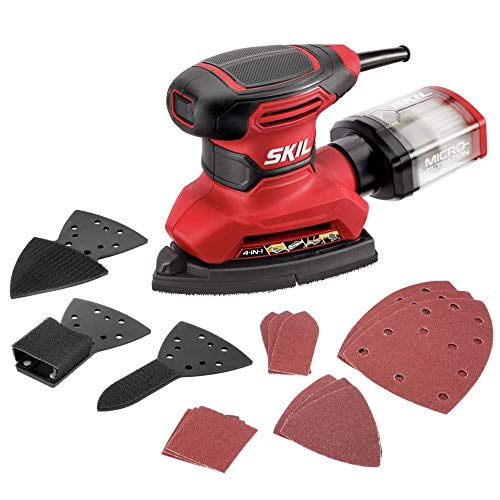
- Three interchangeable detail attachments
- 1.2-amp motor with up to 13,500 OPM
- Dust box and vacuum-port options
Best For: Corners, edges, contours, and mixed DIY sanding
Best Palm-Style Power

- 3.0-amp motor at 12,000 OPM
- Shorter height for closer workpiece access
- Counterweight and rubber over-mold for comfort
Best For: Corded palm sanding and close-access work
Most Portable
Milwaukee M12 FUEL Detail Sander

- Lightweight 1.3-pound cordless design
- Variable trigger with four speed settings
- LED light for work-area visibility
Best For: Portable detail sanding in confined areas
Compact Corded Pick
SKIL 5-Inch Random Orbital Sander

- Compact 5-inch design for tight spaces
- 13,000 OPM with variable speed control
- Cyclonic dust box and low-vibration grip
Best For: DIYers needing a comfortable corded sander for general sanding
Most Versatile Detail Option
2-in-1 Brushless Detail Sander

- Triangular and square interchangeable pads
- 350W brushless motor with six speeds
- Includes 20 sheets and vacuum hose
Best For: Refinishing projects spanning corners, edges, and flat surfaces
Low-Vibration Finishing Choice
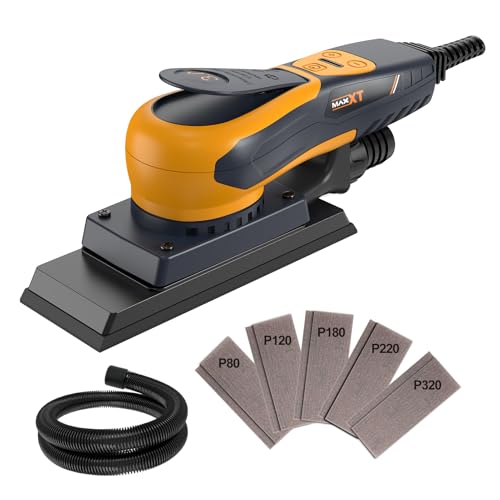
- Compact format for narrow surfaces
- 3.0mm orbit with variable speed
- Universal vacuum outlet and dust collection
Best For: Precise finishing and polishing in small work areas
Best Compact Electric Detail Sander – HYCHIKA 14,000 OPM Detail Sander
For shoppers comparing orbital sanders for tight spaces, the HYCHIKA Detail Sander offers a compact corded design, a pointed detail-sanding shape, and up to 14,000 OPM. Its soft rubber head and included hook-and-loop papers make it suited to corners, edges, and small woodworking tasks.
Best For: Interior detail work, paint removal, polishing, and sanding edges or corners in wood projects.
Pros:
- Compact shape and soft rubber head help reach tight spaces.
- 1.6-amp motor delivers up to 14,000 OPM.
- Includes 12 sanding sheets in P80, P120, and P240 grits.
- Six-hole dust collection system and dust bag help reduce debris.
Cons:
- Corded design requires access to an outlet.
- Not recommended for drywall or cement plaster.
With its detail-oriented shape, useful starter assortment of abrasives, and dust bag, this is a practical choice for small woodwork and home-decoration jobs. It is less suitable when cordless portability or heavy-duty surface sanding is the priority.
Best Pneumatic Mini Sander – 2-Inch and 3-Inch Air Orbital Sander Kit
This mini air sander is a specialized option among orbital sanders for tight spaces, with 2-inch and 3-inch pads for small surfaces, edges, and contours. Its dual-action motion and 1.5-pound body are designed for controlled detail sanding, but operation requires a suitable air compressor.
Best For: Auto-body spot sanding, paint preparation, headlights, bumpers, curved surfaces, and compact woodworking jobs.
Pros:
- Two pad sizes support different small-area sanding tasks.
- Dual-action orbital motion helps produce a more uniform finish.
- Lightweight 1.5-pound design is easy to maneuver.
- Includes 24 hook-and-loop discs in four grits.
Cons:
- Requires an air compressor, hose, and suitable fittings.
- Air consumption is rated at 4 CFM at 90 PSI.
The compact pneumatic design is well matched to controlled work on edges, contours, and isolated repair areas. It makes the most sense for users who already have compatible compressed-air equipment.
Best Detail Sander for Awkward Angles – BLACK+DECKER BDEMS600 Detail Sander
The BLACK+DECKER BDEMS600 is a corded detail sander built for orbital sanders for tight spaces applications. Its compact body, three-position grip, detail finger attachment, and pointed sanding pad help with cramped corners and awkward angles while the 16,000 OPM motor supports fast material removal.
Best For: Detailed wood sanding, tight corners, odd angles, and projects requiring continuous corded power.
Pros:
- Compact design is intended for cramped corners and tight spaces.
- Three-position comfort grip supports control during detail work.
- Detail finger attachment reaches narrow, hard-to-reach spots.
- Dust collection canister helps keep the work surface cleaner.
Cons:
- Corded operation limits portability to areas near an outlet.
- Only the mouse detail sander is listed among the included components.
This model stands out when access and handling matter more than cordless convenience. The detail finger attachment and angled pad make it especially useful for small, irregular areas that a standard rectangular sander may not reach easily.
Best Cordless Low-Profile Sander – DEWALT 20V MAX DCW210B Sander
DEWALT 20V MAX Orbital Sander, Tool Only (DCW210B) | Brushless motor, dust collection
Check Price On AmazonThe DEWALT DCW210B brings cordless convenience to orbital sanders for tight spaces, with a low-profile height for getting close to the work surface. Its brushless motor, variable speed from 8,000 to 12,000 OPM, and rubber overmold grip support controlled sanding without a power cord.
Best For: Mobile woodworking and finishing tasks where cordless access, low-profile handling, and variable speed are useful.
Pros:
- Low-profile design helps users work close to the surface.
- Variable-speed control adjusts from 8,000 to 12,000 OPM.
- Brushless motor is designed for runtime and efficiency.
- Eight-hole hook-and-loop pad allows quick paper changes.
Cons:
- Tool-only package does not include a battery or charger.
- Dust collection accessories beyond the included bag may cost extra.
This is a strong fit for users already invested in the DEWALT 20V MAX platform and who value freedom from a cord. Its low profile helps with access, while the variable speed is useful for adapting to different sanding applications.
Most Versatile – SKIL 4-in-1 Detail Sander
If you need orbital sanders for tight spaces, the SKIL Multi-Function Detail Sander is designed for more than flat surfaces. Its interchangeable detail attachments handle corners, edges, larger areas, and contoured surfaces, while the compact 2.6-pound design helps with controlled work.
Best For: DIYers who need one corded sander for corners, edges, detail work, and contoured surfaces.
Pros:
- Four-in-one design includes three tool-free-change attachments.
- 1.2-amp motor delivers up to 13,500 orbits per minute.
- Micro-filtration dust box and 1-1/4-inch vacuum port offer two dust-management options.
- Low-vibration design, soft rubber grip, and hook-and-loop paper changes improve usability.
Cons:
- Corded operation requires access to a 120-volt outlet.
- Its 1.2-amp motor is less powerful on paper than the 3.0-amp DEWALT option.
The SKIL stands out when versatility matters more than maximum motor capacity. The included attachments and dust-management choices make it a practical pick for varied detail-sanding tasks.
Best Palm-Style Power – DEWALT 5-Inch Orbital Sander
The DEWALT DWE6421 is a compact palm-style choice among orbital sanders for tight spaces. Its shorter height lets you get closer to the workpiece, while the 3.0-amp motor spins the pad at 12,000 OPM for steady sanding on compatible flat work.
Best For: Users who want a powerful corded palm sander with a low-profile design for closer workpiece access.
Pros:
- 3.0-amp motor provides 12,000 OPM.
- Shorter hand-sander height helps bring the user closer to the workpiece.
- Separate counterweight and rubber over-mold help improve comfort.
- Dust-sealed switch is designed to protect against dust ingestion.
Cons:
- At 3.4 pounds, it is heavier than the SKIL and Milwaukee models listed here.
- It is a corded tool, so mobility is limited by the power cord.
- The supplied components list includes a dust bag but not multiple detail attachments.
Choose the DEWALT when motor strength and a low-profile palm design are priorities. It is better suited to general flat-surface sanding than highly specialized contour work.
Most Portable – Milwaukee M12 FUEL Detail Sander
For cordless access in confined areas, the Milwaukee M12 FUEL Detail Sander is a highly portable option among orbital sanders for tight spaces. It weighs 1.3 pounds and combines a 1.5mm orbit diameter with a variable-speed trigger, four speed settings, and an LED light.
Best For: Portable detail sanding where a lightweight, cordless tool and speed control are useful.
Pros:
- Lightweight 1.3-pound design is easy to maneuver.
- Cordless battery power improves portability around the workpiece.
- Variable-speed trigger and four speed settings provide control.
- Built-in LED light can help illuminate the sanding area.
Cons:
- The supplied notes do not list a battery or charger as included components.
- Its detail-focused design may be less suitable for broad surfaces than a 5-inch sander.
- The product details list a 1.5mm orbit diameter rather than a larger sanding-pad specification.
The Milwaukee is the most convenient pick for mobile, close-up detail work. Its low weight, cordless format, and adjustable speed make it appealing when maneuverability is more important than covering large areas quickly.
Compact Corded Pick – SKIL 5-Inch Random Orbital Sander
SKIL 5” Random Orbital Sander with Cyclonic Dust Box & 3pc Sanding Sheet - SR211601, Multicolor
Check Price On AmazonIf you need orbital sanders for tight spaces, the SKIL SR211601 is a practical corded option with a compact body, ergonomic grip, and 5-inch sanding disc. Its 2.8-amp motor delivers up to 13,000 OPM, while variable speed control helps tailor the tool to different materials and sanding tasks.
Best For: DIYers who want a compact, comfortable corded sander for general surface preparation and finishing.
Pros:
- Compact design helps it reach tight spaces and improves control.
- Variable speed supports different materials and applications.
- Cyclonic dust box is transparent and easy to empty.
- Low-vibration design and soft rubber grip help reduce hand fatigue.
Cons:
- Corded operation limits mobility compared with a battery-powered model.
- Only three sanding sheets are included.
The SKIL stands out for straightforward, controlled sanding in confined areas. Its compact dimensions and 3.4-pound weight make it manageable for longer jobs, while the dust box and sealed switch add practical convenience.
Most Versatile Detail Option – 2-in-1 Brushless Detail Sander
For orbital sanders for tight spaces that also handle broader surfaces, this 2-in-1 model uses interchangeable triangular and square pads. Its brushless 350W motor offers six speed settings from 4,000 to 10,000 OPM, giving you control for detail work, paint removal, and finishing.
Best For: Home renovators and furniture refinishers who want one compact tool for corners, edges, and flat panels.
Pros:
- Interchangeable triangular and square pads cover detail and flat-area sanding.
- Brushless motor is designed for lower noise, reduced vibration, and longer service life.
- Six speeds and a top paddle trigger allow on-the-fly adjustment.
- Includes 20 mesh sheets, two backing plates, and vacuum hose.
Cons:
- Its corded AC design requires access to an outlet.
- The listed dimensions are relatively tall, which may limit access in especially confined spots.
This is the most adaptable choice of the three for users who move between corners and larger surfaces. The symmetrical grip supports either hand, and the built-in dust collection accepts 28mm and 35mm vacuum connectors.
Low-Vibration Finishing Choice – MAXXT 350W Sheet Sander
The MAXXT sheet sander is a focused option for orbital sanders for tight spaces, combining a compact palm-sander format with a 3.0mm orbit. Its 350W brushless motor and adjustable 4,000–10,000 RPM range support controlled sanding on wood, metal, and auto-body surfaces.
Best For: Users seeking a compact square sander for finishing, polishing, and narrow work areas.
Pros:
- Compact, lightweight design suits small and narrow surfaces.
- Adjustable speed provides control from 4,000 to 10,000 RPM.
- 3.0mm orbit is intended for precise, smooth finishing.
- Universal dust outlet adaptor supports connection to different vacuum systems.
Cons:
- Only 10 mesh sanding discs are included.
- As a corded tool, it needs a 120-volt power source.
The MAXXT emphasizes controlled finishing rather than maximum speed. Its low-vibration ergonomic design, brushless motor, and vacuum-compatible dust outlet make it a sensible fit for detailed woodworking and other small-area sanding tasks.
How We Picked the Best Orbital Sanders for Tight Spaces
We focused on the features that matter most when sanding in confined areas: compact dimensions, manageable weight, comfortable grips, variable or useful operating speeds, and pad designs suited to detail work. We also considered dust collection, included accessories, power source, and whether each model is better suited to occasional touch-ups, furniture work, trim, or broader surface preparation.
The selection includes detail sanders, palm sanders, five-inch random orbital models, a pneumatic mini sander, and cordless options. This range reflects an important reality: the best tool for a narrow corner is not always the best tool for a large tabletop.
Quick Comparison
- Best for compact detail work: Detail and sheet sanders with pointed or rectangular pads are easier to control around edges and corners.
- Best for furniture and larger panels: Five-inch random orbital sanders cover more area and typically leave fewer obvious sanding marks when used correctly.
- Best for cordless convenience: Battery-powered models eliminate cord management but require compatible batteries and chargers.
- Best for continuous shop use: Pneumatic sanders can be light and maneuverable, but they require a suitably sized air compressor.
Key Buying Factors for Orbital Sanders for Tight Spaces
Size, Pad Shape, and Access
Check the sanding pad dimensions and shape before buying. A compact triangular or detail pad can reach closer to inside corners, narrow trim, and intricate furniture profiles. A five-inch round pad is more versatile for open surfaces but may be awkward near obstacles.
Speed and Control
Higher OPM can remove material quickly, while lower or variable speeds provide better control on paint, veneer, softwood, and delicate finishes. A comfortable grip and low vibration are especially important when working one-handed or in awkward positions.
Power Source and Runtime
Corded models offer consistent power and are practical near an outlet. Cordless sanders improve mobility, but account for battery cost, runtime, and added tool weight. Pneumatic tools are often compact, yet compressor capacity and hose routing can limit convenience.
Dust Collection
Look for a dust box, micro-filter, cyclonic collector, or hose connection that matches your shop vacuum. Effective extraction improves visibility, reduces cleanup, and helps limit airborne dust. No dust system replaces appropriate respiratory and eye protection.
Who Should Buy Which Orbital Sanders for Tight Spaces?
Choose a detail or sheet sander if your priority is tight corners, trim, small repairs, or controlled finish sanding. Choose a five-inch random orbital model if you need one tool for furniture, doors, shelves, and larger flat surfaces. A cordless model is the better fit for mobile work or areas without convenient outlets, while a corded model is usually the simpler value for a fixed workshop.
Buy the pneumatic mini sander only if you already have an air compressor capable of supporting it. For frequent professional use, prioritize brushless motors, low vibration, durable dust extraction, and a comfortable grip. For occasional DIY projects, a compact corded detail sander can deliver the access and control you need without the expense of a full cordless platform.