Choosing the right landscape fabric can make garden maintenance easier, but thickness, weave, roll size, and drainage performance vary considerably. The best permeable landscape fabrics suppress weeds while allowing water and air to reach the soil.
We compared 10 heavy-duty woven and non-woven options for coverage, durability, cutting ease, and practical use around beds, paths, driveways, and other landscaped areas.
Best 10 Permeable Landscape Fabrics Picks for 2026
Heavy-Duty Drainage Pick
VEVOR Non-Woven Geotextile Fabric

- Permeable needle-punched polypropylene
- Supports drainage and gravel filtration
- Useful for French drains and erosion control
Best For: Drainage projects, paths, and heavy-duty landscaping
Large-Area Coverage Pick
4ft x 300ft Woven Weed Barrier

- Covers up to 1,200 square feet
- Tear-resistant 3.2-ounce polypropylene
- Lets water and nutrients pass through
Best For: Large gardens, farms, and landscaping areas
Easy-Cut Garden Pick
Grenebo Non-Woven Weed Barrier

- No-fray fabric cuts cleanly
- Highly permeable and breathable
- Includes 30 landscape staples
Best For: Vegetable gardens and easy DIY bed installation
Wide-Roll Landscaping Pick

- Six-foot-wide roll for broad coverage
- Permeable to air and water
- Printed guidelines aid alignment
Best For: Large landscaping, driveways, and gravel paths
Best Heavy-Duty Coverage

- Covers up to 1,800 square feet
- 2.4-ounce woven polypropylene
- Green stripes aid alignment
Best For: Large landscaping and driveway projects
Best for Flexible Garden Projects
4ft x 100ft Woven Weed Barrier

- Durable 3.5-ounce woven material
- Breathable and water permeable
- Cuts easily for custom layouts
Best For: Vegetable gardens and medium-size beds
Best Complete Installation Kit

- Includes 90 landscape staples
- Blocks 95% of sunlight
- UV treated and tear resistant
Best For: Large landscaping jobs needing quick installation
Wide-Coverage Woven Barrier
5 ft x 100 ft Heavy Duty Fabric

- Covers up to 500 sq. ft.
- Breathable, water-permeable weave
- Guide lines and sealed edges
Best For: Large beds, gravel areas, and driveways
Long-Run Geotextile Value
3 ft x 180 ft Non-Woven Barrier
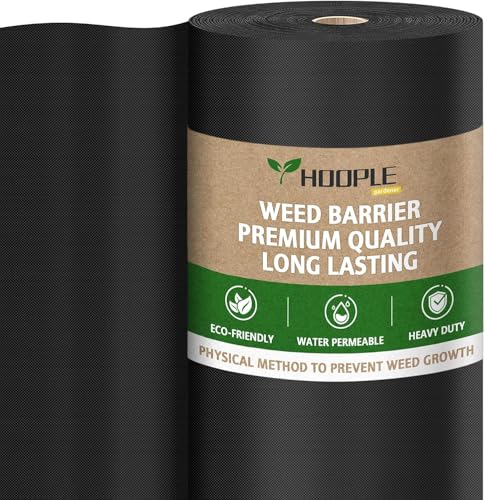
- 180-foot roll for extended runs
- Water- and air-permeable design
- Works under gravel, mulch, and pavers
Best For: Long paths, beds, and base layers
Balanced Heavy-Duty Coverage

- 3.2 oz woven polypropylene
- Water- and air-permeable
- Suitable under mulch or gravel
Best For: Beds, paths, and driveway bases
Heavy-Duty Drainage Pick – VEVOR Non-Woven Geotextile Fabric
For projects needing permeable landscape fabrics, this VEVOR non-woven geotextile combines weed control with drainage and filtration. Its needle-punched polypropylene construction is flexible enough to cut and install while supporting landscaping, French drains, paths, and erosion-control work.
Best For: French drains, gravel paths, underlayment, erosion control, and demanding landscaping applications.
Pros:
- Allows water drainage, air penetration, and gravel filtration.
- Needle-punched, non-woven material is flexible and easy to cut.
- Supports weed suppression by blocking sunlight and reducing evaporation.
- Suitable for landscaping, drainage, stabilization, and farming applications.
Cons:
- The listed specifications contain a density discrepancy, describing the fabric as both 4 oz and 8 oz.
- At 3 feet wide, it may require overlapping for broader areas.
This is a versatile choice when permeability and filtration matter as much as weed control. Its narrower roll is particularly practical for drainage trenches, paths, and smaller landscaped sections.
Large-Area Coverage Pick – 4ft x 300ft Woven Weed Barrier
This 4-by-300-foot woven polypropylene option gives you substantial coverage for gardens, flower beds, and yard projects. As permeable landscape fabrics, it is designed to block weeds while allowing water and nutrients to reach the soil, and its heavy-duty construction suits areas exposed to foot or vehicle traffic.
Best For: Large gardens, farms, flower beds, driveways, and broad landscaping installations.
Pros:
- 300-foot roll provides extensive coverage for larger projects.
- 3.2-ounce polypropylene fabric is described as tear-resistant.
- Allows water and nutrients to reach the soil.
- Can be cut to size and used for erosion control or driveway stabilization.
Cons:
- The large roll weighs 23 pounds, which may make handling more demanding.
- Its 4-foot width may require seams on wider installations.
This fabric is a practical value-oriented pick when you need to cover a large area with one roll. Plan the layout before installation, then cover it with mulch as recommended for a finished landscape.
Easy-Cut Garden Pick – Grenebo Non-Woven Weed Barrier
Grenebo is a convenient option among permeable landscape fabrics for garden beds and vegetable plots. Its no-fray, non-woven design cuts cleanly without unraveling, while the breathable structure supports air and water flow; 30 included staples help simplify installation.
Best For: Vegetable gardens, planting rows, flower beds, and homeowners who want straightforward installation.
Pros:
- No-fray construction makes trimming and shaping easier.
- Highly permeable material supports air and water flow and helps reduce puddling.
- Black-and-green reversible design offers placement flexibility.
- Includes 30 U-shaped landscape staples.
Cons:
- The fabric is folded across its width for delivery and must be fully unfolded before use.
- The 4-foot-wide roll may need overlapping for larger beds.
For smaller or medium garden installations, the clean-cut edges and included staples make this an approachable choice. Its stated suitability for vegetable gardens adds useful flexibility for food-growing spaces.
Wide-Roll Landscaping Pick – iropro 6ft Woven Weed Barrier
With a 6-foot width and 300-foot length, iropro is built for extensive coverage. This woven polypropylene fabric fits the needs of permeable landscape fabrics by allowing air and water through, while its printed green guidelines help align planting rows and make cutting easier.
Best For: Large landscaping projects, driveways, gravel paths, raised beds, patios, and artificial-grass installations.
Pros:
- Wide, long roll can cover broad areas with fewer seams.
- Allows air and water to reach soil while helping control weeds.
- Green guidelines assist with row alignment and installation.
- Designed for uses ranging from gardens to driveways and erosion control.
Cons:
- The 6-foot roll weighs 34.1 pounds, so moving and positioning it may require extra effort.
- It is folded and rolled for storage, so the apparent width is initially half-size until opened.
This is a strong fit when project scale is the priority. The generous dimensions reduce the number of joins, while the alignment lines are helpful for orderly planting and layout work.
Best Heavy-Duty Coverage – Happybuy 6x300ft Weed Barrier
For large beds, paths, or driveways, the Happybuy roll is a practical option among permeable landscape fabrics. Its 6-by-300-foot format covers up to 1,800 square feet, while the woven polypropylene construction is designed to let soil breathe and water pass through.
Best For: Large gardens, flower beds, greenhouse areas, artificial grass, sidewalks, gravel, and driveway projects.
Pros:
- Large 1,800-square-foot coverage area.
- Heavy-duty 2.4-ounce woven polypropylene construction.
- Permeable design supports air and water flow while blocking weeds.
- Green alignment stripes and easy cutting simplify installation.
Cons:
- Installation tools are not included.
- The large roll may be more material than smaller projects require.
This is a strong fit when you need broad coverage and a fabric that can be customized for different layouts. Its generous size and multipurpose design make it especially useful for substantial landscaping jobs.
Best for Flexible Garden Projects – 4ft x 100ft Woven Weed Barrier
This 4-by-100-foot roll offers a manageable size for garden beds and smaller landscaping areas. As permeable landscape fabrics go, its 3.5-ounce woven polypropylene construction balances weed control with airflow and water penetration, and it can be cut to fit your layout.
Best For: Vegetable gardens, tree and shrub areas, mulch or gravel paths, and projects where a 4-foot-wide roll is convenient.
Pros:
- Durable 3.5-ounce woven polypropylene material.
- Breathable, cross-weave design allows air and water to reach the soil.
- Easy to cut with scissors or a utility knife.
- Suitable beneath mulch, rock, or gravel and for erosion-control applications.
Cons:
- The folded packaging means it must be opened to reach its full width.
- Landscape staples are referenced for installation but are not clearly specified as included with the 4-by-100-foot version.
Choose this roll when you want substantial fabric without the footprint of a 300-foot commercial-size roll. Its versatile width and cut-to-fit design work well for routine garden and landscape maintenance.
Best Complete Installation Kit – Shade&Beyond 6x300ft Fabric
The Shade&Beyond roll combines broad coverage with included securing hardware, making it a convenient choice among permeable landscape fabrics. Its 6-by-300-foot woven polypropylene sheet is UV treated, designed to block 95% of sunlight, and supplied with 90 landscape staples.
Best For: Large gardens, yards, orchards, flower beds, pathways, driveways, and landscaping projects needing included staples.
Pros:
- Large 1,800-square-foot coverage format.
- 3.2-ounce woven fabric blocks sunlight while allowing moderate air and water flow.
- UV-treated, tear-resistant construction with heat-sealed cut edges.
- Includes 90 landscape staples for quick installation.
Cons:
- Its large roll may be excessive for compact beds.
- The material is folded for shipping and must be fully unfolded before installation.
- The supplied notes estimate an outdoor lifespan of 2–3 years.
This option stands out for buyers who want a large roll and a simpler setup. The included staples, customizable sizing, and reinforced construction make it particularly practical for extensive outdoor installations.
Wide-Coverage Woven Barrier – 5 ft x 100 ft Heavy Duty Fabric
For larger beds, gravel zones, and driveways, this roll is a practical option among permeable landscape fabrics. Its 3.2 oz woven polypropylene construction helps block sunlight while allowing air and water to reach the soil.
Best For: Wide garden beds, gravel areas, pathways, driveways, and general landscaping projects requiring up to 500 square feet of coverage.
Pros:
- 5 ft x 100 ft roll covers up to 500 square feet.
- Woven structure is breathable and water permeable.
- Green guide lines, sealed edges, and easy-cut material simplify installation.
- Suitable beneath mulch, gravel, rock, or soil.
Cons:
- The wide roll may be less convenient for narrow or small planting areas.
- It must be secured and covered after installation for the intended finish.
This is a strong fit when you want broad coverage and straightforward handling. The guide lines and laser-sealed edges are useful details for a larger landscaping project.
Long-Run Geotextile Value – 3 ft x 180 ft Non-Woven Barrier
This long, narrow roll offers extensive coverage for paths, garden beds, and base layers. As one of the permeable landscape fabrics in this roundup, its non-woven polypropylene design allows water and air through while helping reduce weed growth.
Best For: Long walkways, flower beds, gravel paths, mulch areas, greenhouses, and driveway base layers.
Pros:
- 180-foot length is useful for extended runs.
- Water- and air-permeable non-woven geotextile design.
- Can be trimmed and installed under mulch, gravel, pavers, rocks, or artificial turf.
- Polypropylene material offers tear resistance and tensile strength for outdoor use.
Cons:
- At 3 feet wide, it may require more seams on broad areas.
- The non-woven construction differs from woven options if you prefer a woven texture.
Choose this roll when length matters more than width. Its 180-foot format is especially practical for continuous paths, borders, and repeated narrow installations.
Balanced Heavy-Duty Coverage – 4 ft x 100 ft Woven Fabric
This 4-foot-wide roll balances manageable handling with substantial coverage. Its 3.2 oz woven polypropylene construction makes it a practical choice among permeable landscape fabrics for beds, gravel, mulch, and driveway base applications.
Best For: Garden and flower beds, gravel paths, mulch areas, walkways, and driveway base layers where a 4-foot width is convenient.
Pros:
- 4 ft x 100 ft roll provides broad project coverage.
- Woven geotextile structure allows water and air to pass through.
- Designed with tensile strength and tear resistance for outdoor use.
- Easy to trim, staple, and cover with landscape materials.
Cons:
- It requires landscape staples and a covering layer for installation.
- A 100-foot roll may provide more material than needed for small projects.
This is a versatile middle-ground option for projects that need more width than a narrow strip but less bulk than a 5-foot roll. It works across several common landscape finishes.
How We Picked the Best Permeable Landscape Fabrics
We focused on the details that matter after installation: material construction, stated weight, permeability, UV resistance, available roll dimensions, and suitability for common landscaping projects. Woven polypropylene fabrics generally offer strong weed suppression and long-term durability, while non-woven geotextiles are often easier to shape and useful beneath gravel, mulch, or pathways.
Because coverage needs vary widely, we included compact rolls for smaller beds and large-format options for extensive gardens, commercial-style planting areas, and long paths. We also considered whether included staples or no-fray construction could simplify installation.
Quick Comparison
- Best for small garden beds: Choose a 3- or 4-foot roll that is easier to handle and trim.
- Best for large areas: Six-foot-wide, 300-foot rolls reduce seams and cover substantial ground efficiently.
- Best for paths and gravel: Look for a heavier woven fabric or a durable non-woven geotextile.
- Best for easier cutting: No-fray or non-woven designs can be simpler to shape around plants and borders.
- Best for long-term exposure: Prioritize UV-resistant material and cover the fabric with mulch, stone, or another protective layer.
Key Buying Factors for Permeable Landscape Fabrics
Woven Vs. Non-Woven Construction
Woven fabric uses interlaced plastic strands and is typically a strong choice for rows, flower beds, and areas where weeds are the primary concern. Non-woven fabric has a felt-like structure that can conform well to uneven ground and provide useful separation beneath gravel or hardscape materials.
Weight and Durability
Fabric weight is commonly listed in ounces per square yard. Heavier material may resist tearing and punctures better, but it can also be harder to cut and install. For routine garden beds, around 3 ounces is often a practical balance; demanding paths and driveways may justify a heavier option.
Drainage and Soil Contact
Permeability allows rain and irrigation to pass through instead of pooling on top. Confirm that the product is intended for landscape drainage, and prepare the ground by removing existing weeds, roots, and sharp debris before laying the fabric.
Roll Size and Installation
Measure the area before buying, then allow extra material for overlaps and edges. Overlap adjoining pieces by several inches, secure them with landscape staples, and cut precise openings around plants. A protective top layer of mulch or stone improves appearance and helps limit UV degradation.
Who Should Buy Which Permeable Landscape Fabrics?
Home gardeners covering a few planting beds should favor manageable 3- or 4-foot rolls. Buyers landscaping large yards or multiple beds can save installation time with 6-foot-wide, 300-foot rolls. Choose woven fabric when weed suppression and tear resistance are the priorities; select non-woven geotextile when flexibility, filtration, or use beneath gravel matters most. If you expect the material to remain exposed during installation, UV resistance and prompt coverage should be especially important.