The right soil pH meter can help you identify growing conditions that limit nutrient availability before plant problems become difficult to correct. The products in this roundup range from simple analog testers to more capable digital instruments.
Use the comparison and buying advice below to match features such as calibration, probe design, measurement range, and extra soil readings to your plants and testing routine.
Best 10 Soil Ph Meters Picks for 2026
Best Budget 3-in-1

- Tests soil moisture, pH, and sunlight
- No battery required
- Suitable for indoor and outdoor use
Best For: Basic garden and houseplant monitoring
Best for Precision Growing

- Tests pH and temperature in multiple media
- Replaceable Swiss spear probe
- Includes guided calibration and TruRead mode
Best For: Serious growers and direct-media testing
Best Digital Multi-Reading Tool
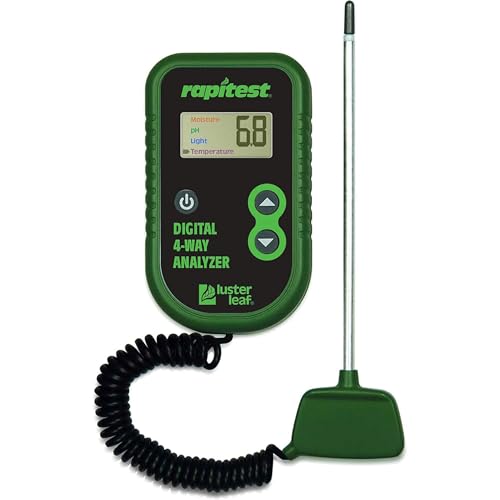
- Measures pH, moisture, temperature, and light
- Digital display is easy to read
- Includes guidance for 450+ plants
Best For: Gardeners wanting broad soil and plant-condition data
Best for Deep Soil Testing

- Long probe reaches deeper into soil
- Measures pH and moisture
- Self-powered and battery-free
Best For: Outdoor beds, lawns, orchards, and field use
Best Smart Monitoring Pick

- Digital readings without soil slurry preparation
- App supports automatic data storage
- Includes dibber, calibration powder, and batteries
Best For: App-connected monitoring for indoor plants and gardens
Best Long-Term Battery Pick
LAWNFUL Industrial-Grade Soil pH Meter

- Dedicated soil-only pH measurement
- Double-needle stainless-steel probes
- Includes AA batteries and one-year warranty
Best For: Portable soil testing with minimal upkeep
Best Multifunction Pick
4-in-1 Digital Soil Test Meter

- Measures pH, moisture, temperature, and sunlight
- Backlit display with rotating head
- Useful for indoor and outdoor plants
Best For: Whole-plant-care checks beyond soil pH
Most Versatile
High-Accuracy Digital Soil pH Meter

- Three-point calibration with manual adjustment
- Backlit LCD, temperature display, and alerts
- Alloy cap protects the probe
Best For: Gardeners needing a versatile digital meter for soil and liquids
Most Comprehensive

- Measures seven soil and environmental conditions
- Dual dials plus LCD temperature and humidity display
- Designed for indoor and outdoor plant care
Best For: Beginners managing multiple aspects of plant health
Best Simple Pick

- Reads soil moisture and pH simultaneously
- No batteries or function switching required
- Lightweight probe for indoor and outdoor use
Best For: Beginners seeking an affordable, easy soil-only tester
Best Budget 3-in-1 – SONKIR MS02 Soil Tester
For gardeners who want basic soil information without batteries, the SONKIR MS02 is a practical choice among soil ph meters. Its switchable functions check soil moisture, pH, and sunlight, making it useful for routine plant care indoors or outdoors. It is intended for soil testing only, not for measuring the pH of other liquids.
Best For: Home gardens, lawns, farms, and indoor or outdoor plant care.
Pros:
- Combines moisture, pH, and sunlight testing in one compact tool.
- Requires no battery; insert it into the soil and wait for the reading.
- Portable design is convenient for different garden areas.
Cons:
- The meter may not move if the soil is too dry, so watering may be necessary before testing.
- It cannot be used to test the pH of liquids.
The MS02 is a straightforward, low-maintenance option for gardeners who value several basic readings in one tool. Its simple design is best suited to general monitoring rather than specialized soil analysis.
Best for Precision Growing – Apera GroStar GS2 Soil pH Pen
The Apera GroStar GS2 is a specialized option among soil ph meters for growers who need direct testing in soil and other growing media. It measures pH and temperature in soil, coco coir, rockwool, and nutrient solutions, while its replaceable Swiss spear probe is designed for direct soil measurements.
Best For: Growers working with soil, coco coir, rockwool, or nutrient solutions who want a dedicated pH pen.
Pros:
- Designed for direct soil pH testing and nutrient-solution testing.
- Replaceable Swiss spear pH probe supports long-term use.
- Backlit display and grower-focused workflow support quick two-point calibration.
- TruRead mode provides average, maximum, and minimum readings across locations.
Cons:
- Probe maintenance is required, although the meter includes condition and calibration reminders.
- Its specialized design may be more than casual gardeners need.
With direct-media testing, temperature measurement, and guided calibration features, the GS2 is the strongest fit here for growers who need more controlled readings. The replaceable probe and maintenance reminders add practical value for ongoing use.
Best Digital Multi-Reading Tool – Rapitest 4-Way Analyzer
The Luster Leaf Rapitest 4-Way Digital Soil Analyzer is a versatile pick among soil ph meters for gardeners who want more than pH alone. Its digital output measures soil pH, moisture, temperature, and light, while the corded probe lets you position the probe and read the display at the same time.
Best For: Home gardeners who want four soil and growing-condition readings plus plant-specific guidance.
Pros:
- Measures pH, moisture, temperature, and light.
- Digital output is designed for easy reading.
- Corded probe makes handling and viewing the display more convenient.
- Includes a plant list covering more than 450 plants, along with gardening tips.
Cons:
- It provides several readings, which may be unnecessary for shoppers seeking only pH testing.
- The supplied notes do not indicate that it is battery-free.
This analyzer stands out for combining four useful measurements with reference material for a wide range of plants. It is a good fit when a digital, all-in-one approach is more useful than a basic pH-only meter.
Best for Deep Soil Testing – 295mm Electrode pH Meter
This 295mm-electrode model is a practical choice among soil ph meters when deeper penetration is useful. It measures soil pH and moisture, uses a slender metal probe for deeper access, and works without batteries across home gardens, lawns, orchards, vineyards, and field production.
Best For: Gardeners and maintenance users who need deeper soil access for pH and moisture checks.
Pros:
- Long 295mm electrode supports deep soil penetration.
- Measures both soil pH and moisture.
- Waterproof metal electrode and durable construction are suited to regular soil use.
- Self-powered operation requires no batteries.
Cons:
- Periodic calibration is recommended to maintain accuracy.
- Use is specified within a 5 to 50°C operating range.
- It does not provide the sunlight, temperature, or multi-function readings offered by some alternatives.
The long probe is the main reason to choose this model, particularly for deeper beds or broader outdoor applications. It offers a focused combination of pH and moisture testing without the need to manage batteries.
Best Smart Monitoring Pick – YINMIK Digital Soil pH Tester
For gardeners who want more than a one-time reading, this YINMIK soil pH meter delivers digital measurements directly from the soil and can connect to an app for automatic data storage. Its tapered stainless-steel dibber is designed for different growing media, while removing the dibber lets the meter test certain water-based plant solutions.
Best For: Indoor plant owners and gardeners who want app-connected monitoring plus soil and water testing flexibility.
Pros:
- Provides immediate digital soil pH readings without making a slurry.
- App connectivity supports automatic data storage and real-time checking.
- Includes a stainless-steel dibber, calibration powders, batteries, brush, dropper, and plant pH card.
Cons:
- Requires three LR44 batteries, though they are included.
- The app adds setup steps compared with a basic standalone meter.
This is a versatile choice among soil pH meters, particularly if you value recorded readings and want one device for soil plus compatible water testing. The included accessories also make it ready to use out of the box.
Best Long-Term Battery Pick – LAWNFUL Industrial-Grade Soil pH Meter
This LAWNFUL soil pH meter focuses on straightforward soil-only testing with an industrial-grade design, double-needle stainless-steel probes, and a calibration-free LCD display. It is a practical option for gardeners or researchers who want a portable device without liquid-testing functionality.
Best For: Users seeking a dedicated soil pH tester with a portable design, high-precision positioning, and long stated battery life.
Pros:
- Industrial-grade product with high-precision positioning for gardening, home, and lab research.
- Double-needle stainless-steel probes are described as sensitive and corrosion-resistant.
- Three included AA batteries are stated to support up to five years of use.
- Includes a one-year warranty and weighs 7.8 ounces.
Cons:
- Measures soil pH only and cannot test liquids.
- Its feature set is more specialized than multifunction soil testers.
Choose this model when dedicated soil measurement matters more than extra sensors. Its calibration-free display and included batteries keep the setup simple, while the soil-only limitation should be considered before buying.
Best Multifunction Pick – 4-in-1 Digital Soil Test Meter
If you want one tool to assess several growing conditions, this 4-in-1 meter combines soil pH, moisture, temperature, and sunlight readings. Its backlit LCD, rotating head, and simple probe-based operation make it convenient for checking indoor pots, gardens, farms, and outdoor plants.
Best For: New and experienced growers who want broader plant-care data alongside soil pH readings.
Pros:
- Measures soil moisture, pH, temperature, and sunlight intensity.
- Large backlit LCD and 0°–45° rotating head improve readability.
- Designed for quick readings after inserting the probe about four inches into the soil.
- Works for indoor and outdoor applications, including potted and succulent plants.
Cons:
- Four AAA batteries are required but not included.
- Cannot be used directly to test liquids.
- Very dry or hard soil should be watered and allowed to sit before testing.
This is a strong all-around choice for growers who want context around their soil pH rather than a single number. For more representative results, the instructions recommend taking readings from at least five locations and averaging them.
Most Versatile – High-Accuracy Digital Soil pH Meter
For shoppers seeking soil pH meters that can do more than check garden beds, this digital model combines pH testing with temperature readings and supports three-point calibration. Its backlit LCD, data hold, and alloy protective cap make it suited to regular testing across gardening and other applications.
Best For: Gardeners who want a versatile, calibratable digital meter for soil, water, plants, and other solutions.
Pros:
- Supports three-point calibration using acidic, neutral, and alkaline standards.
- Backlit LCD displays pH and real-time temperature readings.
- Red screen alert flags strongly acidic or alkaline readings.
- Zinc-alloy protective cap helps shield the probe during soil testing and storage.
Cons:
- Requires manual adjustment during precise calibration when readings do not match the standard solution.
- Probe should be rinsed after use and stored with sufficient KCl solution.
- Its broader liquid-testing capability may be more than needed for simple soil checks.
This is the most feature-rich option in the group, especially for users who value calibration control and a visible temperature display. It does require more maintenance than a basic analog soil tester, but that upkeep supports longer electrode life.
Most Comprehensive – 7-in-1 Soil and Plant Tester
If you want soil pH meters that also monitor broader growing conditions, this 7-in-1 tester combines soil pH, moisture, fertility, temperature, and light readings with air temperature and humidity. Its dual-dial and LCD design is aimed at beginners managing indoor or outdoor plants.
Best For: Beginners who want one tool for tracking several soil, plant, and surrounding-air conditions.
Pros:
- Measures soil moisture, pH, fertility, temperature, and light.
- Also displays air temperature and humidity on the LCD screen.
- Single probe is designed to be less disruptive to plant roots.
- Works for indoor and outdoor gardens, lawns, farms, and potted plants.
Cons:
- It is not a water moisture meter and should not be used to test liquids.
- Results may take three to five minutes to display.
- Requires all three batteries to be installed or replaced together.
This model is a strong choice when pH is only one part of your plant-care routine. Its extra readings add convenience, though shoppers focused solely on soil pH may prefer a simpler instrument.
Best Simple Pick – 2-in-1 Dual-Dial Soil Tester
Among soil pH meters, this 2-in-1 model keeps the basics straightforward: insert the single probe into soil and read moisture and pH simultaneously on two dials. It needs no batteries or function switching, making it a practical choice for routine checks in gardens and potted plants.
Best For: Beginners and budget-conscious gardeners who want simultaneous soil moisture and pH readings.
Pros:
- Displays soil moisture and pH at the same time.
- Requires no batteries and has no function switch to manage.
- Sturdy single probe is designed for repeated use with less root disruption.
- Suitable for indoor and outdoor gardens, greenhouses, farms, and potted plants.
Cons:
- Measures soil only and should not be used in water or other liquids.
- Not intended for very hard grass-covered ground.
- Provides fewer measurements than a multi-function digital tester.
This is the easiest option to use when you only need two core soil readings. Its battery-free dual-dial design favors convenience and affordability, while users wanting temperature, humidity, or data features will need a more advanced meter.
How We Picked These Soil Ph Meters
We focused on meters suited to common gardening tasks, including checking houseplant pots, vegetable beds, lawns, containers, and larger growing areas. The selection covers basic moisture-and-pH tools as well as dedicated digital testers and multipurpose analyzers.
Our evaluation criteria include the type of measurement, display readability, probe or electrode design, calibration requirements, replaceable parts, portability, and the clarity of the manufacturer’s intended use. Because soil testing conditions vary, we also considered whether each style is better suited to quick screening or repeatable, more controlled measurements.
Quick Comparison
| Meter Type | Best For | Main Advantage | Potential Limitation |
|---|---|---|---|
| Analog combination meter | Basic garden checks | Simple operation and no batteries | Less precise and slower to interpret |
| Digital multipurpose meter | Houseplants and general gardening | Easy-to-read results plus extra readings | More features do not always mean greater pH accuracy |
| Dedicated digital pH tester | Frequent or detailed testing | Typically better control and resolution | May require calibration and electrode care |
| Soil and nutrient-solution tester | Advanced gardeners and growers | More versatile testing capability | Higher cost and a steeper learning curve |
Key Buying Factors for Soil Ph Meters
Accuracy and Calibration
Check whether the meter supports calibration and whether calibration solutions are included. A calibration-capable digital tester is generally preferable when pH decisions affect fertilizing, growing media, or sensitive plants. Follow the instructions closely; an uncalibrated meter can produce misleading confidence.
Probe Design and Soil Preparation
Probe quality matters because soil can be compacted, dry, rocky, or unevenly mixed. Use a clean insertion point and avoid forcing a probe into hard ground. Some instruments are designed for direct soil testing, while others work best with a prepared soil-water slurry or nutrient solution.
Readability and Measurements
A backlit LCD can help in greenhouse or indoor conditions. Decide whether you need only pH or also moisture, temperature, light, fertility, or humidity. Extra sensors are useful for routine plant care, but they should not replace a reliable pH measurement system.
Maintenance and Operating Cost
Look for replaceable electrodes when frequent use is expected. Rinse probes after testing, store them as directed, and never leave a pH electrode dry if the manufacturer specifies storage solution. Battery requirements and water resistance are also worth checking before purchase.
Who Should Buy Which Soil Ph Meters?
For Occasional Garden Checks
Choose a straightforward analog or basic digital meter if you want quick guidance for beds, lawns, or a few containers and do not need laboratory-level repeatability.
For Houseplants and Indoor Growing
A compact digital multipurpose tester with a readable screen and moisture measurement is convenient for checking pots, especially when watering habits are the main concern.
For Serious Gardeners and Frequent Testing
Choose a dedicated digital soil pH tester with calibration support, a dependable electrode, and clear maintenance instructions. This is the better direction when you regularly adjust soil or manage plants with narrow pH preferences.
For Advanced or Mixed Testing
If you test both soil and nutrient solutions, prioritize a purpose-built instrument with replaceable components and documented operating procedures rather than choosing solely by the number of advertised functions.