Overwatering and underwatering are easier to prevent when you can check soil conditions before reaching for the watering can. The best wireless soil moisture meters provide convenient readings for houseplants, raised beds, lawns, and greenhouse crops.
This roundup compares ten options across sensor design, monitoring range, connectivity, display features, and installation style so you can choose a meter that fits your plants and routine.
Best 10 Wireless Soil Moisture Meters Picks for 2026
Best Long-Range Monitor
4-in-1 Wireless Soil Moisture Meter

- Moisture, temperature, light, and clock display
- Up to 328-foot wireless range
- Supports up to 12 sensors per display
Best For: Monitoring multiple indoor and outdoor plants remotely
Best for Deep Soil
Ecowitt WH51L Wireless Soil Sensor

- 1-meter probe reaches deep soil
- Built-in LCD shows current moisture
- Works with Ecowitt gateways and consoles
Best For: Deep containers, raised beds, and Ecowitt system users
Best Smart Alerts
RainPoint Wi-Fi Soil Moisture Kit

- Includes sensor and Mini Wi-Fi Hub
- Sends customizable app alerts
- Supports expansion to 39 RainPoint devices
Best For: App-based monitoring and future watering automation
Best Simple Value
2-Pack Long-Probe Moisture Meters

- Battery-free analog operation
- Extra-long probes for deep pots
- Two meters with immediate readings
Best For: Simple manual checks without apps or batteries
Best Wireless Pick
EDGEVEIL 4-in-1 Wireless Soil Moisture Meter
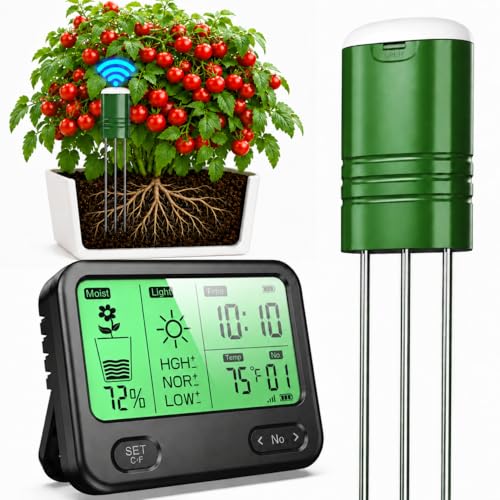
- Up to 328-foot wireless range
- Tracks moisture, temperature, light, and time
- Supports up to 12 sensors per display
Best For: Monitoring multiple indoor and outdoor plants remotely
Best Simple Option
XLUX Battery-Free Soil Moisture Meter

- No batteries or charging required
- Clear 10-scale color-coded dial
- Slim probe helps limit root disturbance
Best For: Simple, direct moisture checks without electronics
Best Smart Two-Pack
RAINPOINT Wireless Soil Moisture Sensors

- Includes two leave-in moisture sensors
- Checks moisture automatically every three minutes
- Optional app monitoring requires a separate Wi-Fi hub
Best For: Frequent monitoring of two plants or growing areas
Best for Multi-Zone Garden Monitoring
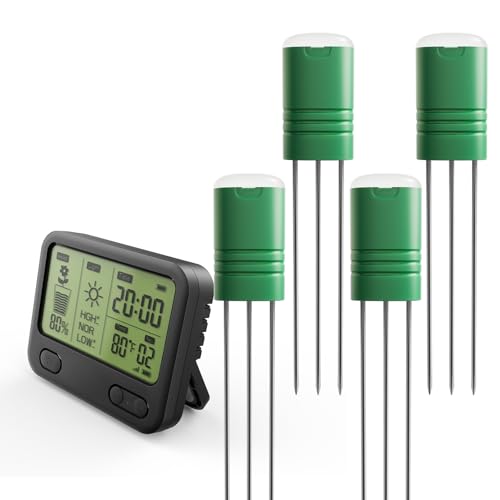
- Expandable monitoring for up to 12 zones
- TDR probes measure moisture, temperature, and light
- 230-foot open-area range with dry-zone alerts
Best For: Tracking multiple garden areas from one indoor receiver
Best for App-Connected Houseplants

- Checks moisture automatically every three minutes
- Capacitive probe is designed for long-term use
- Optional app monitoring requires a RAINPOINT Wi-Fi hub
Best For: Leave-in monitoring of houseplants and garden beds
Best for Simple No-App Monitoring

- Four sensors track plants from one indoor receiver
- Measures moisture, temperature, and light
- Auto-pairs and uses no app or Wi-Fi
Best For: Multi-plant monitoring with simple receiver-based setup
Best Long-Range Monitor – 4-in-1 Wireless Soil Moisture Meter
For gardeners who want wireless soil moisture meters that cover more than watering needs, this EDGEVEIL model combines moisture, temperature, sunlight, and clock data on a large screen. Its stated range of up to 328 feet and expandable sensor system make it practical for monitoring plants across a home, balcony, garden, or yard.
Best For: Indoor and outdoor gardeners managing multiple plants from a central display.
Pros:
- Displays soil moisture, temperature, light level, and time together.
- Wireless range is listed at up to 328 feet.
- One display can connect with up to 12 sensors.
- Triple-probe TDR technology and a waterproof, corrosion-resistant probe support continuous monitoring.
Cons:
- Requires two AAA batteries.
- The product title and notes include an unrelated soil probe rod listing, so buyers should verify the package contents.
This is a versatile choice when remote viewing and broader plant-condition information matter more than a basic spot check. The large display and low-moisture alert should also make routine monitoring easier for beginners.
Best for Deep Soil – Ecowitt WH51L Wireless Soil Sensor
The Ecowitt WH51L is a specialized option among wireless soil moisture meters, using a 1-meter wired probe to reach deeper soil than many compact sensors. It includes an LCD for local readings, while app-based monitoring requires a compatible Ecowitt Wi-Fi gateway or display console sold separately.
Best For: Gardeners who need deeper soil readings and already use, or plan to build, an Ecowitt monitoring system.
Pros:
- 1-meter probe wire can measure soil moisture at depths approaching 80 cm.
- Built-in LCD displays real-time moisture data.
- IP68-rated probe offers strong water protection.
- Supports up to eight WH51L sensors with compatible Ecowitt gateways or consoles.
Cons:
- Wi-Fi app monitoring requires a gateway sold separately.
- Compatible display consoles are also sold separately.
- Requires attention to placement: the sensor body should sit at least 20 cm above the soil surface for better RF transmission.
This sensor is best viewed as a modular component rather than a complete smart-garden kit. Its long probe and LCD are useful for raised beds, deep containers, and garden soil, but the additional Ecowitt hardware adds setup cost and complexity.
Best Smart Alerts – RainPoint Wi-Fi Soil Moisture Kit
This RainPoint kit adds app connectivity to wireless soil moisture meters, pairing a leave-in sensor with a Mini Wi-Fi Hub Gen2. It provides readings every minute, customizable high- and low-moisture thresholds, and push or email notifications when plants need attention.
Best For: Connected plant care, shared household monitoring, and users interested in expanding toward automatic watering.
Pros:
- Includes a soil sensor and Mini Wi-Fi Hub Gen2.
- Provides real-time readings and logs moisture changes over time.
- Custom high- and low-moisture alerts can help prevent overwatering and underwatering.
- Can integrate with up to 39 RainPoint devices for an automated watering setup.
Cons:
- Wi-Fi features require a compatible 2.4 GHz RainPoint hub connection.
- Batteries are not included.
- More setup is involved than with a simple standalone dial meter.
For people who want notifications rather than occasional manual checks, this is one of the more feature-rich choices. Its soil-type selection and capacitive sensor are designed to support more tailored readings, while the hub opens the door to broader RainPoint automation.
Best Simple Value – 2-Pack Long-Probe Moisture Meters
These battery-free XLUX meters offer a straightforward alternative to wireless soil moisture meters. Insert a probe into the soil and read the immediate result on the large analog dial, with an extra-long probe designed to reach deeper into larger pots and garden soil.
Best For: Budget-minded plant owners who want quick, manual readings without batteries, apps, or wireless setup.
Pros:
- Battery-free operation keeps the design simple.
- Extra-long probe reaches the bottom of deeper pots.
- Large dial uses three zones and ten scales for quick interpretation.
- Two meters allow testing in separate pots or garden areas.
Cons:
- Not a wireless or continuous-monitoring solution.
- Should not be left in soil for more than five minutes because the metal tip may corrode.
- Not intended for very hard soil, water, or other liquids.
This two-pack is a practical pick when simplicity matters more than remote data. It provides an immediate moisture reading with no batteries to replace, but it requires removing and cleaning the probe after each test.
Best Wireless Pick – EDGEVEIL 4-in-1 Wireless Soil Moisture Meter
Among wireless soil moisture meters, the EDGEVEIL stands out for gardeners who want readings without checking every pot individually. It combines moisture, temperature, light, and time data on a large screen, while its wireless range lets you monitor plants from up to 328 feet away.
Best For: Indoor and outdoor gardeners managing multiple plants from a central display.
Pros:
- Wireless range of up to 328 feet for convenient remote checking.
- Measures moisture, temperature, light, and real-time clock data.
- Triple-probe TDR technology and a waterproof, corrosion-resistant probe.
- One display can connect with up to 12 sensors.
Cons:
- Requires two AAA batteries.
- More features may be unnecessary for shoppers seeking a simple moisture-only meter.
The EDGEVEIL is a feature-rich choice for larger plant collections, especially if you value continuous monitoring and wireless convenience over a basic handheld reading.
Best Simple Option – XLUX Battery-Free Soil Moisture Meter
For shoppers who do not need wireless connectivity, the XLUX offers a straightforward alternative to wireless soil moisture meters. Its battery-free design provides an immediate reading through a large, color-coded dial, making it easy to check moisture directly at the plant.
Best For: Beginners and gardeners who want a simple, battery-free moisture check for indoor or outdoor soil.
Pros:
- Requires no batteries or charging.
- Large dial with 10 dry-to-wet scales for quick interpretation.
- Slim single probe is designed to minimize soil disturbance around roots.
- 304 stainless steel probe is described as anti-rust.
Cons:
- Not wireless or designed for continuous leave-in monitoring.
- Must be inserted, read, and removed within five minutes.
- For soil use only; it should not be used in liquids.
The XLUX is a practical pick when reliability and simplicity matter more than remote alerts or multi-sensor monitoring. Its battery-free operation also keeps ongoing maintenance minimal.
Best Smart Two-Pack – RAINPOINT Wireless Soil Moisture Sensors
The RAINPOINT two-pack is a strong choice among wireless soil moisture meters for gardeners who want frequent readings and app-based monitoring. Each sensor automatically checks moisture every three minutes and displays the result on an LCD, while remote access requires a compatible RAINPOINT Wi-Fi hub sold separately.
Best For: Gardeners monitoring two plants or growing areas who want leave-in sensors and optional app access.
Pros:
- Two sensors are included in the set.
- Automatic moisture detection every three minutes plus manual readings.
- Capacitive probe is designed to resist rust-related accuracy loss.
- IPX5 waterproof protection supports indoor and outdoor use.
Cons:
- Remote monitoring requires a compatible 2.4 GHz Wi-Fi hub sold separately.
- App functionality depends on the RAINPOINT Home system.
- It focuses on soil moisture rather than offering a broader multi-function display.
RAINPOINT makes sense for shoppers who want automated, leave-in readings and may later add hub-based remote monitoring. Factor in the separate hub requirement before choosing it for a connected garden setup.
Best for Multi-Zone Garden Monitoring – 3-Probe Wireless Soil Sensor
This expandable system is a strong choice among wireless soil moisture meters when you want one indoor display for multiple planting areas. Its included sensors track moisture, temperature, and light, while the receiver can support up to 12 zones.
Best For: Gardeners monitoring raised beds, potted plants, lawns, and vegetable rows from indoors.
Pros:
- Expandable to 12 monitoring zones.
- TDR technology and stainless-steel triple probes are designed for stable readings across different soil conditions.
- 230-foot open-area RF range, moisture alerts, and an IPX5 waterproof sensor design.
- Batteries are included, with an advertised 8–12 months of runtime.
Cons:
- Wireless range can decrease when walls or other obstacles intervene.
- Designed for soil use, not liquids or loose media such as pure perlite, coco coir, or gravel.
- The system begins with two included wireless sensors; additional zones require expansion.
Choose this model if centralized, multi-zone monitoring matters more than app connectivity. Its receiver-based design avoids Wi-Fi setup and adds configurable dry-zone alerts for routine garden care.
Best for App-Connected Houseplants – Smart Capacitive Soil Meter
This RAINPOINT meter is a practical option among wireless soil moisture meters for gardeners who want frequent readings without removing the probe. It checks soil moisture automatically every three minutes and displays the result on its LCD; remote app monitoring requires a compatible RAINPOINT Wi-Fi hub sold separately.
Best For: Houseplant owners and gardeners who want leave-in monitoring with optional app access.
Pros:
- Automatic moisture detection every three minutes, plus on-demand manual readings.
- Capacitive probe avoids the rust concerns associated with traditional resistive probes.
- IPX5 waterproof protection supports indoor and outdoor use.
- Includes pH test strips and a Phillips screwdriver.
Cons:
- Remote monitoring requires a compatible 2.4 GHz RAINPOINT Wi-Fi hub sold separately.
- The supplied notes describe moisture monitoring rather than temperature or light measurements.
- App features depend on using a supported hub.
This is the better fit if you prefer a compact leave-in sensor and may want smartphone access later. For basic local checks, the built-in LCD works without adding the optional hub.
Best for Simple No-App Monitoring – 4-Sensor Plant Monitor
This receiver-based system suits shoppers seeking wireless soil moisture meters without app pairing. It includes four sensors and an indoor display for moisture, temperature, and light data, with automatic pairing and a visual alert when moisture falls below the set limit.
Best For: Indoor and outdoor plant owners who want multi-sensor monitoring without Wi-Fi or Bluetooth.
Pros:
- Includes four sensors and a receiver for monitoring multiple plants or areas.
- 230-foot stated range and an easy-to-read indoor digital screen.
- IPX5 waterproof construction supports use in rain and sprinklers.
- Auto-pairs out of the box, and batteries are included with an advertised 8–12 month lifespan.
Cons:
- Requires standard AA/AAA batteries, with premium alkaline batteries recommended for stable performance.
- Compacted or rocky soil should be loosened before inserting the 6.3-inch probe.
- It does not provide app-based monitoring.
Pick this model when straightforward setup and four-sensor coverage are priorities. Its receiver and flashing moisture alert provide at-a-glance guidance while avoiding Wi-Fi drops and Bluetooth pairing.
How We Picked These Wireless Soil Moisture Meters
We focused on the features that matter most in everyday plant care: moisture-reading consistency, probe design, wireless range, display clarity, sensor durability, and setup requirements. The selection includes Wi-Fi systems that can send alerts, RF models with dedicated LCD receivers, multi-sensor kits for covering several pots, and battery-free meters designed for simple spot checks.
We also considered whether each meter is intended for indoor plants, outdoor beds, or both. Some products require a compatible gateway or hub, while others work as standalone monitors. Checking that requirement before buying can prevent compatibility surprises.
Quick Comparison
| Type | Best for | What to look for |
|---|---|---|
| Wi-Fi sensor and hub kits | Remote monitoring and alerts | Gateway compatibility, app features, and network setup |
| RF sensor systems | Local monitoring across multiple pots | Receiver range, probe count, and display readability |
| Multi-function testers | Basic plant and garden diagnostics | Moisture, temperature, and light measurements |
| Battery-free meters | Low-maintenance spot checks | Probe length, insertion depth, and reading simplicity |
Key Buying Factors for Wireless Soil Moisture Meters
Connectivity and Range
Wi-Fi models are the better choice when you want alerts or readings while away from home, but they commonly need a dedicated hub. RF systems usually provide a simpler connection to a nearby LCD receiver and can work well in homes, patios, and small gardens. Confirm the advertised range is realistic for walls, floors, and outdoor obstructions.
Probe Design and Placement
Long probes are useful for deep containers, outdoor planters, and larger beds. Capacitive probes are often designed for leave-in monitoring and can reduce the corrosion concerns associated with some exposed metal probes. Avoid forcing a probe into compacted soil, which can damage the sensor or roots.
Sensor Coverage and Measurements
A single sensor may be enough for one plant, while a two-, three-, or four-probe kit can monitor different pots or soil zones at once. Moisture is the essential reading, but temperature and light data can help explain why a plant is drying quickly or growing poorly.
Power, Alerts, and Weather Resistance
Battery-free meters require less maintenance but generally offer fewer connected features. Smart models may provide low- and high-moisture alerts, though batteries and hubs add upkeep. For outdoor use, check waterproofing claims and protect receivers or gateways from direct exposure.
Who Should Buy Which Wireless Soil Moisture Meters?
Choose a Wi-Fi hub kit if you care about remote access, scheduled checks, or automatic moisture alerts for valuable houseplants. Pick an RF receiver system if you want several sensors with an easy-to-read local display and no dependence on a home network. A multi-function 4-in-1 tester suits gardeners who want moisture readings alongside soil temperature and light information. Battery-free long-probe meters are best for straightforward, occasional checks where simplicity matters more than app access.