The right bench vise gives you a stable third hand for sawing, drilling, filing, assembly, and repair work. The best choice depends on more than jaw width: mounting strength, swivel range, throat depth, materials, and clamping capacity all affect real-world performance.
We compared 10 popular bench vises across compact homeowner models, heavy-duty workshop options, pipe-capable designs, and flexible articulating vises to help you match the tool to your bench and typical projects.
Best 10 Bench Vises Picks for 2026
Best Home Workshop Pick

- 4.5-inch jaws and 3-inch opening
- 240-degree swivel head with anvil
- 30,000 PSI gray iron construction
Best For: Home workshops and general DIY repairs
Best Straightforward 4-Inch Option

- 4-inch jaws and 4-inch opening
- 72,000 PSI ductile iron construction
- Large anvil for forming work
Best For: General workshop and forming tasks
Best Heavy-Duty Pick
Forward DT08125A 5-Inch Bench Vise
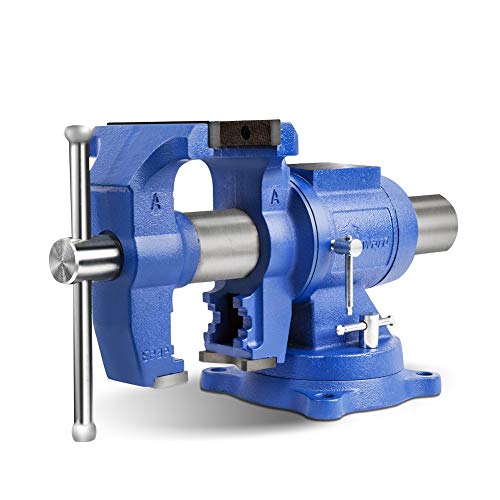
- 5-inch jaws and 5-inch opening
- 360-degree rotating head and swivel base
- 5,500-pound stated clamping force
Best For: Heavy-duty DIY and industrial work
Best Multi-Jaw Value
WORKPRO 4.5-Inch Combination Vise

- Multi-jaw design holds flat stock and pipes
- 240-degree swivel locking base
- Up to 2,204 pounds of clamping force
Best For: Home workshops and varied woodworking projects
Best for Easy Setup
VEVOR 6.5-Inch Swivel Bench Vise

- 5,620-pound stated clamping force
- 360-degree rotating head and base
- Pipe jaws, V-jaws, anvil, and magnetic pads
Best For: Heavy-duty pipe repair, metalworking, and larger workpieces
Best Traditional Workshop Pick
PONY 4-Inch Heavy-Duty Bench Vise
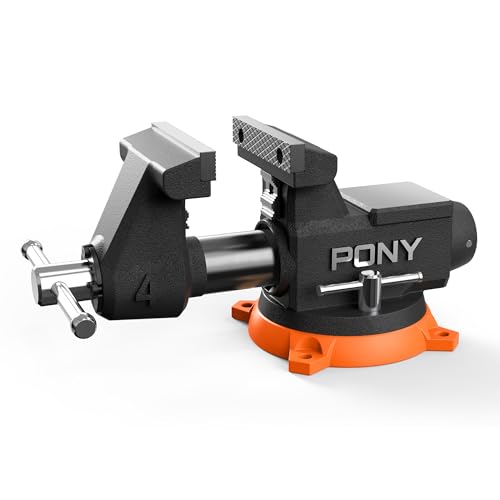
- 4,400-pound stated clamping force
- 360-degree swivel base and built-in anvil
- Replaceable pipe jaws and mounting hardware included
Best For: General garage and professional workshop tasks
Best Multi-Angle Pick
WORK IQ TOOLS IQ Articulating Bench Vise

- 360-degree ball-and-socket articulation
- Eight locking positions rated to 130 ft-lbs
- Swappable jaw pads for varied materials
Best For: Multi-angle repairs, woodworking, gunsmithing, and hobbies
Heavy-Duty All-Rounder

- 60,000 PSI ductile iron body with powder-coated finish
- 360° swivel base and replaceable serrated jaws
- Includes mounting hardware and magnetic jaw pads
Best For: General workshop drilling, cutting, grinding, and pipe work
Maximum Jaw Range

- 6.5-inch forward and 9.3-inch reverse openings
- 60,000 PSI ductile iron with 4,496-lb clamping force
- 360° swivel base with pipe-jaw capability
Best For: Larger workpieces and projects needing extra jaw opening
Compact Pipe Specialist

- 5-inch jaws with 5-inch maximum opening
- Built-in pipe jaw for 0.59–2.36-inch round stock
- Four-bolt mounting and 360° rotating base
Best For: Compact workshops and frequent round-pipe clamping
Best Home Workshop Pick – Yost LV-4 Homeowner's Vise
For home workshops and light-to-moderate DIY tasks, the Yost LV-4 is a practical choice among bench vises. Its 4.5-inch jaws, 3-inch opening, 240-degree swivel, and cast gray iron construction provide useful holding capacity without an overly large footprint.
Best For: Home workshops, general repairs, and woodworking tasks that benefit from a swivel base and built-in anvil.
Pros:
- 4.5-inch jaws with a 3-inch maximum opening
- 240-degree rotating vise head and 3.5-by-2.7-inch anvil
- 30,000 PSI gray iron construction
Cons:
- Mounting hardware is not included
- Smaller pipe capacity than some larger bench vises
The LV-4 offers a useful balance of size, adjustability, and home-shop functionality. Confirm your workbench can accommodate the mounting requirements before buying.
Best Straightforward 4-Inch Option – Wilton Apprentice 4-Inch Vise
The Wilton Apprentice is a straightforward 4-inch vise for users who want useful jaw capacity and a substantial work surface. Its 4-inch opening, ductile iron construction, and large anvil make it suitable for varied workshop applications.
Best For: General workshop jobs, hammering and forming, and projects requiring a 4-inch jaw opening.
Pros:
- 4-inch jaw width and 4-inch maximum opening
- 72,000 PSI ductile iron provides added toughness
- Large anvil surface for hammering and forming
Cons:
- No swivel-base feature is specified in the supplied details
- Pipe capacity is limited to 1/8 to 2 inches
This vise keeps the feature set focused while offering strong material specifications and a generous opening. It is a sensible pick when a fixed, general-purpose bench vise meets your needs.
Best Heavy-Duty Pick – Forward DT08125A 5-Inch Bench Vise
For demanding clamping work, the Forward DT08125A stands out among bench vises with a 5-inch jaw width, 5-inch opening, and stated 5,500-pound clamping force. Its ductile iron body, rotating head, swivel base, and multiple jaw sets add substantial versatility.
Best For: Heavy-duty DIY or industrial work involving grinding, cutting, tapping, pipes, and awkwardly positioned workpieces.
Pros:
- 5-inch jaws, 5-inch opening, and 2.6-inch throat depth
- 360-degree rotating head and swivel base
- Top, pipe, and V-jaws support varied workpieces
- Large reinforced anvil and stated 5,500-pound clamping force
Cons:
- 33-pound weight may require a robust workbench
- Larger size is less convenient for compact work areas
This is the most capability-focused option in the group. Its weight and multi-jaw design favor users who need high clamping force and positioning flexibility rather than a compact home vise.
Best Multi-Jaw Value – WORKPRO 4.5-Inch Combination Vise
The WORKPRO combination vise is a flexible option for home workshops and woodworking projects. Its 4.5-inch jaws, 4-1/4-inch opening, multi-jaw design, and 240-degree swivel help hold both flat materials and pipes or tubes.
Best For: Home users and small workshops that need one vise for flat stock, pipes, tubing, and general woodworking.
Pros:
- Multi-jaw design accommodates flat materials and pipes
- 240-degree swivel locking base
- 4.5-inch jaws with a 4-1/4-inch opening
- Stated clamping force of up to 2,204 pounds
Cons:
- Iron construction is less specifically rated than the Forward model
- Its 4.8 kg weight may be lighter for especially demanding work
The WORKPRO emphasizes versatility and approachable installation. It is a strong fit when varied jaw configurations matter more than maximum heavy-duty capacity.
Best for Easy Setup – VEVOR 6.5-Inch Swivel Bench Vise
For demanding bench vise work, the VEVOR combines a wide 6.5-inch jaw, substantial ductile cast iron construction, and up to 5,620 pounds of stated clamping force. Its rotating head and base make it a flexible choice for pipe repair, metalworking, woodworking, and other projects requiring adjustable positioning.
Best For: Heavy-duty workshop tasks, pipe repair, metalworking, and projects involving larger or irregularly shaped workpieces.
Pros:
- 6.5-inch jaws open up to 5 inches for larger workpieces.
- 360-degree vertical and horizontal rotation helps position work from multiple angles.
- Pipe jaws, V-jaws, a large anvil, and included magnetic jaw pads support varied applications.
- Ductile cast iron construction and included mounting bolts suit demanding use.
Cons:
- At 38.9 pounds, it is less convenient to move around than a lighter vise.
- Its larger industrial design may be more than needed for small, light-duty projects.
The VEVOR is a strong fit when capacity, clamping strength, and positioning flexibility matter most. Choose it for a substantial workshop vise rather than a compact bench-top option.
Best Traditional Workshop Pick – PONY 4-Inch Heavy-Duty Bench Vise
The PONY is a practical bench vise for home garages and professional workshops, pairing a 4-inch jaw with 4,400 pounds of stated clamping force. Its 360-degree swivel base, replaceable pipe jaws, and integrated anvil cover common woodworking, drilling, pipe-cutting, and metalworking needs.
Best For: General workshop use where a durable, versatile vise with a swivel base and anvil is needed.
Pros:
- 4,400 pounds of stated clamping force handles heavy-duty tasks.
- 360-degree rotatable base makes it easier to adjust the working angle.
- Ductile iron construction is specified with 6,000 PSI tensile strength.
- Enclosed rear design, replaceable pipe jaws, mounting hardware, and anvil add practical utility.
Cons:
- The 4-inch jaw is smaller than the VEVOR’s 6.5-inch jaw.
- Its compact dimensions may limit capacity for especially large workpieces.
The PONY offers a balanced combination of strength, adjustability, and everyday workshop features. It is a sensible choice for users who want a conventional heavy-duty bench vise without the larger footprint of a 6.5-inch model.
Best Multi-Angle Pick – WORK IQ TOOLS IQ Articulating Bench Vise
The IQ Vise takes a different approach to bench vise flexibility with a 360-degree articulating ball-and-socket mechanism and eight locking positions. Its 5-inch parallel jaws, swappable pads, and quick-cam lever make it especially useful when repair, woodworking, gunsmithing, or hobby projects require frequent angle changes.
Best For: Multi-angle repairs, woodworking, gunsmithing, and detailed hobby work using varied jaw-pad materials.
Pros:
- Rotates, tilts, and swivels to position work at different angles.
- Eight fixed positions are rated for up to 130 ft-lbs of torque.
- 5-inch parallel jaws accept interchangeable pads for standard, odd-shaped, or delicate workpieces.
- Hardened steel and cast aluminum construction weighs 10 pounds and bolts to a workbench.
Cons:
- Additional Sure-Fit or leather jaws and IQ Connect accessories are sold separately.
- Its stated 130 ft-lb rating may not suit every extremely high-force application.
The IQ Vise is the most specialized option here, prioritizing positioning and accessory flexibility over traditional heavy cast-iron bulk. It is a compelling bench vise for detailed work where changing angles quickly is more important than maximum clamping capacity.
Heavy-Duty All-Rounder – 6-Inch Swivel Bench Vise
For shoppers comparing bench vises for general workshop use, this 6-inch VEVOR model combines a ductile iron body, a 360-degree swivel base, and a built-in anvil. Its serrated replaceable jaws handle flat stock and pipe, while the included mounting hardware and magnetic jaw pads simplify setup.
Best For: General-purpose drilling, cutting, sharpening, grinding, and tapping where flexible positioning and strong clamping are useful.
Pros:
- 60,000 PSI ductile iron construction with a powder-coated finish.
- 6-inch jaws open to 5.9 inches and provide up to 4,496 pounds of clamping force.
- 360-degree swivel base, 2.9-by-3-inch anvil, and pipe clamping from 0.6 to 2.9 inches.
- Includes M10 bolts, nuts, and magnetic nylon jaw pads.
Cons:
- At 25 pounds, it may be more vise than needed for lightweight benches or small jobs.
- The supplied dimensions and 6-inch jaw size require adequate bench space.
Choose this model if you want one of the more versatile bench vises for mixed material work. Its swivel range and pipe capability add flexibility, while the ductile iron body supports demanding applications.
Maximum Jaw Range – 6.5-Inch Reverse-Opening Vise
This VEVOR model stands out among bench vises for its wide 6.57-inch jaws and unusually large reverse opening. The ductile iron construction, swivel base, pipe-jaw capability, and included hardware make it suited to substantial workpieces and varied workshop tasks.
Best For: Users who need extra jaw capacity for larger flat materials, reverse clamping, and pipe or tube work.
Pros:
- 6.57-inch jaw width with a 6.5-inch forward opening and 9.3-inch reverse opening.
- 60,000 PSI ductile iron construction and up to 4,496 pounds of clamping force.
- 360-degree swivel locking base and a 2.8-by-3-inch anvil.
- Handles pipe from 0.6 to 2.8 inches and includes bolts, nuts, and magnetic jaw pads.
Cons:
- Its 27-pound weight and large jaw capacity may be excessive for compact workbenches.
- The reverse-opening mechanism is most useful when your projects require that added range.
Among these bench vises, this is the capacity-focused option. Its reverse opening gives it a clear advantage for oversized workpieces, while the swivel base and pipe jaws preserve everyday versatility.
Compact Pipe Specialist – 5-Inch Swivel Bench Vise
For buyers seeking bench vises with a smaller footprint, this 5-inch VEVOR model offers a practical balance of capacity and portability. It uses a four-bolt mounting design, rotates 360 degrees, and includes a dedicated pipe-jaw function for round stock.
Best For: Compact workshops and users who regularly clamp round pipes while still needing a general-purpose vise.
Pros:
- 5-inch jaws open to 5 inches and deliver up to 4,496 pounds of clamping force.
- Dedicated pipe jaw securely accommodates round stock from 0.59 to 2.36 inches.
- 360-degree rotating base and four-bolt mounting design support positioning and stability.
- Includes magnetic jaw pads, M10 nuts, and M10-by-50 bolts.
Cons:
- Its 5-inch jaw width and opening provide less capacity than the larger models here.
- The anvil surface is smaller at 2.17 by 2.36 inches.
Pick this vise when bench space and pipe handling matter more than maximum jaw size. At 17.5 pounds, it is the lightest option in this selection while retaining a ductile iron body and useful swivel adjustment.
How We Picked These Bench Vises
We focused on the features that matter most during everyday workshop use: jaw width and opening, throat depth, base design, construction, clamping force, anvil area, and the range of work each vise can hold. We also included different sizes and price categories rather than treating the largest vise as automatically the best choice.
Specifications can vary by seller or production run, so confirm the manufacturer’s current measurements before ordering. Most importantly, consider whether your workbench can safely support the vise and the force you expect to apply.
Quick Comparison
| Best For | What to Look For |
|---|---|
| Home repairs and light projects | 4- to 4.5-inch jaws, compact footprint, swivel base |
| General workshop use | 4- to 5-inch jaws, rigid mounting, replaceable jaws |
| Heavy metalwork | 6-inch-plus jaws, ductile iron construction, high clamping force |
| Pipe and irregular stock | Pipe jaws or multipurpose jaw configuration |
| Angled and detail work | Articulating or multi-position head |
Key Buying Factors for Bench Vises
Jaw Width and Opening
Jaw width affects the size of the workpiece the vise can support, while maximum opening determines how far apart the jaws can spread. Four-inch models are often sufficient for household repairs and smaller woodworking tasks. Choose 5- or 6-inch jaws for larger stock, fabrication, and more demanding metalwork.
Mounting and Swivel Design
A vise is only as useful as its attachment to the bench. Check the mounting-hole pattern, hardware requirements, and available bench space. A 360-degree swivel base makes it easier to position work, but the locking mechanism must tighten securely without noticeable movement.
Construction and Clamping Force
Cast or ductile iron bodies generally provide useful rigidity, but construction quality and mounting still matter more than a headline force rating alone. High-force models are appropriate for tough work, provided the bench, fasteners, and workpiece can handle the load.
Throat Depth, Jaws, and Extra Features
Greater throat depth supports taller pieces below the jaws. Replaceable or interchangeable jaw plates can extend service life and let you use softer or specialized surfaces. Anvils are convenient for light striking and shaping, while pipe jaws help secure round stock without crushing it.
Who Should Buy Which Bench Vises?
Choose the Yost or Wilton compact models for light-duty home maintenance, hobby work, and smaller benches. A WORKPRO or PONY vise suits general-purpose users who want a practical balance of size, versatility, and price. The Forward and larger VEVOR models are better suited to metalworking, fabrication, drilling, and larger workpieces, assuming your bench is strong enough for them.
For unusual angles, frequent repositioning, or precision hobby work, the WORK IQ TOOLS articulating vise offers a more flexible setup than a conventional fixed-head design. Before buying, measure your bench, confirm the vise’s mounting pattern, and leave enough clearance to operate the handle and rotate the base.