Applying compost evenly can improve lawn and garden coverage while reducing the time and effort required for manual spreading. The best tow-behind compost spreaders offer a practical way to topdress larger areas from an ATV, UTV, lawn tractor, or by hand.
This roundup compares 10 models across working width, capacity, adjustability, construction, and push-or-tow versatility so you can choose a spreader suited to your property and materials.
Best 10 Tow Behind Compost Spreaders Picks for 2026
Best Large-Capacity Broadcast Spreader
Agri-Fab 130-Pound Pull-Behind

- 130-pound hopper for large areas
- Spreads up to 12 feet wide
- Works with most riding mowers
Best For: Broad lawn coverage with seed, fertilizer, salt, or ice melt
Best Dual-Mode Option
TEMFAR 44-Inch Compost Spreader

- Push or tow for flexible operation
- Powder-coated high-strength steel
- Mesh basket breaks clumps and filters debris
Best For: Small and large areas requiring compost or peat moss spreading
Best Aerating Combination
Brinly 40-Inch Aerator Spreader
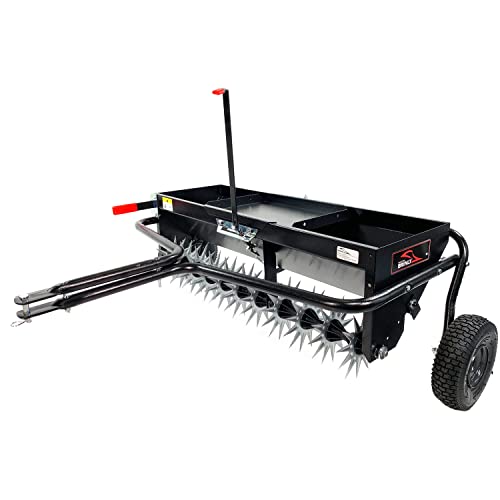
- Spreads while aerating soil
- 100-pound steel hopper
- Weight tray adds up to 75 pounds
Best For: Lawn renovation using seed, fertilizer, or lime
Wide-Coverage Towable
Dapper Supply 44-Inch Compost Spreader

- 44-inch mesh drum for broad coverage
- Push or tow behind lawn equipment
- Powder-coated steel with one-year warranty
Best For: Large lawns and flexible push/tow use
Compact Manure Specialist
Titan Attachments 8.7-Cubic-Foot Spreader

- 8.7-cubic-foot, 200-pound rated capacity
- Ground-driven spreading with adjustable opening
- All-terrain wheels and ATV/UTV towing
Best For: Small barns, stalls, and manure handling
Adjustable Push-Tow Pick
VEVOR 44-Inch Compost Spreader

- 44-inch width with 7.2-cubic-foot capacity
- Four adjustable handle-height settings
- Pushes or tows behind tractors and ATVs
Best For: Versatile lawn topdressing and seeding
Flexible Lawn Care
TEMFAR 36-Inch Push/Tow Compost Spreader
- Push or tow behind a tractor or riding mower
- 36-inch steel basket for broader coverage
- Mesh screen helps filter clumps and debris
Best For: Homeowners needing both manual and tow-behind operation
High-Capacity Coverage
VEVOR 130-LB Tow-Behind Broadcast Spreader

- 130-pound hopper reduces refill frequency
- 30 settings and up to 10-foot spread width
- 13-inch tires support varied terrain
Best For: Large lawns and small farms needing broadcast coverage
Compact Compost Control
Thunderbay 24-Inch Push/Tow Roller Spreader
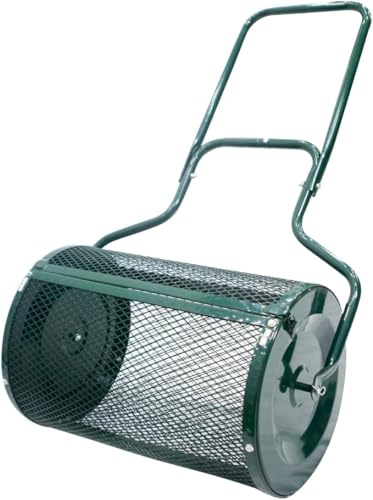
- Roller design spreads compost and soil amendments evenly
- 20-pound capacity for backyard applications
- Powder-coated finish and secure side latches
Best For: Backyard gardeners handling compost and soil amendments
Best Mesh Drum Tow-Behind – 36-Inch Compost Spreader
If you want a dedicated option among tow behind compost spreaders, this 36-inch GUDWUDZ model is designed for towing behind an ATV or lawn tractor. Its steel mesh drum helps distribute compost, peat moss, topsoil, manure, and mulch while breaking up clumps as it rolls.
Best For: Lawn and garden owners who need a tow-behind topdressing spreader that can filter larger rocks and twigs from finer material.
Pros:
- 19-inch steel mesh drum helps spread material evenly and break up clumps.
- Mesh design helps separate larger rocks, twigs, and debris.
- 50-inch hitch bar is designed for ATV and lawn tractor use.
- Rust-resistant coating and available 36-, 44-, and 60-inch sizes add flexibility.
Cons:
- At 41 pounds, it is heavier than a purely manual spreader.
- Requires towing equipment rather than operating as a standalone broadcast spreader.
This is a practical choice when your main goal is distributing bulky topdressing materials rather than seed or fertilizer. The mesh drum and debris-filtering design make it especially suited to compost and peat moss applications.
Best Large-Capacity Broadcast Spreader – Agri-Fab 130-Pound Pull-Behind
For larger properties, the Agri-Fab 45-0463 is a high-capacity pull-behind broadcast spreader with a 130-pound hopper and a spread width of up to 12 feet. While it is designed primarily for seed, fertilizer, salt, and ice melt, it is a useful alternative to tow behind compost spreaders when broad lawn coverage is the priority.
Best For: Large property managers and homeowners spreading seed, fertilizer, lawn treatments, salt, or ice melt over broad areas.
Pros:
- 130-pound hopper can cover up to 25,000 square feet with fewer refills.
- 10- to 12-foot spread width helps reduce the number of passes.
- Universal hitch fits most riding mowers and lawn tractors.
- Pneumatic tires, enclosed gears, and steel tubing support regular use.
Cons:
- It is a broadcast spreader, not a dedicated mesh-drum compost spreader.
- Its wide distribution pattern may offer less targeted placement than a topdressing roller.
Choose this Agri-Fab when capacity and coverage matter more than screening or rolling compost. Its universal hitch and all-season material compatibility make it a versatile lawn-maintenance tool.
Best Dual-Mode Option – TEMFAR 44-Inch Compost Spreader
The TEMFAR 44-inch model stands out among tow behind compost spreaders because it supports both towing and manual pushing. Connect it to a tractor or riding mower for larger areas, or push it by hand when you need more control in smaller sections of a lawn or garden.
Best For: Users who want one compost, mulch, fertilizer, or peat moss spreader for both tractor-assisted and manual applications.
Pros:
- Dual-mode design supports towing and manual pushing.
- High-strength steel construction has a rust-resistant powder finish.
- Half-inch by three-quarter-inch mesh helps break up clumps and screen larger debris.
- Side latch and locking pin are designed for straightforward assembly and use.
Cons:
- Manual operation may require more effort when the basket is heavily loaded.
- Its mesh opening may not suit users who want completely unscreened material distribution.
This is a flexible pick for mixed-size properties. The push/tow capability is the key advantage, while the steel mesh basket adds useful clump-breaking and debris-filtering performance for compost and soil work.
Best Aerating Combination – Brinly 40-Inch Aerator Spreader
Brinly Tow Behind Combination Aerator Spreader with Weight Tray, 40-Inch, Flat Black
Check Price On AmazonThe Brinly AS2-40BH-P combines spreading and aeration in one tow-behind attachment. It can distribute seed, fertilizer, or lime while its steel stars perforate soil up to 2 inches deep, making it a specialized choice for lawn renovation rather than a dedicated compost-drum application.
Best For: Lawn owners who want to spread seed, fertilizer, or lime while aerating compacted soil in the same pass.
Pros:
- Two-in-one design spreads material while aerating the lawn.
- 100-pound steel hopper provides substantial material capacity.
- Weight tray holds up to 75 pounds to increase soil penetration.
- Adjustable flow control and transport wheels improve handling and distribution.
Cons:
- It is not intended as a dedicated compost, peat moss, or mulch drum spreader.
- At 77.8 pounds, it is considerably heavier than the other listed options.
- Its aerating tines may be unnecessary for simple material spreading.
Consider this Brinly when aeration is as important as spreading. Its strong steel hopper, adjustable flow, and added weight capacity make it better suited to lawn-care programs that combine soil penetration with seed or fertilizer application.
Wide-Coverage Towable – Dapper Supply 44-Inch Compost Spreader
For larger lawns and garden projects, this 44-inch model is one of the more flexible tow behind compost spreaders because it can be pushed by hand or attached to a lawn tractor, ATV, or ride-on mower. Its wide mesh drum is designed to distribute compost, peat moss, topsoil, manure, and mulch evenly.
Best For: Large properties and homeowners who want a wide spreader that can switch between push and tow use.
Pros:
- 44-inch mesh drum supports broad, even coverage.
- Powder-coated steel construction helps resist rust and corrosion.
- Hinged lid and locking latches make refilling easier and help prevent spills.
- Backed by a one-year limited warranty and U.S.-based customer support.
Cons:
- The wide design may be less convenient in narrow spaces.
- The supplied details do not specify a capacity measurement.
This is a practical choice when coverage width and material versatility matter most. Its push/tow flexibility adds convenience, while the steel frame is suited to recurring outdoor use.
Compact Manure Specialist – Titan Attachments 8.7-Cubic-Foot Spreader
This Titan Attachments model is a compact option among tow behind compost spreaders, designed for manure handling around small barns, horse stalls, and similar spaces. Its ground-driven mechanism, adjustable relief panel, and towable design support controlled spreading behind a garden tractor or ATV/UTV.
Best For: Owners of one to four stalls who need a compact manure spreader for use behind an ATV, UTV, or lawn tractor.
Pros:
- 8.7-cubic-foot capacity is rated for up to 200 pounds.
- Ball coupler or pin hitch supports different towing setups.
- Adjustable opening helps accommodate finer, drier, wetter, or larger material.
- Heavy-duty 16-inch all-terrain wheels are suited to rough ground.
Cons:
- At 163 pounds, it is substantially heavier than small lawn topdressing spreaders.
- Its compact capacity and stall-focused design may not suit large-scale applications.
- The recommended towing speed is limited to 10–16 MPH.
Choose this spreader when manure management and maneuverability around small agricultural spaces are higher priorities than a lightweight lawn roller. The ground-driven operation keeps the controls straightforward, while the adjustable opening adds material-handling flexibility.
Adjustable Push-Tow Pick – VEVOR 44-Inch Compost Spreader
The VEVOR 44-inch model combines walk-behind and tow-behind operation, making it a versatile choice for homeowners comparing tow behind compost spreaders. Its diamond-shaped mesh is designed to screen out clumps and debris, while the 7.2-cubic-foot drum handles peat moss, compost, topsoil, sand, and manure.
Best For: Users who want adjustable handle height, broad coverage, and the option to push or tow behind a tractor, ATV, or UTV.
Pros:
- 44-inch spreading width supports efficient lawn and farm coverage.
- Four handle-height settings can accommodate different users.
- Dense diamond mesh promotes more consistent distribution.
- Powder-coated Q235 steel and a triangular bracket support outdoor durability and stability.
Cons:
- The 7.2-cubic-foot capacity is smaller than the Titan model’s rated 8.7 cubic feet.
- It requires a 1-inch hitch pin for towing.
- The product weighs 43.2 pounds, which may still be cumbersome to move when loaded.
This model stands out for buyers who value ergonomic adjustability and material versatility. The push/tow format is useful for changing job sizes, while the mesh drum and wide coverage are suited to lawn topdressing and seeding tasks.
Flexible Lawn Care – TEMFAR 36-Inch Push/Tow Compost Spreader
For shoppers comparing tow behind compost spreaders, the TEMFAR stands out for its dual-mode design. It can connect to a tractor or riding mower for larger areas, while the manual-push option offers more control in smaller spaces. Its mesh basket is designed to break up clumps and screen out larger debris as you work.
Best For: Homeowners who want one compost spreader for both towing and manual lawn care.
Pros:
- Supports both towing behind a tractor or riding mower and manual pushing.
- 36-inch basket helps cover more ground per pass.
- High-strength, powder-coated steel construction is designed to resist rust.
- Mesh screen helps reduce clogging from damp or lumpy material.
Cons:
- At 34.4 pounds, it may be more effort to maneuver manually than a smaller spreader.
- The 36-inch width may be less convenient in tight garden areas.
The TEMFAR is a practical choice when flexibility matters. Its towing interface, push capability, and clump-filtering basket make it suitable for mixed-size lawns and varied spreading materials.
High-Capacity Coverage – VEVOR 130-LB Tow-Behind Broadcast Spreader
The VEVOR is a strong option among tow behind compost spreaders when broad coverage and fewer refills are priorities. Its 130-pound hopper, 30 adjustable settings, and nearly 10-foot spreading width are suited to distributing seed, fertilizer, salt, and ice melt across larger outdoor areas.
Best For: Lawn owners and small farms that need high-capacity broadcast spreading across lawns, gravel, or seasonal terrain.
Pros:
- 130-pound hopper capacity can reduce the need for frequent refilling.
- 30 settings provide more control over application rates.
- Spreads across an approximately 9.8- to 10-foot width.
- 13-inch pneumatic tires and powder-coated steel construction suit varied terrain.
Cons:
- Its broad broadcast pattern may be less suitable for narrow beds or precise compost placement.
- The large hopper can make the spreader bulky when fully loaded.
Choose the VEVOR if efficiency over larger areas matters more than the roller-style control of a dedicated compost spreader. Its adjustable broadcast system and all-season versatility make it a flexible yard and property tool.
Compact Compost Control – Thunderbay 24-Inch Push/Tow Roller Spreader
The Thunderbay gives shoppers a compact roller-style alternative to larger tow behind compost spreaders. Its 24-inch compost basket is built to distribute compost, peat moss, manure, sand, and topsoil evenly, while the push/tow-behind format supports flexible use around a backyard or garden.
Best For: Backyard gardeners who want a sturdy roller spreader for compost and other soil amendments.
Pros:
- Handles compost, fertilizer, peat moss, manure, sand, and topsoil.
- Diamond-shaped openings are designed for smooth, even spreading.
- Rust-resistant powder-coated finish supports outdoor use.
- 11-inch filling door and side latches simplify loading and closure.
Cons:
- Its 20-pound capacity requires more frequent loading than a high-capacity broadcast spreader.
- The supplied specifications identify manual operation, so towing capability may be less clearly defined than on dedicated tow models.
The Thunderbay is best suited to smaller-scale composting tasks where controlled roller coverage is more useful than maximum capacity. Its durable finish, accessible filling door, and broad material compatibility add everyday practicality.
How We Picked the Best Tow Behind Compost Spreaders
We focused on spreaders designed for compost, peat moss, topsoil, manure, fertilizer, seed, salt, or similar lawn and garden materials. Selection criteria included hopper or roller capacity, working width, tow-hitch compatibility, wheel and frame construction, spreading adjustments, and whether each model supports both pushing and towing.
Because material texture varies widely, no single spreader is ideal for every job. Roller-style compost spreaders are generally suited to screened compost and peat moss, while broadcast models are more flexible for granular fertilizer, seed, salt, and other free-flowing materials.
Quick Comparison
- For routine lawn topdressing: Consider a 36- or 44-inch roller spreader with adjustable height settings.
- For fertilizer, seed, and salt: Choose a broadcast spreader with a calibrated flow control and a larger hopper.
- For ATV or UTV use: Look for a sturdy universal hitch, pneumatic tires, and a frame rated for heavier loads.
- For smaller yards: A compact 24-inch push/tow model is easier to maneuver and store.
- For larger properties: Wider coverage and higher capacity can reduce refill stops, provided your towing equipment can handle the loaded weight.
Key Buying Factors for Tow-Behind Compost Spreaders
Material Compatibility
Check whether the spreader is intended for screened compost, peat moss, manure, topsoil, fertilizer, or granular products. Wet, clumped, or fibrous material can bridge in a hopper or clog a broadcast mechanism, so dry and reasonably uniform material is usually easiest to distribute.
Width and Capacity
A wider roller covers more ground per pass, but it may be harder to pull through tight spaces. Hopper capacity affects how often you stop to reload. Remember that a large capacity can create substantial towing weight when filled with dense compost or manure.
Adjustment and Coverage Control
Height settings, adjustable gates, spinner controls, and multiple application settings help match output to the material and task. Calibration is still important: test a small area first and adjust the setting rather than relying on the numbered dial alone.
Hitch, Tires, and Construction
Confirm that the hitch fits your lawn tractor, ATV, UTV, or other tow vehicle. Wide pneumatic tires can improve stability on uneven ground, while powder-coated or rust-resistant steel helps the spreader withstand outdoor storage. A robust frame matters most when hauling dense loads.
Who Should Buy Which Tow Behind Compost Spreaders?
Homeowners maintaining established lawns should prioritize a manageable roller width, simple height adjustment, and push/tow flexibility. Gardeners working with peat moss or screened compost will typically benefit from a roller-style model that distributes material across the surface without requiring a powered broadcast spinner.
Property owners spreading fertilizer, seed, or ice melt should look toward a broadcast spreader with a larger hopper and precise flow control. Users with ATVs, UTVs, or lawn tractors should choose a tow-behind model with a compatible universal hitch, durable tires, and enough capacity for the intended area.
Before buying, measure gates and storage space, estimate the loaded weight, and verify that your tow vehicle can pull it safely. For the most consistent results, use dry material, break up clumps, make overlapping passes, and clean the spreader after each application.