Overwatering and underwatering are easier to prevent when you can check what is happening below the soil surface. The best digital soil moisture meters provide a clearer starting point than judging soil by appearance alone.
This roundup compares simple battery-free probes, multifunction testers, professional-grade meters, and wireless multi-probe systems so you can choose the right tool for houseplants, gardens, lawns, or larger growing areas.
Best 10 Digital Soil Moisture Meters Picks for 2026
Best All-in-One Pick
4-in-1 Backlit Digital Soil Meter

- Measures moisture, pH, temperature, and sunlight
- Backlit LCD and rotating head improve readability
- Works indoors and outdoors
Best For: Gardeners wanting multiple plant-care readings in one meter
Best Battery-Free Option
Long-Probe Moisture Meter 2-Pack

- Needs no batteries or setup
- 5.5-inch probe reaches deeper soil
- Immediate large-dial moisture readings
Best For: Checking moisture in larger pots and garden soil
Best for Detailed Plant Monitoring

- Checks seven soil and ambient conditions
- Dual dial and LCD display readings
- Long single probe suits medium and large pots
Best For: Beginners tracking soil and indoor growing conditions
Best Professional-Grade Pick
Dielectric Soil Moisture Meter

- Dielectric probe measures 0–100% VWC
- Nonmetallic probe resists corrosion
- Four-foot cable keeps display in hand
Best For: Serious gardeners wanting a durable, specialized moisture meter
Wireless Monitoring Pick
EDGEVEIL 4-in-1 Soil Moisture Meter

- Monitors moisture, temperature, light, and time
- Wireless range reaches up to 328 feet
- Supports up to 12 sensors per display
Best For: Remote monitoring of multiple indoor and outdoor plants
Professional Measurement Pick
General Tools DSMM500 Digital Meter

- Covers a 0–50% moisture measurement range
- Uses an 8-inch heavy-duty probe
- Offers min/max memory and data hold
Best For: Professional, agricultural, and commercial soil testing
Simple Battery-Free Pick

- Needs no batteries or charging
- Uses a clear 10-scale dry-to-wet dial
- Slim probe helps reduce root disturbance
Best For: Simple spot-checking of indoor and outdoor soil
Most Versatile
6-in-1 Digital Soil Moisture Meter

- Measures moisture, pH, fertility, temperature, light, and humidity.
- Foldable head and dual displays support easier reading.
- No calibration required; uses one AAA battery.
Best For: Gardeners wanting one tool for multiple soil and plant-care readings
Best for Remote Monitoring
Wireless 3-Probe Soil Moisture Meter
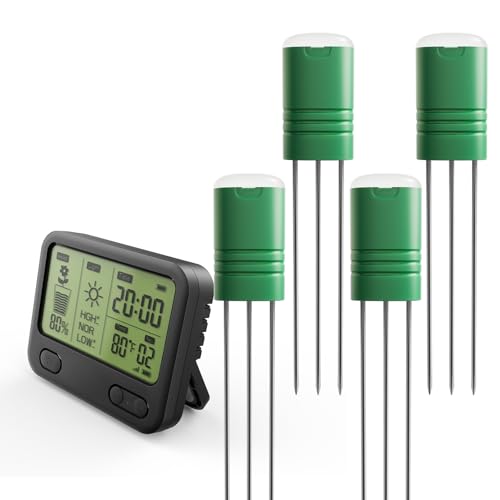
- Monitors up to 12 zones from an indoor LCD receiver.
- Measures moisture, temperature, and light with alerts.
- Includes batteries and IPX5-rated outdoor sensors.
Best For: Tracking multiple garden areas without checking each plant manually
Best Simple Pick

- Tests soil moisture, pH, and sunlight.
- Operates without batteries for simple setup.
- Compact design suits indoor and outdoor plant care.
Best For: Basic, occasional soil checks on a budget
Best All-in-One Pick – 4-in-1 Backlit Digital Soil Meter
For gardeners who want more than moisture readings, this 4-in-1 digital soil moisture meter also checks soil pH, temperature, and sunlight. Its backlit display, visual icons, and rotating head make the readings easier to view indoors or outdoors.
Best For: Growers who want one meter for moisture, pH, temperature, and light measurements.
Pros:
- Measures soil moisture, pH, temperature, and sunlight intensity.
- Large backlit LCD with a 45-degree rotating head improves readability.
- Designed for indoor plants, gardens, farms, succulents, and outdoor plants.
Cons:
- Requires four AAA batteries, which are not included.
- Testing requires inserting the probe about 4 inches and waiting around 10 seconds.
- It should not be used to test liquids or inserted into dry, hard soil.
This is a versatile choice for beginners who want several plant-care measurements in one handheld tool. Follow the stated testing instructions and average readings from multiple locations for more useful soil data.
Best Battery-Free Option – Long-Probe Moisture Meter 2-Pack
If you only need moisture readings, this battery-free digital soil moisture meter alternative keeps things simple. Its extra-long probe reaches deeper into pots, while the large dial gives an immediate reading without setup or a waiting period.
Best For: Houseplant owners and gardeners checking moisture deep inside larger pots or garden soil.
Pros:
- Battery-free design is ready to use whenever needed.
- Long 5.5-inch probe reaches soil near the bottom of deeper containers.
- Large dial provides an immediate reading across three moisture zones.
- Single-probe design helps reduce root and soil disturbance.
Cons:
- Measures soil moisture only, without pH, temperature, or light readings.
- Should not be left in soil for more than five minutes because the metal tip can corrode.
- Not intended for very hard soil, water, or other liquids.
This two-pack is a practical low-maintenance choice for straightforward watering decisions. It is especially useful when the surface looks dry but deeper soil may still contain moisture.
Best for Detailed Plant Monitoring – 7-in-1 Soil Test Kit
This 7-in-1 soil tester expands beyond basic digital soil moisture meters by combining soil readings with indoor air temperature and humidity. Its dual-dial and LCD design covers moisture, pH, fertility, temperature, light, and ambient conditions in one unit.
Best For: Beginners and plant enthusiasts monitoring several soil and indoor growing conditions together.
Pros:
- Measures soil moisture, pH, fertility, temperature, and sunlight.
- Also displays indoor air temperature and humidity on the LCD.
- Single probe is about 6.8 inches long and suited to medium and large pots.
- Can be used for indoor and outdoor gardens, lawns, farms, and potted plants.
Cons:
- Requires three batteries, and the instructions emphasize replacing or installing all three together.
- LCD results may take 3–5 minutes, while some functions require a separate timing process.
- It is not a water moisture meter and should not be used with liquids.
Choose this model if a broad snapshot of plant conditions is more useful than a quick moisture-only check. Its combination of soil and ambient readings can help gardeners monitor seedlings and indoor plants more systematically.
Best Professional-Grade Pick – Dielectric Soil Moisture Meter
For shoppers seeking a more specialized digital soil moisture meter, this professional-grade model uses a dielectric probe and reports moisture from 0 to 100% VWC. The cable-connected probe lets you keep the display in hand, while the backlit graphical screen also shows temperature and light levels.
Best For: Serious gardeners who want a compact, cable-connected meter designed for repeated moisture checks.
Pros:
- Dielectric sensor is described as less sensitive to soil salts, fertilizers, and pH.
- Nonmetallic probe will not corrode or require cleaning.
- Four-foot cable lets you read the display without stooping over the soil.
- Rugged grip case, compact size, and backlit display support convenient use.
Cons:
- Uses two AA batteries.
- Measures moisture, temperature, and light, but does not list pH or fertility testing.
- The cable-connected design may be less streamlined than an integrated probe.
This is the strongest fit for users prioritizing probe durability and measurement consistency around varying soil conditions. Its cable and handheld case are also practical for checking plants without repeatedly bending over to view the screen.
Wireless Monitoring Pick – EDGEVEIL 4-in-1 Soil Moisture Meter
Among digital soil moisture meters, the EDGEVEIL stands out for gardeners who want remote monitoring and more than a single moisture reading. Its display tracks moisture, temperature, sunlight, and time, while the wireless sensor can remain in the soil for ongoing checks.
Best For: Indoor and outdoor gardeners managing multiple plants from one central display.
Pros:
- Wireless range of up to 328 feet for checking plants from a distance
- Combines moisture, temperature, light, and clock readings
- One display can connect with up to 12 sensors
- Triple-probe TDR sensor and waterproof, corrosion-resistant probe
Cons:
- Requires two AAA batteries
- More features than needed for shoppers seeking a simple spot check
This is a strong choice when convenience and continuous monitoring matter. The large screen and low-moisture alert simplify routine care, while the expandable design suits growing plant collections.
Professional Measurement Pick – General Tools DSMM500 Digital Meter
For shoppers comparing digital soil moisture meters for detailed readings, the General Tools DSMM500 offers a broad 0–50% measurement range, a heavy-duty 8-inch probe, and memory features for reviewing results. Its fast sampling time also supports efficient testing across larger planting areas.
Best For: Commercial, agricultural, and professional users who need a more measurement-focused soil tester.
Pros:
- Measures soil moisture from 0% to 50%
- Includes minimum/maximum memory and data hold
- Heavy-duty 8-inch probe reaches deeper soil
- Samples readings in approximately 0.8 seconds
Cons:
- Requires four AAA batteries, which are not included
- Accuracy is specified as ±(5% of reading + 5 digits)
The DSMM500 is better suited to users who value probe reach, stored readings, and a stated measurement range over consumer-oriented extras. IP65 water resistance adds practical protection for routine soil testing.
Simple Battery-Free Pick – XLUX T10 Plant Moisture Meter
The XLUX T10 keeps soil testing straightforward. Unlike many digital soil moisture meters, it requires no batteries or charging: insert the slim probe, read the color-coded dial, and remove it after checking the soil.
Best For: Houseplant owners who want an instant, low-maintenance moisture check without batteries.
Pros:
- Battery-free operation provides immediate readings
- Large dial uses 10 dry-to-wet scales
- Slim single probe is designed to minimize root disturbance
- 304 stainless steel probe is described as anti-rust
Cons:
- Requires temporary testing and should be removed within five minutes
- Designed for soil only, not liquids
- Must be wiped clean and stored in its protective sleeve
This is a practical option for plant owners who prefer simplicity over remote or multi-function monitoring. Its clear dial and battery-free design make routine spot checks easy, provided the probe is used and maintained as directed.
Most Versatile – 6-in-1 Digital Soil Moisture Meter
This digital soil moisture meter is designed for gardeners who want more than a moisture reading. It combines soil moisture, pH, fertility, temperature, sunlight intensity, and air humidity readings in one compact tool, with a pointer dial and LCD display for quick interpretation.
Best For: Gardeners managing indoor plants, lawns, farms, and outdoor beds who want broad soil and environmental measurements.
Pros:
- Combines six soil and plant-care measurements in one device.
- Uses a foldable head and dual display areas for more comfortable viewing.
- Requires no calibration and provides readings after a short 5–10 second wait.
- Compact, lightweight design with a sturdy alloy probe.
Cons:
- Requires one AAA battery, which is not included.
- Designed for soil testing only and should not be used in liquids or water.
- The probe should be wiped dry immediately after each test.
This is a strong choice when a single meter needs to cover several routine garden checks. Its broad measurement range adds convenience, though buyers seeking only moisture monitoring may not need all of its functions.
Best for Remote Monitoring – Wireless 3-Probe Soil Moisture Meter
This wireless digital soil moisture meter is built for monitoring multiple planting areas without walking outside to check each one. Its sensors measure moisture, temperature, and light, while the indoor LCD receiver displays zone status and alerts you when a reading falls below the moisture threshold.
Best For: Gardeners monitoring raised beds, rows, pots, lawns, or other zones from indoors.
Pros:
- Supports up to 12 wireless monitoring zones, starting with two included sensors.
- Offers up to a 230-foot open-area RF range, though obstacles can reduce it.
- Uses TDR technology and stainless-steel triple probes for stable moisture readings.
- Includes moisture alerts, IPX5 water resistance, batteries, and an advertised 8–12 months of runtime.
Cons:
- Walls and other obstacles may reduce the wireless range.
- Not intended for liquids or loose media such as pure perlite, coco coir, or gravel.
- Expanding to 12 zones requires additional sensors beyond the two included.
Among these digital soil moisture meters, this is the most convenient option for distributed monitoring. It costs more in complexity than a handheld tester, but the receiver and dry-zone alerts can make watering routines easier to manage.
Best Simple Pick – SONKIR MS02 3-in-1 Soil Meter
The SONKIR MS02 is a straightforward digital soil moisture meter alternative for basic plant-care checks. A function switch lets you measure soil moisture, pH, or sunlight, and the analog readout works without batteries after the probe is inserted into the soil.
Best For: Indoor and outdoor gardeners who want a compact, battery-free tool for basic moisture, pH, and light checks.
Pros:
- Combines soil moisture, pH, and sunlight testing in one portable meter.
- Needs no battery, simplifying setup and ongoing use.
- Compact and lightweight for houseplants, gardens, lawns, and farms.
- Designed with durable materials for repeated soil testing.
Cons:
- Requires moist soil; the indicator may not move when soil is too dry.
- Testing may take a few minutes rather than providing an instant reading.
- Cannot test pH in liquids or other non-soil materials.
This is a practical pick for simple, occasional soil checks without batteries or electronic setup. It has fewer functions than the other options and is less suitable for remote or continuously monitored watering.
How We Picked the Best Digital Soil Moisture Meters
We focused on the factors that have the greatest effect on everyday usefulness: moisture-reading capability, probe design, display readability, measurement range, power requirements, durability, and ease of use. We also included different types of testers because a simple moisture probe can be ideal for houseplants, while a multifunction or wireless model may better suit gardens, lawns, farms, and greenhouse setups.
Additional readings such as soil pH, temperature, light, fertility, and air humidity were considered useful extras rather than automatic signs of better moisture measurement. A meter should first be easy to place correctly and interpret consistently.
Quick Comparison
| Best For | Look For | Typical Choice |
|---|---|---|
| Houseplants | Simple display, compact probe, low maintenance | Battery-free or basic digital meter |
| Gardens and raised beds | Long probe and weather-resistant construction | Multifunction soil tester |
| Detailed diagnostics | Reliable readings plus pH or temperature data | Professional-grade meter |
| Multiple locations | Remote monitoring and several probes | Wireless multi-probe system |
Key Buying Factors for Digital Soil Moisture Meters
Probe Length and Construction
A longer probe can reach the root zone in deep pots, raised beds, and lawns without disturbing the surface. Look for corrosion-resistant materials if the meter will remain in damp soil or be used frequently. Avoid forcing any probe through stones, compacted clay, or roots.
Readout and Measurement Approach
Large backlit screens are easier to read in low light, while graphical displays can make changes easier to interpret. Multifunction meters may use different scales or modes, so check whether the moisture reading is clearly separated from pH, temperature, light, or fertility measurements.
Power and Maintenance
Battery-free models are convenient for occasional checks, whereas battery-powered units often support brighter displays, memory, wireless transmission, or additional sensors. Wipe probes clean after use, do not leave them submerged unless designed for it, and follow the manufacturer’s calibration or care instructions.
Accuracy and Consistency
No handheld meter replaces proper watering knowledge. Take readings in several spots, insert the probe to a consistent depth, and allow the display to stabilize. For valuable plants or professional growing, prioritize a recognized precision meter and use repeated measurements instead of relying on one reading.
Who Should Buy Which Digital Soil Moisture Meters?
Choose a battery-free meter if you want quick checks for a few indoor plants with minimal maintenance. Choose a 4-in-1, 6-in-1, or 7-in-1 tester if you also want soil temperature, pH, light, fertility, or humidity information for garden troubleshooting. Choose a professional-grade model when repeatability and probe durability matter more than the lowest price. Choose a wireless multi-probe meter for larger spaces, multiple containers, or situations where checking each location manually is inconvenient.
Whichever model you select, use it as a decision aid rather than an automatic watering command. Compare its readings with the plant’s appearance, pot drainage, soil type, and recent watering history for better results.