Pruning fruit trees is easier when you can reach selected branches from the ground instead of climbing a ladder. The right pole saw combines useful reach with enough control to make clean cuts without excessive fatigue.
We selected 10 options spanning compact pruners, long-reach manual saws, and brushless electric models. Use the guide below to match cutting power, reach, weight, and branch size to your orchard or backyard trees.
Best 10 Pole Saws for Fruit Trees Picks for 2026
Best Extended-Reach Manual Pick
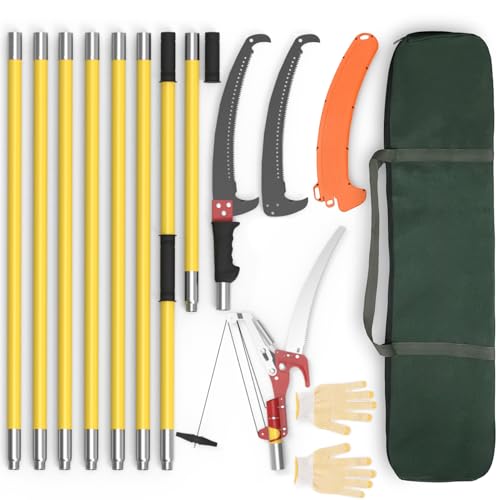
- Reaches approximately 27 feet
- Includes saw and pruner heads
- Comes with spare saw and carry bag
Best For: Gardeners needing maximum manual reach
Best Cordless 2-in-1 Option
SEESII Brushless Electric Pole Saw

- Converts to a handheld mini chainsaw
- Includes two 4,000mAh batteries
- Reaches up to 15.5 feet with user height
Best For: Cordless pruning and ground-level cutting
Best Lightweight Classic

- Lightweight 4.8-pound aluminum pole
- Includes 15-inch pruning saw
- Covered by a lifetime warranty
Best For: Routine backyard pruning with moderate reach
Best Modular Steel Manual Saw

- Offers three adjustable lengths
- Uses a 16.7-inch manganese-steel blade
- Works handheld or extended
Best For: Flexible manual pruning across multiple heights
Best Manual All-Rounder

- Saw and bypass shears in one tool
- Four-pulley design improves leverage
- Adjustable, detachable 10-foot pole
Best For: Backyard fruit trees and routine seasonal pruning
Best for Maximum Reach
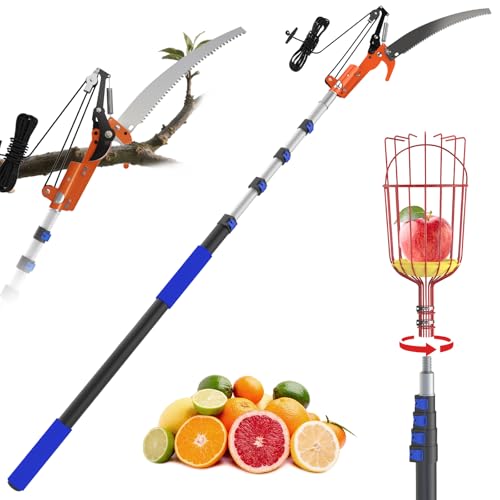
- 5-to-20-foot telescoping extension pole
- Includes saw, scissors, and fruit picker
- Foam-lined basket helps protect picked fruit
Best For: Tall fruit trees and combined pruning and harvesting
Best for Stable Orchard Pruning
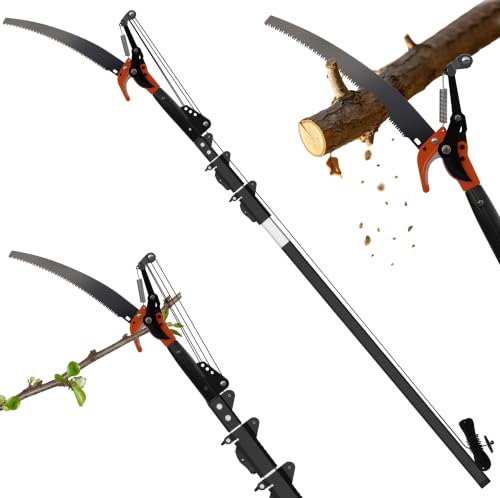
- Square shaft and push-button locking system
- 15-inch curved, coated carbon-steel blade
- Pulley head assists with medium branches
Best For: Orchards and taller trees requiring stable manual pruning
Best Adjustable Reach

- 5–20 ft adjustable four-stage pole
- 19-inch coated carbon-steel blade
- Detachable saw with foam grips
Best For: Versatile overhead and handheld pruning
Best for Maximum Height

- 7.3–27 ft reach with eight fiberglass poles
- Saw, scissors, rope, and pulley system
- Double-lock joints and storage bag
Best For: Tall trees and mixed pruning tasks
Best Dual-Lock Design

- 5–24 ft pole reaches up to 30 ft overhead
- Flip-and-screw dual locks
- Three-pulley pruner with 13-inch alloy-steel blade
Best For: High fruit-tree branches and reduced-effort pruning
Best Extended-Reach Manual Pick – 7.3-27 Ft Pole Saw & Pruner
For shoppers comparing pole saws for fruit trees, this manual saw-and-pruner set stands out for its unusually broad 7.3- to 27-foot reach. It combines a saw head, pruner head, pulley system, hook knives, spare saw, and carry bag, making it suited to varied pruning jobs. The manufacturer notes that the full 27-foot setup weighs 9.5 pounds and may be difficult to control, so the roughly 20-foot configuration may be more practical for many users.
Best For: Gardeners who want maximum manual reach and both sawing and branch-pruning capability.
Pros:
- Extends from approximately 7.3 to 27 feet for high branches.
- Includes separate saw and pruner heads, a spare saw, and a carry bag.
- Alloy-steel saw blades, hook knives, and a pulley system support versatile trimming.
Cons:
- The fully extended setup can feel heavy and harder to control.
- Manual operation requires pulling and physical effort.
This is a feature-rich choice when reach is the priority, especially for tall fruit trees. For better control and comfort, consider using fewer pole sections and follow the manufacturer’s suggestion to use back support during extended trimming sessions.
Best Cordless 2-in-1 Option – SEESII Brushless Electric Pole Saw
Among pole saws for fruit trees, the SEESII 2-in-1 model offers a convenient battery-powered approach for trimming higher limbs and making ground-level cuts. It converts from a pole saw to a handheld mini chainsaw, reaches up to 15.5 feet when combined with the user’s height, and includes two 4,000mAh batteries. Its brushless motor, adjustable cutting head, and tool-free chain maintenance add practical versatility.
Best For: Homeowners who want cordless reach plus a handheld saw for smaller cutting tasks.
Pros:
- Converts between handheld and pole-saw configurations.
- Includes two batteries and a fast charger, with claimed runtime of up to 120 minutes.
- Brushless motor, adjustable cutting angles, safety switch, and protective baffles support convenient operation.
- Listed weight is 6.9 pounds as a pole saw and 3.4 pounds handheld.
Cons:
- Its stated reach is lower than the longest manual option in this roundup.
- Battery charging and chain maintenance are required.
The SEESII is a flexible choice for routine fruit-tree pruning when you value speed and cordless convenience. The handheld conversion is particularly useful when a single tool needs to handle both elevated branches and cuts close to the ground.
Best Lightweight Classic – Fiskars 8-12 Ft Tree Pruner
For straightforward pole saws for fruit trees, this Fiskars manual tool pairs an extendable tree pruner with a 15-inch double-grind pruning saw. Its lightweight aluminum pole extends from 7.9 to 12 feet and weighs less than five pounds, while the chain-drive gearing, low-friction coating, and double-locking system are designed to make pruning more controlled and less tiring.
Best For: Home gardeners seeking a lightweight manual pruner and saw from a well-established garden-tool brand.
Pros:
- Lightweight aluminum pole weighs 4.8 pounds and extends to 12 feet.
- Includes a 15-inch double-grind saw blade for cutting higher branches.
- Chain-drive gearing provides added cutting power, and the pole has a double-locking system.
- Backed by a lifetime warranty.
Cons:
- Maximum reach is more limited than several other options here.
- It is a manual tool rather than a powered saw.
This is a sensible pick for regular backyard pruning where moderate reach and low weight matter more than maximum height. The combination of a saw and pruner makes it practical for shaping fruit trees without carrying separate tools.
Best Modular Steel Manual Saw – 14.5 Ft Adjustable Pole Saw
This modular manual option is one of the more adaptable pole saws for fruit trees, with detachable sections that create 8.5-, 11-, or 14.5-foot configurations. Its three-sided manganese-steel blade uses a double-sided barb design to grip branches, while stainless-steel poles, a powder-coated finish, an anti-slip grip, and an additional securing screw focus on stability during extended pruning.
Best For: Gardeners who want adjustable manual reach for both close trimming and moderately high branches.
Pros:
- Three selectable lengths—8.5, 11, and 14.5 feet—adapt to different jobs.
- 16.7-inch manganese-steel blade is designed for fast, clean cuts.
- Can be used handheld or fully extended for shrubs, hedges, and tall branches.
- Stainless-steel poles and an extra screw help secure the saw head.
Cons:
- It is manual, so cutting requires physical effort.
- The detachable sections require assembly and adjustment between lengths.
- It is a saw only and does not include a separate pruner head.
The adjustable length makes this a practical all-around saw when you need more flexibility than a fixed pole provides. It is especially useful for users who want one manual tool for low branches, shrubs, and taller fruit-tree limbs.
Best Manual All-Rounder – 10FT 2-in-1 Pole Saw
For homeowners comparing pole saws for fruit trees, the Walensee 10FT model offers a practical combination of a carbon-steel bypass shear and tree saw. Its four-pulley system is designed to improve leverage when trimming overhead branches, while the adjustable pole keeps routine pruning tasks on the ground.
Best For: Backyard fruit trees, shrubs, palms, and seasonal maintenance where a moderate reach and two cutting options are useful.
Pros:
- Combines pruning shears for smaller branches with a saw for thicker limbs.
- Four-pulley system helps provide smoother pulling action and better leverage.
- Detachable sections support adjustment, assembly, and storage.
Cons:
- Its 10-foot size offers less reach than the longer models in this roundup.
- The listed cutting width is 1.2 inches, so it is aimed at routine branch trimming rather than very large limbs.
This is a straightforward manual option for regular backyard pruning. The combined saw-and-shear design makes it versatile, though shoppers managing especially tall trees may prefer a longer pole.
Best for Maximum Reach – 26FT Telescoping Pole Saw
Among pole saws for fruit trees, this manual telescoping model stands out for its extended 5-to-20-foot pole and included fruit picker. It pairs a carbon-steel saw and scissors with a basket attachment, giving orchard and garden users one system for both trimming and harvesting.
Best For: Tall fruit trees and users who want long reach plus a dedicated fruit-picking basket.
Pros:
- Adjustable pole supports long-reach trimming without a ladder.
- Includes a 13.8-inch saw, pruning scissors, and a fruit-picker basket with foam protection.
- Universal 3/4-inch threaded tip allows attachment changes across compatible SKGPOLE accessories.
- Four flip locks and non-slip foam handles support length adjustment and grip.
Cons:
- The longer extension can be more demanding to control during overhead work.
- It is manual, so cutting and picking still require user effort.
This is the most versatile choice for high branches and harvest work. Its reach and fruit basket add useful functionality, but the extended length may be more tool than needed for smaller backyard trees.
Best for Stable Orchard Pruning – 20FT Labor-Saving Pole Saw
For shoppers seeking pole saws for fruit trees, this 2-in-1 manual pruner emphasizes stability and cutting control. Its square four-section pole uses push-button hole locking, while the pulley head and curved, quenched-steel blade are designed for overhead pruning of fruit, palm, and orchard branches.
Best For: Orchard pruning and taller trees where a square shaft, secure locking, and pulley-assisted branch cutting are priorities.
Pros:
- Square pole design helps resist slipping or twisting while applying pressure.
- Push-button hole lock is intended to reduce pole sliding under load.
- 15-inch curved blade has double-row teeth, a non-stick coating, and a 108-degree profile.
- Multi-pulley linkage helps reduce effort when snipping medium branches.
Cons:
- The pole adjusts from 5 to 12 feet, with a stated maximum working height of 15 feet, so its practical reach is below the 26-foot model.
- The manual design still requires pulling the cord and guiding the saw by hand.
This model is well suited to users who value a steadier-feeling pole and labor-saving pruning head over maximum extension. Its blade and locking design make it a strong fit for recurring orchard and mature-tree maintenance.
Best Adjustable Reach – 26FT Karveden Manual Pole Saw
For shoppers comparing pole saws for fruit trees, the Karveden offers a flexible manual setup for reaching overhead branches without a ladder. Its four-stage pole adjusts from 5 to 20 feet, while the saw can also be used by hand for lower limbs and other cutting tasks.
Best For: Homeowners who want adjustable reach and a detachable saw for fruit trees, shrubs, bamboo, and similar jobs.
Pros:
- Adjusts from 5 to 20 feet with flip-tab locks.
- 19-inch carbon-steel blade has sharpened teeth and a non-stick coating.
- Foam grips and a connecting screw support more comfortable, secure handling.
- Standard 3/4-inch universal threads allow use with compatible accessories.
Cons:
- Manual operation requires user effort for cutting.
- The long 20-foot configuration may be harder to maneuver in tight spaces.
This is a straightforward choice when reach and versatility matter more than powered cutting. The detachable blade and one-year warranty add practical value for recurring yard and garden maintenance.
Best for Maximum Height – VEVOR 27FT Manual Pole Saw
Among pole saws for fruit trees, the VEVOR stands out for its extended 7.3- to 27-foot reach. It combines a saw blade with pruning scissors, a rope-and-pulley system, and eight fiberglass handles for tackling both high branches and smaller growth.
Best For: Gardeners handling tall fruit trees, palms, shrubs, and mixed pruning work who want maximum manual reach.
Pros:
- Eight poles extend from 7.3 to 27 feet.
- Carbon-steel blade has a rust-resistant Teflon coating, hook knives, and a 1.2 mm thickness.
- Includes pruning scissors with a pulley system to reduce cutting effort.
- Double-lock joints, a blade sleeve, and a storage bag improve usability and storage.
Cons:
- At 13 pounds, it may feel heavy during extended use.
- The long multi-section design can require more setup and control.
The VEVOR is a feature-rich manual option for reaching especially tall branches. Its scissors and pulley system make it more versatile than a saw-only design, though its weight is worth considering before long pruning sessions.
Best Dual-Lock Design – TONYINGO 30FT Manual Pole Saw
The TONYINGO is designed for shoppers seeking pole saws for fruit trees with both overhead reach and branch-pruning assistance. Its 5- to 24-foot pole reaches up to 30 feet overhead and combines a saw with a pulley-assisted pruner head.
Best For: Fruit-tree owners who want very high reach, dual-lock stability, and a labor-saving pruner for branches and deadwood.
Pros:
- 5- to 24-foot adjustment provides up to 30 feet of overhead reach.
- Flip locks and screw locks help prevent accidental retraction.
- Three-pulley pruner system reduces cutting force.
- Lightweight aluminum pole and EVA foam grip support maneuverability and comfort.
Cons:
- The 13-inch blade is shorter than the 19-inch blade on the Karveden.
- Manual cutting still depends on user effort.
- Very extended pole settings may be more difficult to control.
With its dual-lock pole and pulley-assisted pruner, the TONYINGO is a strong fit for high branches that need more than basic sawing. Choose it if maximum stated reach and secure length adjustment are priorities.
How We Picked the Best Pole Saws for Fruit Trees
We focused on the features that matter most for orchard and backyard pruning: usable reach, cutting design, weight, adjustability, control, and versatility. The selection includes manual pole saws for quiet, precise maintenance; combination models with bypass-style shears or branch scissors; and an electric option for reducing effort on repeated cuts.
Reach claims can vary by user height and working angle, so treat maximum extension as a guide rather than a guarantee. A shorter, stiffer pole may be easier to control than an extremely long one when making careful cuts around fruiting wood.
Quick Comparison
| Type | Best for | Main advantage | Trade-off |
|---|---|---|---|
| Manual saw and pruner | Light seasonal pruning | Quiet and cordless | Requires physical effort |
| Long-reach manual model | Tall trees and hard-to-reach limbs | Broad working range | More flex and fatigue at full extension |
| 2-in-1 saw and scissors | Mixed branch sizes | Switch between cutting methods | More mechanisms to adjust |
| Electric pole saw | Frequent or heavier trimming | Less manual sawing effort | Needs charging or power management |
Key Buying Factors for Pole Saws for Fruit Trees
Reach and Pole Stiffness
Choose enough reach to work from the ground, but avoid selecting solely by the largest advertised number. A rigid, secure locking system improves accuracy and reduces strain, especially when cutting at full extension.
Cutting Capacity and Blade Design
Check the stated branch capacity and look for a sharp, replaceable, or resharpenable blade. Fine pruning cuts should be made with shears or scissors where possible; the saw is better suited to thicker limbs that exceed the pruner’s capacity.
Weight, Balance, and Adjustment
Weight becomes more noticeable overhead. Telescoping sections, rotating heads, padded or nonslip grips, and balanced construction can make a major difference during longer sessions. A model that adjusts quickly is useful when moving between low and high branches.
Manual Versus Electric Operation
Manual tools are quiet, simple, and generally easy to store. Electric pole saws can reduce effort on repeated cuts, but consider battery runtime, charging, motor weight, and whether the tool is appropriate for the branch diameter you plan to cut.
Who Should Buy Which Pole Saws for Fruit Trees?
For occasional backyard pruning: Choose a compact manual pole pruner or a 2-in-1 model with shears and a saw. These are practical for shaping smaller fruit trees and removing individual branches.
For tall trees: Select a long-reach telescoping pole, but prioritize reliable locks and manageable weight over maximum advertised height. Work in stages rather than forcing cuts at an unstable angle.
For frequent or demanding trimming: An electric model may be worthwhile if you regularly cut numerous branches and have suitable battery or power access.
For mixed orchard maintenance: A combination saw-and-scissors design offers flexibility. Use the pruner for smaller live branches and the saw for thicker limbs, while following proper pruning timing and avoiding cuts that exceed the tool’s rated capacity.