The best handheld belt sanders remove material quickly while giving you enough control to flatten boards, smooth edges, shape curves, or refine detailed work. The right choice depends on more than motor power: belt size, speed control, dust collection, ergonomics, and power source all affect results.
We compared 10 corded, cordless, pneumatic, benchtop-capable, and detail-focused models to help you match a sander to your projects, workspace, and preferred workflow.
Best 10 Handheld Belt Sanders Picks for 2026
Best Cordless Band File

- Brushless motor with up to 5,600 ft/min
- 104-degree rotating arm
- Tool-free belt changes
Best For: Cordless detail sanding and flexible positioning
Best Variable-Speed Corded Sander
Makita 9903 3 x 21-Inch Belt Sander

- 8.8-amp motor
- 690–1,440 ft/min variable speed
- Auto-tracking belt system
Best For: Large workshop sanding and flush-to-wall work
Best Cordless Full-Size Sander
DEWALT 20V MAX DCW220B Belt Sander

- Brushless 20V MAX motor
- 25-speed selection dial
- Up to 95% dust collection efficiency
Best For: Large cordless sanding jobs with adjustable control
Best Pressure-Control Sander
SKIL 7510-01 3 x 18-Inch Belt Sander

- Pressure-control warning system
- 6-amp corded motor
- Micro-filtration and vacuum compatibility
Best For: Controlled wood sanding and edge work
Best Variable-Speed Pick

- Six-dial variable-speed control
- Includes 10 sanding belts
- Bench-sander and vacuum-adapter options
Best For: Adjustable-speed woodworking and flexible dust collection
Best Straightforward Electric Pick

- Angled belt sands near adjoining surfaces
- 800 FPM maximum speed
- Tool-free belt release and dust bag
Best For: Simple, fast material removal on general projects
Best Pneumatic Industrial Pick
Ingersoll Rand 360-418 Air Belt Sander

- 0.6-hp air motor with 20,000 rpm free speed
- Lightweight 2.4-pound right-angle design
- Tool-free belt and arm adjustments
Best For: Compressed-air metal fabrication and surface finishing
Best Combination Sander
WEN HB424V 4-by-24-Inch Belt Sander

- 10-amp variable-speed motor
- Converts for benchtop sanding
- Includes dust bag and two belts
Best For: DIYers needing handheld and stationary sanding in one tool
Best Detail Sander
WEN 6307 1/2-by-18-Inch File Sander
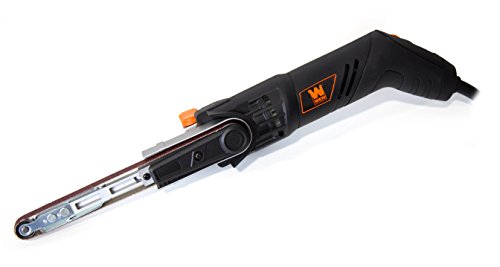
- Lightweight 2.4-pound design
- Belt pivots up to 55 degrees
- Auto-tracking needs no adjustments
Best For: Detail work and sanding in narrow or hard-to-reach areas
Best Lightweight Sander
WEN HB321V 3-by-21-Inch Belt Sander

- Weighs 6.4 pounds
- 7.5-amp variable-speed motor
- Includes dust bag and 80-grit belt
Best For: General DIY sanding with reduced tool weight
Best Cordless Band File – DEWALT 20V MAX XR DCM200B
DEWALT 20V MAX XR Cordless Bandfile Power Tool Belt Sander, Bare Tool Only (DCM200B)
Check Price On AmazonThe DEWALT DCM200B is a compact handheld belt sander for users who want cordless convenience and a narrow band-file format. Its brushless motor delivers up to 700 MWO and belt speeds up to 5,600 ft/min, while the rotating arm and variable-speed controls support detailed work in different positions.
Best For: Cordless detail sanding, metalwork, and applications that benefit from a rotating arm and changeable contact arm.
Pros:
- Brushless 20V motor delivers up to 700 MWO and 5,600 ft/min.
- 104-degree rotating arm improves flexibility and stores compactly.
- Tool-free belt changes and variable-speed controls simplify operation.
Cons:
- Bare-tool package requires a compatible 20V battery and charger.
- Its band-file format is less suited to broad surface sanding than a full-size belt sander.
The DCM200B is a specialized choice among handheld belt sanders, particularly for buyers already invested in DEWALT 20V batteries and needing maneuverability over wide sanding coverage.
Best Variable-Speed Corded Sander – Makita 9903 3 x 21-Inch Belt Sander
Makita 9903 3" x 21" Belt Sander | Corded heavy-duty sander, abrasive belt, rear and side handle
Check Price On AmazonThe Makita 9903 is a corded 3 x 21-inch belt sander designed for controlled material removal across larger surfaces. Its 8.8-amp motor, variable-speed dial, auto-tracking belt system, and flush-sanding design make it a practical option for demanding workshop projects.
Best For: Large wood-sanding jobs where consistent belt tracking, adjustable speed, and flush-to-wall sanding are important.
Pros:
- Powerful 8.8-amp motor supports demanding sanding work.
- Variable-speed control ranges from 690 to 1,440 ft/min.
- Auto-tracking belt system requires no manual adjustment.
- Front grip and flush-sanding design improve handling and access.
Cons:
- Corded operation limits mobility compared with battery-powered models.
- At 9.5 pounds, it is heavier than several compact handheld belt sanders.
Choose the Makita 9903 when steady corded power and a full 3 x 21-inch sanding area matter more than portability. The included dust bag and belt add useful out-of-box convenience.
Best Cordless Full-Size Sander – DEWALT 20V MAX DCW220B Belt Sander
The DEWALT DCW220B brings cordless flexibility to larger sanding applications, with a brushless 20V MAX motor and a broad sanding surface. Its 25-speed selection dial, tool-free belt release, and compatible dust-collection system help balance productivity, control, and cleanup.
Best For: Large sanding jobs for DEWALT 20V users who want cordless operation, adjustable speed, and dust-management options.
Pros:
- Brushless motor is designed for corded-style applications and runtime.
- 16.7% more sanding surface area than the cited Milwaukee comparison model.
- 25-speed selection dial and variable-speed trigger provide detailed control.
- Tool-free belt changes and up to 95% dust collection efficiency support cleaner work.
Cons:
- Bare-tool package requires a compatible DEWALT 20V battery and charger.
- DEWALT AirLock dust collection accessories are sold separately.
The DCW220B is a strong fit for buyers seeking handheld belt sanders for substantial surfaces without a power cord. Its included dust bag adds basic collection, while AirLock compatibility expands the setup.
Best Pressure-Control Sander – SKIL 7510-01 3 x 18-Inch Belt Sander
The SKIL 7510-01 is a corded 3 x 18-inch belt sander built to make wood sanding easier to control. Pressure-control technology warns against excessive force, while micro-filtration, vacuum compatibility, automatic belt alignment, and flush-edge sanding add practical workshop value.
Best For: Woodworkers who want guided pressure control, centered belt tracking, and straightforward dust-management options.
Pros:
- Pressure-control technology warns when too much force is applied.
- 6-amp motor is designed for sanding wood surfaces.
- Micro-filtration captures fine dust particles and supports cleaner work.
- Auto-track alignment and flush-edge sanding improve usability.
Cons:
- Corded operation restricts movement around the work area.
- Its 3 x 18-inch format offers less sanding coverage than the Makita 3 x 21-inch model.
For practical wood projects, the SKIL 7510-01 offers a helpful mix of control and convenience. It is especially appealing to users who value pressure feedback and the option to connect a standard 1-1/4-inch vacuum hose.
Best Variable-Speed Pick – Jellas 7-Amp Belt Sander
For woodworkers comparing handheld belt sanders, the Jellas combines a 7-amp motor with six variable-speed settings, a 3-by-21-inch belt format, and several dust-management options. Its included abrasives and 10-foot cord make it ready for a range of sanding projects.
Best For: Woodworking projects that benefit from adjustable speed, included sanding belts, and flexible dust collection.
Pros:
- Six-dial variable-speed control helps match sanding speed to the application.
- Includes 10 belts ranging from 40 to 180 grit.
- Can be secured as a bench sander with the included C clamps.
- Includes a dust bag and 32mm/35mm vacuum adapter.
Cons:
- Its corded design requires access to an outlet.
- Using it as a bench sander requires setup with the included clamps.
The Jellas is a versatile choice when speed control and sanding flexibility matter. The lock-on button, soft grip, and low-profile design also support longer sessions, while correct belt installation is important for avoiding scratches and extending belt life.
Best Straightforward Electric Pick – CRAFTSMAN 7-Amp Belt Sander
The CRAFTSMAN CMEW213 is a practical option among handheld belt sanders, pairing a 7-amp corded motor with a 3-by-21-inch belt and a maximum speed of 800 feet per minute. Its angled belt design is intended to help sand closer to adjoining surfaces.
Best For: General-purpose users who want fast material removal, simple belt changes, and an onboard dust bag.
Pros:
- Angled belt design helps reach closer to adjoining surfaces.
- 800 feet-per-minute maximum speed supports fast material removal.
- Tool-free belt release simplifies belt changes.
- Three-position over-molded handle adds comfort during use.
Cons:
- Only one sanding belt is included.
- It is corded and does not offer variable-speed control.
Choose the CRAFTSMAN when straightforward operation and quick stock removal are higher priorities than extensive accessories or speed adjustment. The included dust bag adds convenience for routine sanding, and the 6.6-pound weight is a useful consideration for extended work.
Best Pneumatic Industrial Pick – Ingersoll Rand 360-418 Air Belt Sander
For fabrication and metal-finishing work, the Ingersoll Rand 360-418 takes a different approach to handheld belt sanders by using compressed air rather than electricity. Its compact right-angle design, 0.6-horsepower motor, and 4,700 surface feet per minute suit spot-weld, rust, burr, and surface-deposit removal.
Best For: Auto shops, metalworking, and industrial users with a suitable air-compressor setup.
Pros:
- Lightweight 2.4-pound design can help reduce fatigue.
- Power regulator provides adjustable control for different tasks.
- Tool-free belt changes and articulating-arm adjustments support productivity.
- Includes 60-, 80-, and 100-grit Norton belts.
Cons:
- Requires a separate air compressor, which is not included.
- Its 1/2-by-18-inch belt format is specialized for finishing and fabrication tasks.
- It is less suited to users seeking a standard household electric belt sander.
The Ingersoll Rand is best viewed as a compact pneumatic finishing tool rather than a general woodworking sander. Its low weight, right-angle configuration, and articulating arm make it practical for tight areas, provided the user already has the required compressed-air equipment.
Best Combination Sander – WEN HB424V 4-by-24-Inch Belt Sander
WEN 10-Amp 4-by-24-Inch Variable Speed Combination Handheld and Benchtop Belt Sander (HB424V)
Check Price On AmazonFor shoppers comparing handheld belt sanders, the WEN HB424V stands out as a versatile corded model that can also attach to a benchtop for stationary sanding. Its 10-amp variable-speed motor covers 660 to 1310 feet per minute, giving you useful control across larger sanding tasks.
Best For: DIYers who want one belt sander for handheld work and occasional benchtop sanding.
Pros:
- Variable-speed 10-amp motor supports controlled sanding from 660 to 1310 feet per minute.
- Converts to an upward-facing stationary belt sander with the included mounting hardware.
- Includes a lock-on switch, quick-release belt lever, dust bag, and two 80-grit belts.
Cons:
- Its 4-by-24-inch format is larger than a detail-oriented file sander.
- The corded design requires access to a 120-volt power source.
The HB424V is a strong choice when flexibility matters more than minimum size. The benchtop conversion and included accessories add value for users handling both portable and stationary sanding jobs.
Best Detail Sander – WEN 6307 1/2-by-18-Inch File Sander
Among handheld belt sanders, the WEN 6307 is designed for more targeted work. Its narrow 1/2-by-18-inch belt pivots up to 55 degrees, while the variable-speed dial adjusts belt speed from 1080 to 1800 feet per minute for detail sanding and access in tighter areas.
Best For: Detail sanding, edge work, and projects that benefit from a narrow pivoting belt.
Pros:
- Compact 2.4-pound design is easier to maneuver during detail work.
- Pivoting belt reaches up to 55 degrees for improved access and positioning.
- Auto-tracking and tool-free belt installation simplify operation and changes.
Cons:
- The 1/2-inch belt is intended for detail work rather than broad surface sanding.
- Its 2-amp motor is less substantial than the motors on the larger WEN sanders here.
The 6307 makes the most sense when precision and maneuverability are priorities. Its slim belt, pivoting head, and light weight suit smaller sanding areas better than large panels.
Best Lightweight Sander – WEN HB321V 3-by-21-Inch Belt Sander
WEN 7.5-Amp 3-by-21-Inch Variable Speed Handheld Portable Belt Sander (HB321V)
Check Price On AmazonThe WEN HB321V is a practical option for shoppers seeking handheld belt sanders with a more compact feel. Its 7.5-amp variable-speed motor runs the 3-by-21-inch belt from 620 to 1200 feet per minute, and the 6.4-pound body is designed to help limit user fatigue.
Best For: General DIY sanding where a lighter portable tool is preferable to a larger belt sander.
Pros:
- Compact 6.4-pound design can reduce fatigue during sanding.
- Variable-speed operation ranges from 620 to 1200 feet per minute.
- Includes a lock-on switch, quick-release tension lever, dust bag, and 80-grit belt.
Cons:
- It has less motor power than the 10-amp HB424V.
- The included 80-grit belt may not suit every finishing application.
- It is corded and requires a 120-volt power source.
The HB321V balances useful sanding capacity with a lighter portable design. It is a sensible middle ground for DIYers who want variable speed and a full-size belt without moving up to the larger combination model.
How We Picked the Best Handheld Belt Sanders
We evaluated these Handheld Belt Sanders by comparing the features that matter during real woodworking, renovation, and fabrication tasks. Our criteria included belt dimensions, motor or air performance, variable-speed capability, tracking and adjustment controls, dust-collection options, comfort, portability, and the type of work each tool is designed to handle.
We also considered practical differences between corded and cordless tools, standard woodworking sanders and narrow file sanders, and general-purpose models versus tools intended for metal fabrication. Because no single design suits every job, the selection includes options across several use cases and budgets.
Quick Comparison
- Best for cordless convenience: DEWALT 20V MAX XR Bandfile or 20V MAX Brushless Belt Sander
- Best for general woodworking: Makita 9903, SKIL 7510-01, CRAFTSMAN CMEW213, or WEN HB321V
- Best for larger surfaces: WEN HB424V with its 4-by-24-inch belt
- Best for detail work: WEN 6307 Variable Speed Detailing File Sander
- Best for pneumatic fabrication: Ingersoll Rand 360-418
- Best for an included dust bag and accessories: Jellas 7-Amp model
Key Buying Factors for Handheld Belt Sanders
Belt Size and Intended Work
The common 3-by-21-inch format balances removal speed, maneuverability, and affordable abrasive belts. A 3-by-18-inch tool can feel more compact, while a 4-by-24-inch sander covers more surface per pass but is heavier and less nimble. Narrow file sanders are better for edges, contours, tubing, and tight spaces than for flattening broad boards.
Power Source and Runtime
Corded models provide consistent power for long sanding sessions, but they require cable management. Cordless models improve mobility and work well where outlets are inconvenient; budget for compatible batteries and chargers if the tool is sold bare. Pneumatic sanders require a compressor capable of supplying their airflow at the stated operating conditions.
Speed, Control, and Dust Collection
Variable speed is useful when working with different woods, finishes, plastics, or metals because slower settings can reduce scorching and improve control. Look for reliable belt tracking and an easy-to-reach adjustment system. A dust bag or vacuum port helps contain debris, although sanding still requires appropriate respiratory and eye protection.
Ergonomics and Maintenance
Weight, grip shape, vibration, trigger design, and balance become important during extended use. Check how easily belts can be changed and whether replacement abrasives are readily available. Keep abrasive belts clean, inspect cords or batteries, and avoid forcing the tool into the work.
Who Should Buy Which Handheld Belt Sanders?
Choose a standard 3-by-21-inch corded sander if you want an affordable, versatile tool for furniture, doors, shelves, and general shop projects. Pick a cordless DEWALT model when portability and compatibility with an existing 20V MAX battery system matter most. For large boards or aggressive stock removal, the larger WEN combination sander is the better fit if you can accept additional bulk.
Choose the WEN detailing file sander or DEWALT bandfile for narrow edges, curves, weld cleanup, and hard-to-reach areas. Metalworkers and fabrication professionals should consider the Ingersoll Rand pneumatic option when their compressor setup can support it. If dust control, speed adjustment, and included accessories are priorities, compare the SKIL, Jellas, Makita, and CRAFTSMAN models closely before buying.