A loud compressor can make short jobs feel much longer, especially in garages, workshops, and occupied homes. The best quiet air compressors balance lower operating noise with enough tank capacity, pressure, and airflow for the tools you use most.
Our selection includes compact one-gallon models, portable mid-size compressors, and larger tanks for longer work sessions. Use the guide below to match capacity, portability, and performance to your projects.
Best 10 Quiet Air Compressors Picks for 2026
Quietest Large-Tank Pick

- 60 dBA operation for indoor use
- 8-gallon aluminum tank
- Oil-free pump with wheels
Best For: Indoor projects needing quiet operation and more tank capacity
High-Pressure Trim Pick

- 200 PSI maximum pressure
- 3.0 SCFM at 90 PSI
- Dual couplers for two nailers
Best For: Trim work and compact high-pressure applications
Quiet Job-Site Pick

- 60 dB Quiet Series operation
- 1.5 HP motor and 135 PSI
- Roll-cage protection and oil-free pump
Best For: Indoor or job-site work requiring quiet, protected performance
Compact Rolling Pick
3-Gallon Ultra Quiet Compressor
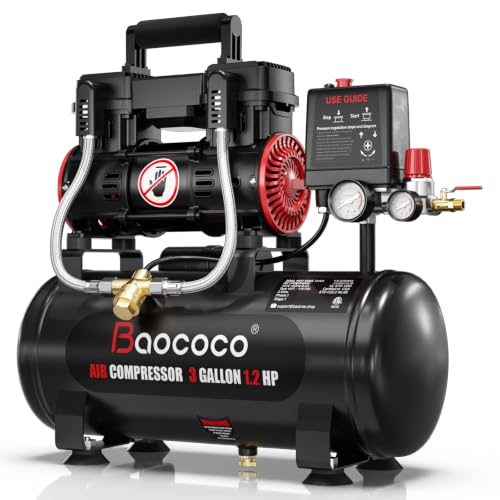
- Approximately 70 dB operation
- Fast stated refill times
- Wheels, handle, and oil-free design
Best For: Home workshops and light renovation or automotive tasks
Quietest Portable Pick
Metabo HPT EC28M 1-Gallon Quiet Air Compressor

- 59 dB operation supports conversation while running
- 25.2-pound portable design with steel roll cage
- Oil-free pump with quick coupler and overload protection
Best For: Quiet indoor work, finish nailing, and portable jobsite use
Large-Tank Workshop Choice
15-Gallon 2HP Quiet Air Compressor
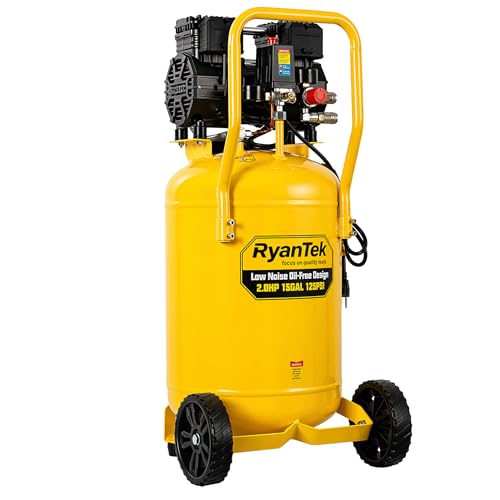
- 15-gallon vertical tank helps reduce cycling
- 4.5 CFM at 90 PSI and 125 PSI maximum
- 66 dB oil-free twin-cylinder operation
Best For: Workshops, painting, auto repair, and longer pneumatic-tool sessions
DIY Versatility Pick
Stealth SAQ-1234 2-Gallon Quiet Air Compressor

- Approximately 60 dB operation with low-vibration design
- 125 PSI maximum with 1.8 CFM at 90 PSI
- Oil-free pump with safety and overheat protection
Best For: Home DIY, tire inflation, airbrushing, and light nailing
Quiet Workshop Pick
California Air Tools CAT-4710W
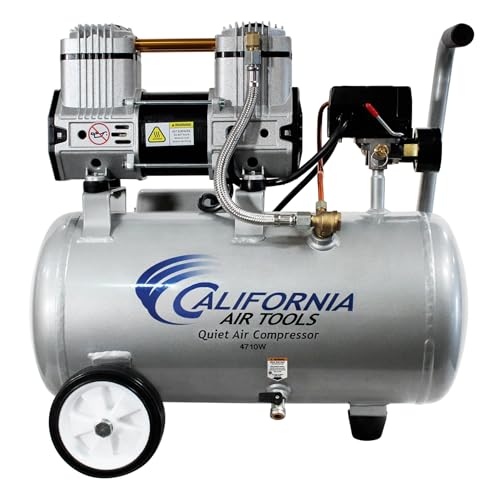
- 75 dB operation with a 4.7-gallon tank
- Oil-free pump for lower maintenance
- Wheels and handle improve portability
Best For: Homeowners, DIY users, and small workshops
Quietest Compact Choice

- Very low 58 dB operating noise
- Compact 1-gallon oil-free design
- Protective roll-cage construction
Best For: Indoor repairs and lighter-duty portable work
High-Output Value Pick
MZB 2.4-Gallon Ultra Quiet Compressor

- 70 dB operation with 1.2 HP power
- Stated 5.65 CFM airflow at 115 PSI
- Fast 28–32 second tank fill claim
Best For: Varied DIY, nailing, spraying, and repair tasks
Quietest Large-Tank Pick – California Air Tools 8010A
If you need quiet air compressors for indoor projects, the California Air Tools 8010A is a strong option. Its 60 dBA operating noise, oil-free pump, and 8-gallon aluminum tank balance reduced noise with useful capacity for nailing, air brushing, inflation, cleaning, sanding, and spraying.
Best For: Indoor users who want a relatively quiet, portable compressor with a larger tank.
Pros:
- Runs at a low 60 dBA noise level.
- Oil-free dual-piston pump requires less routine maintenance.
- 8-gallon aluminum tank and 120 PSI maximum provide useful capacity.
- Weighs about 37.3 pounds and includes wheels for transport.
Cons:
- Its larger tank makes it less compact than the 3-gallon alternatives.
- Airflow is rated at 2.20 CFM at 90 PSI, which may limit some demanding tools.
The 8010A stands out when low noise and tank capacity matter more than the smallest footprint. Its stated 165-second fill time and 60-second recovery from 90 to 120 PSI add practical efficiency for intermittent work.
High-Pressure Trim Pick – DEWALT DWFP55130
Among quiet air compressors for trim work, the DEWALT DWFP55130 emphasizes high pressure, portability, and nailer-friendly airflow. It delivers 3.0 SCFM at 90 PSI, reaches 200 PSI maximum, and includes dual quick couplers for supporting two nailers.
Best For: Trim installers and DIY users who prioritize high pressure, quick recovery, and compact storage.
Pros:
- 200 PSI maximum pressure supports a large number of nail shots.
- 3.0 SCFM at 90 PSI provides useful airflow for trim applications.
- Compact 2.5-gallon design can operate or store vertically or horizontally.
- Dual couplers can support two nailers.
Cons:
- At 71.5 dBA, it is louder than the 60 dBA models in this roundup.
- The smaller 2.5-gallon tank offers less reserve capacity for sustained airflow.
- The supplied specifications list an item weight of 0.69 kg, which may be inconsistent with the stated 36-pound product weight.
The DWFP55130 is a practical choice when nailer performance and storage flexibility are more important than achieving the lowest possible noise level. Its oil-free pump and low 12-amp draw also support relatively simple electric operation.
Quiet Job-Site Pick – Makita MAC320Q Quiet Series
Makita MAC320Q Quiet Series 1-1/2 HP, 3 Gallon, Oil-Free, Electric Air Compressor
Check Price On AmazonThe Makita MAC320Q is one of the quieter air compressors for indoor and job-site use, operating at 60 dB. Its 1.5 HP motor, 3-gallon tank, oil-free dual-piston pump, and roll-cage construction provide a useful combination of power, portability, and protection.
Best For: Contractors and DIY users who want quiet operation with a protected, portable compressor for cutting, grinding, and spraying.
Pros:
- 60 dB Quiet Series operation is suitable for noise-sensitive work areas.
- 1.5 HP motor and 135 PSI maximum offer solid rated power.
- Oil-free pump is designed for maintenance-free operation.
- Roll-cage construction helps protect the compressor during transport and storage.
Cons:
- The 3-gallon tank provides less capacity than the 8-gallon California Air Tools model.
- The supplied item weight is listed as 25.79 kg, so portability should be considered carefully.
- Its listed dimensions and weight details may warrant verification before purchase.
The MAC320Q is a compelling middle-ground option for buyers who want 60 dB operation without moving up to a large tank. Its lower 1,750 RPM operating speed is also intended to support longer motor and pump life.
Compact Rolling Pick – 3-Gallon Ultra Quiet Compressor
For buyers seeking compact quiet air compressors for home maintenance, this 3-gallon model offers approximately 70 dB operation, oil-free use, and built-in wheels. Its 1.2 HP motor reaches 115 PSI and is designed for inflation, nailing, air brushing, painting, polishing, and dust removal.
Best For: Home workshops and light automotive or renovation tasks where easy rolling and quick refills are useful.
Pros:
- Approximately 70 dB operation is quieter than traditional compressors.
- Reaches working pressure in about 50 seconds from a cold start, with 20-second subsequent refills as stated.
- Oil-free design avoids regular oil changes.
- Handle and built-in wheels improve portability.
Cons:
- Its 70 dB rating is louder than the 60 dB options in this roundup.
- The 3-gallon tank and 115 PSI maximum are better suited to lighter-duty tasks than extended high-demand use.
- The supplied product information does not state a CFM airflow rating.
This compressor is a practical fit when compact handling and fast stated refill times matter. Its steel tank, copper-wound motor, automatic shut-off, and two quick couplers add convenience for general household and small-workshop jobs.
Quietest Portable Pick – Metabo HPT EC28M 1-Gallon Quiet Air Compressor
If you need quiet air compressors for indoor work or shared jobsite spaces, the Metabo HPT EC28M stands out with a 59 dB operating level. Its compact 1-gallon tank, oil-free design, and 25.2-pound weight make it easy to carry while supporting common nailing and inflation tasks.
Best For: Users who prioritize very low noise, portability, and straightforward maintenance for finish, framing, siding, roofing, or inflation work.
Pros:
- Very quiet 59 dB operation allows normal conversation while cycling.
- Lightweight 25.2-pound design includes a comfortable rubber handle and steel roll cage.
- Universal quick coupler and integrated PSI controls simplify tool changes and adjustments.
- Oil-free construction reduces maintenance, with overload protection for added durability.
Cons:
- The 1-gallon tank is better suited to portable, intermittent tasks than extended high-demand use.
- Its professional warranty is limited to one year.
The EC28M is a practical choice when quiet operation and easy transport matter more than large tank capacity. It is especially appealing for finish work, small jobs, and indoor use where compressor noise can be disruptive.
Large-Tank Workshop Choice – 15-Gallon 2HP Quiet Air Compressor
Among quiet air compressors for workshops, this 15-gallon model combines 66 dB operation with a 2HP twin-cylinder pump. Its 4.5 CFM at 90 PSI, 125 PSI maximum, and vertical tank are designed for longer run times and applications such as nailing, painting, inflation, and auto repair.
Best For: Home workshops and users who need a larger tank, consistent airflow, and mobility for multiple pneumatic tools.
Pros:
- Large 15-gallon tank reduces motor cycling during extended work.
- Twin-cylinder, oil-free pump delivers 4.5 CFM at 90 PSI and reaches 125 PSI.
- Vertical design saves floor space, while wheels and a handle improve mobility.
- Upward-facing gauges, dual outlets, and a horizontal drain valve support convenient operation.
Cons:
- At 68.3 pounds, it is substantially less portable than compact compressors.
- Its 66 dB rating is quiet for a larger compressor but not the lowest noise level in this group.
- The larger tank requires more storage space than small portable models.
This compressor is the strongest fit when capacity and sustained workshop usability are priorities. The vertical format helps manage its footprint, but buyers should plan for its heavier weight and larger storage needs.
DIY Versatility Pick – Stealth SAQ-1234 2-Gallon Quiet Air Compressor
The Stealth SAQ-1234 is one of the compact quiet air compressors aimed at home DIY work. Its 60 dB operation, 2-gallon tank, and 125 PSI maximum support tire inflation, airbrushing, stapling, and nailing while the oil-free pump keeps maintenance simple.
Best For: DIY users who want a relatively quiet, portable compressor for inflation, light nailing, airbrushing, and general household projects.
Pros:
- Low-vibration design and soundproofing keep operating noise around 60 dB.
- 125 PSI maximum pressure with 2.8 CFM at 40 PSI and 1.8 CFM at 90 PSI.
- Oil-free operation includes safety-valve and overheat protection.
- Reinforced handle and rubber bases make the steel tank easier to move between rooms.
Cons:
- The 2-gallon tank and 0.75HP motor are intended more for intermittent DIY work than demanding continuous use.
- At 41.9 pounds, it is portable but heavier than the 1-gallon Metabo HPT.
- The supplied notes list a flow rate rather than a conventional CFM specification at 90 PSI beyond the stated 1.8 CFM.
The SAQ-1234 offers a useful balance of quiet operation, pressure, and versatility for home projects. Choose it when you want more tank capacity than a 1-gallon model without moving up to a full-size workshop compressor.
Quiet Workshop Pick – California Air Tools CAT-4710W
If you need quiet air compressors for a garage, small business, or DIY workspace, the California Air Tools CAT-4710W offers a practical balance of reduced noise, usable tank capacity, and portability. Its 4.7-gallon steel tank and oil-free pump support common nailing and workshop tasks without regular oil maintenance.
Best For: Homeowners, DIY users, and small workshops that need a portable compressor with more reserve capacity.
Pros:
- Operates at a listed 75 dB noise level.
- 4.7-gallon tank provides useful air storage for intermittent tasks.
- Oil-free, dual-piston pump requires less routine maintenance.
- Wheels and handle make the 35-pound unit easier to move.
Cons:
- At 75 dB, it is not the quietest option in this roundup.
- Its 2.20 CFM at 90 PSI may be limiting for demanding continuous-use tools.
Choose this model when tank capacity and mobility matter more than achieving the lowest possible noise level. Its 135 PSI maximum and low 7.5-amp draw also suit standard 110-volt outlets.
Quietest Compact Choice – Makita MAC100Q
Makita MAC100Q Quiet Series, 1/2 HP, 1 Gallon Compact, Oil-Free, Electric Air Compressor
Check Price On AmazonThe Makita MAC100Q is a strong choice among quiet air compressors when low operating noise and compact portability are priorities. Its Quiet Series design is rated at just 58 dB, while the oil-free pump and roll-cage construction make it well suited to indoor and job-site use.
Best For: Indoor repairs, trim work, and users who prioritize a compact compressor with especially low noise.
Pros:
- 58 dB noise rating is the lowest listed in this roundup.
- Compact 1-gallon design is easier to carry and store.
- Oil-free dual-piston pump supports maintenance-free operation.
- Roll-cage construction helps protect the compressor during transport and storage.
Cons:
- The 1-gallon tank offers less air storage than larger models.
- Its 0.7 CFM at 90 PSI is better suited to lighter-duty applications.
For indoor environments where compressor noise is a major concern, the MAC100Q stands out. Its 135 PSI maximum pressure and lightweight design add versatility, though the smaller tank favors short, intermittent tasks.
High-Output Value Pick – MZB 2.4-Gallon Ultra Quiet Compressor
The MZB 2.4-Gallon Ultra Quiet Air Compressor is designed for users who want quiet air compressors with a comparatively high stated airflow. Rated at 70 dB and delivering up to 5.65 CFM at 115 PSI, it is aimed at varied tasks including nailing, spraying, tire inflation, carpentry, and auto repair.
Best For: DIYers and small workspaces needing higher stated airflow for varied pneumatic applications.
Pros:
- 70 dB noise rating supports quieter operation than many conventional compressors.
- Stated 5.65 CFM output at 115 PSI suits a broad range of listed tools.
- Fast tank fill time is listed at approximately 28–32 seconds.
- Oil-free 1.2 HP motor avoids oil contamination and routine oil changes.
Cons:
- Its 2.4-gallon tank is smaller than the California Air Tools model.
- The supplied specifications list a maximum pressure of 8 in one field, creating some specification ambiguity.
- The notes do not provide a listed weight, so portability is harder to compare directly.
This MZB model is appealing when airflow and quick recovery are more important than maximum tank size. Confirm the pressure specification before purchase, especially if your tools require a specific PSI range.
How We Picked the Best Quiet Air Compressors
We focused on compressors that emphasize reduced operating noise, oil-free maintenance, practical portability, and useful performance for home and light professional work. The lineup spans compact units for inflation and brad nailers, mid-size models for trim and finish work, and larger tanks that reduce cycling during extended tasks.
We also considered tank size, maximum pressure, airflow at 90 PSI, footprint, wheels or handles, and the needs of common pneumatic tools. Published noise ratings are useful for comparison, but results can vary with distance, flooring, enclosure, and the compressor’s duty cycle.
Quick Comparison
| Best For | Recommended Type | What to Prioritize |
|---|---|---|
| Inflating tires and sports equipment | 1-gallon compact compressor | Low weight, quick setup, easy storage |
| Brad and finish nailers | 1- to 3-gallon portable model | Fast recovery, oil-free pump, manageable noise |
| Trim work and renovations | 3- to 8-gallon compressor | 90-PSI airflow, hose reach, portability |
| Longer intermittent tool use | 15-gallon compressor | Tank capacity, stable airflow, usable CFM |
Key Buying Factors for Quiet Air Compressors
Noise Rating
Look for the lowest decibel rating that still meets your performance needs. A difference of several decibels can be noticeable, but placement matters too. Set the unit on a stable surface away from walls and use hearing protection around any running compressor.
Tank Size and Recovery
A larger tank stores more compressed air and can reduce how frequently the motor starts. Smaller tanks are easier to carry and work well for short bursts, while larger tanks are better suited to repeated nailing, cleaning, or inflation. Tank size does not replace airflow: check CFM at 90 PSI for tool compatibility.
Pressure and Airflow
Maximum PSI indicates storage pressure, not necessarily sustained tool performance. Compare the compressor’s CFM rating at 90 PSI with the pneumatic tool’s requirements, leaving some headroom for reliable operation and recovery.
Portability and Maintenance
Wheels and a sturdy handle help with heavier tanks, while compact models are easier to store on a shelf or in a vehicle. Oil-free pumps generally simplify maintenance, although they may be less suitable for demanding continuous-duty applications than larger professional systems.
Who Should Buy Which Quiet Air Compressors?
Choose a Compact 1-Gallon Model If:
You mainly inflate tires, clear small areas, use a stapler, or run a brad nailer for brief periods. These compressors are easiest to store and carry, making them practical for apartments, small garages, and punch-list work.
Choose a 3- to 8-Gallon Model If:
You need a better balance of portability and reserve air for trim carpentry, finish work, DIY repairs, or frequent inflation. These are the most versatile choices for many home workshops.
Choose a 15-Gallon Model If:
You expect longer sessions, want fewer motor cycles, or need more reserve capacity for demanding intermittent tools. Confirm available floor space and electrical requirements before buying.