Wireless rain gauges make it easier to monitor rainfall without stepping outside or checking a manual cylinder. The best models collect precipitation outdoors, send readings to an indoor display, and add useful features such as rainfall history, alerts, temperature readings, or storm warnings.
We selected 10 wireless rain gauges for different needs, from straightforward self-emptying collectors to multifunction weather stations. Use the guide below to compare accuracy-related features, installation requirements, durability, and everyday convenience before buying.
Best 10 Wireless Rain Gauges Picks for 2026
Best Everyday Pick

- Self-emptying collector needs little routine maintenance
- Tracks daily, weekly, monthly, and yearly rainfall
- Customizable alert and indoor LCD display
Best For: Gardeners and casual weather-watchers
Most Comprehensive Station
Sainlogic 12-in-1 Weather Station

- Combines rainfall with wind, pressure, temperature, and humidity
- 6.5-inch screen with three backlight levels
- Wireless setup suits farms, orchards, and large outdoor areas
Best For: Weather enthusiasts, gardeners, and farmers
Best SmartHUB Add-On
AcuRite Wireless Rain Collector

- Self-emptying cup minimizes maintenance
- Transmits readings up to every 16 seconds
- Requires compatible smartHUB for device monitoring
Best For: Existing AcuRite users seeking app-based rainfall data
Best Large-Display Station
Digital Rain Gauge Weather Station

- 7.5-inch color LCD with adjustable brightness
- Combines rainfall, temperature, humidity, pressure, and forecasts
- Self-emptying gauge with three-channel support
Best For: Homes wanting an easy-to-read multi-function weather station
Best Overall
AcuRite Self-Emptying Wireless Rain Gauge
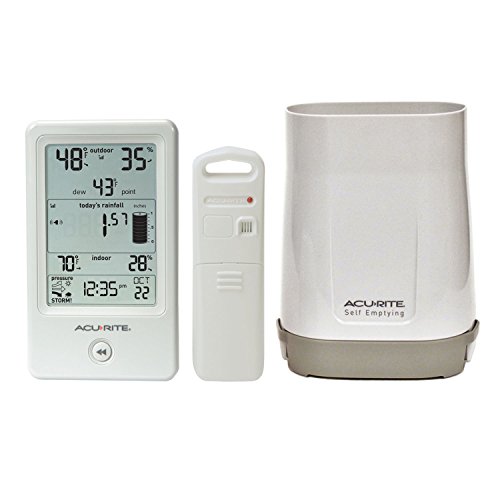
- Tracks daily, weekly, monthly, and yearly rainfall
- Adds storm and programmable rain alerts
- Includes outdoor temperature and humidity readings
Best For: Home weather monitoring and lawn-care planning
Best Display Features
Wireless Digital Rain Gauge with Thermometer

- Offers eight rainfall measurement periods
- Includes alarms, temperature, calendar, and clock features
- Uses a brief blue backlight for nighttime viewing
Best For: Detailed indoor rainfall and weather readouts
Best Simple Setup
AcuRite Wireless Digital Rain Gauge

- Self-emptying tipping-bucket collector
- Updates indoor totals every 60 seconds
- Includes history and programmable rain alerts
Best For: Simple rainfall monitoring for lawns and gardens
Smart Alarm Pick

- Self-emptying tipping-bucket sensor
- 9-day rainfall history
- 300-foot wireless range
Best For: Gardeners wanting detailed rainfall and temperature monitoring from indoors
History-Focused Choice
Wireless Rain Gauge with Blue Backlight

- Eight rainfall measurement views
- Self-emptying outdoor sensor
- 15-second blue backlight
Best For: Users who want detailed rainfall history plus clock and calendar functions
Decor-Friendly Pick
- Eight rainfall accumulation views
- Self-emptying digital sensor
- Graph, alarms, and blue backlight
Best For: Homes, offices, and greenhouses needing a multifunction indoor weather display
Best Everyday Pick – AcuRite Wireless Rain Gauge
For straightforward wireless rain gauges, the AcuRite 02446M focuses on backyard rainfall tracking without requiring daily emptying. Its indoor LCD display shows current and historical totals, while the outdoor collector transmits readings wirelessly.
Best For: Gardeners and casual weather-watchers who want simple rainfall monitoring with alerts and history.
Pros:
- Self-emptying collector reduces daily maintenance.
- Tracks rainfall for today, yesterday, the past week, month, and year.
- Customizable audible alert notifies you when a chosen rainfall total is reached.
- Compact indoor vertical display shows the current date and time.
Cons:
- Designed primarily for rainfall monitoring rather than full weather-station data.
- Requires batteries.
This is a practical choice when rainfall totals are your main priority. The history views and customizable alert add useful convenience for watering decisions, while the self-emptying design keeps routine upkeep low.
Most Comprehensive Station – Sainlogic 12-in-1 Weather Station
If you want wireless rain gauges combined with broader outdoor data, this Sainlogic station adds wind, pressure, temperature, humidity, and comfort readings. Its large adjustable-backlight screen is designed to keep multiple measurements visible indoors.
Best For: Weather enthusiasts, gardeners, farmers, and users monitoring larger outdoor areas.
Pros:
- Rainfall tracking includes stated precision specifications and manual calibration.
- Measures wind speed and direction, barometric pressure, dew point, perceived temperature, and more.
- Large 6.5-inch display has three adjustable backlight levels and bold fonts.
- Wireless transmission supports outdoor placements such as farms, orchards, poles, rooftops, and fences.
Cons:
- More complex than a rainfall-only gauge.
- Battery backup is mentioned, but batteries are not included.
This model makes sense when rain is only one part of your weather-monitoring needs. Its broad sensor package and large display offer more context for planning outdoor work, though the additional functions may be unnecessary for simple backyard rainfall checks.
Best SmartHUB Add-On – AcuRite Wireless Rain Collector
This AcuRite collector is a focused option for adding wireless rainfall data to a compatible setup. It has no built-in display, but readings can be monitored through a smartphone, computer, or tablet when paired with a separately sold smartHUB.
Best For: Users who already have a compatible AcuRite system or want app-based rainfall access.
Pros:
- Automatic self-emptying collection cup requires minimal maintenance.
- Transmits sensor data at intervals of up to 16 seconds.
- Wireless range is listed at up to 100 feet.
- Simple installation and operation with two AA alkaline batteries.
Cons:
- No display is included.
- Smartphone, computer, or tablet monitoring requires a compatible smartHUB sold separately.
- Provides rainfall data rather than a broader set of weather measurements.
Choose this collector when you prefer integrating rainfall data into an existing AcuRite setup instead of using a standalone indoor screen. Confirm smartHUB compatibility and account for its separate purchase before choosing this route.
Best Large-Display Station – Digital Rain Gauge Weather Station
Among wireless rain gauges, this weather station stands out for its 7.5-inch color LCD and broad mix of household and outdoor information. It combines rainfall with temperature, humidity, pressure history, forecasts, moon phase, alarms, and an atomic-clock function.
Best For: Homes that want an easy-to-read indoor display and a multi-purpose weather station.
Pros:
- Self-emptying wireless rain gauge is designed for low-maintenance monitoring.
- Large color display offers five brightness levels when connected to the power adapter.
- Tracks rainfall, temperature, humidity, air pressure history, forecasts, and trends.
- Supports three remote channels for monitoring additional locations, with one sensor included.
Cons:
- The station is corded electric, so indoor placement needs access to power.
- Only one remote sensor is included despite support for three channels.
- Its many functions may be more than needed for rainfall-only monitoring.
This is a strong fit for households that want rainfall data alongside a broad dashboard of indoor and outdoor conditions. The oversized display is useful for visibility, while the self-emptying collector avoids frequent manual maintenance.
Best Overall – AcuRite Self-Emptying Wireless Rain Gauge
For shoppers comparing wireless rain gauges, the AcuRite 01089MCB combines a self-emptying outdoor collector with an indoor display, storm alerts, and useful temperature and humidity readings. Its rain sensor transmits from up to 100 feet, while the separate outdoor temperature and humidity sensor has a listed range of up to 330 feet.
Best For: Homeowners who want rainfall tracking plus broader backyard weather information.
Pros:
- Tracks totals for the current day, previous day, week, month, year, and previous year.
- Includes an oncoming storm alert and programmable rain alarm.
- Shows indoor and outdoor temperature and humidity, with high and low records.
- Self-emptying collector reduces routine maintenance.
Cons:
- The monochrome LCD display is functional rather than feature-rich.
- The rain display and temperature/humidity sensor list different wireless ranges.
- Requires three AAA batteries.
This is a well-rounded choice when you want more than a simple rainfall total. Its historical readings, alerts, and additional environmental measurements make it especially practical for lawn care and everyday weather monitoring.
Best Display Features – Wireless Digital Rain Gauge with Thermometer
This wireless rain gauge is aimed at shoppers who want multiple rainfall views on an indoor console. It offers eight precipitation measurements, historical data, a graphical display, temperature readings, and a brief blue backlight for checking conditions at night.
Best For: Users who prefer detailed rainfall intervals and a multifunction indoor display.
Pros:
- Displays rainfall for now, one hour, 24 hours, today, seven days, month, year, and total accumulation.
- Self-emptying design is intended to minimize maintenance.
- Includes programmable precipitation and potential flood-condition alarms.
- Adds indoor and outdoor temperature, calendar, dual alarms, snooze, and WWVB-controlled time.
Cons:
- The backlight stays on for only 15 seconds.
- The listing provides limited information about measurement accuracy and wireless range.
- The feature-rich console may be more than needed for shoppers seeking basic rainfall totals.
Choose this model if data visibility and flexible time periods matter most. The indoor console provides more measurement categories than a basic gauge, while the self-emptying collector keeps outdoor upkeep simple.
Best Simple Setup – AcuRite Wireless Digital Rain Gauge
The AcuRite 00899 is a straightforward option among wireless rain gauges, pairing a self-emptying tipping-bucket collector with an indoor LCD console. It sends updated outdoor rain totals every 60 seconds and adds rainfall history, a programmable rain alarm, and the current date and time.
Best For: Shoppers who want simple indoor rainfall monitoring with alerts and historical tracking.
Pros:
- Self-emptying collector is designed for easy installation and low maintenance.
- Transmits outdoor rain totals to the display every 60 seconds.
- Provides rainfall history and programmable rain-rate or flood-watch alerts.
- Includes a readable digital console with date and time.
Cons:
- The listed lower temperature rating is 32°F.
- It requires five AA batteries.
- It focuses on rainfall rather than adding outdoor temperature and humidity sensors.
This model makes sense for buyers who want dependable rainfall information without a larger weather-station feature set. Its self-emptying collector and frequent updates keep the emphasis on convenient rain monitoring.
Smart Alarm Pick – 9-Day Wireless Rain Gauge
This wireless rain gauge is a practical choice for monitoring precipitation, temperature, and weather trends from indoors. Its self-emptying tipping-bucket sensor, 300-foot transmission range, and programmable rain alarm make it useful for gardens, yards, farms, and other outdoor areas.
Best For: Homeowners and gardeners who want rainfall history, temperature readings, and advance rain or flood alerts.
Pros:
- Self-emptying sensor automatically records and transmits rainfall data.
- Tracks up to 9 days of rainfall history with selectable mm/inch units.
- Offers 0.1 mm/0.01-inch resolution and a wireless range of up to 300 feet.
- Indoor console also displays temperature, time, and calendar information.
Cons:
- Its rainfall history is limited to 9 days.
- The supplied notes do not specify whether batteries or mounting hardware are included.
This model stands out for its longer stated wireless range and fine measurement resolution. Choose it if you want detailed readings and a compact indoor display without manually emptying the outdoor collector.
History-Focused Choice – Wireless Rain Gauge with Blue Backlight
For shoppers comparing wireless rain gauges, this model offers a broad set of rainfall views alongside indoor and outdoor temperature readings. The console records current, hourly, daily, weekly, monthly, yearly, and total accumulation, while its self-emptying sensor keeps routine maintenance simple.
Best For: Users who want extensive rainfall history and an indoor console that doubles as a clock and calendar.
Pros:
- Displays eight rainfall measurements, including current, 1-hour, 24-hour, 7-day, month, year, and total accumulation.
- Includes historical data and a cylindrical graphical rainfall representation.
- Self-emptying design automatically measures rainfall and temperature.
- Blue backlight stays on for 15 seconds for nighttime viewing.
Cons:
- The backlight is temporary rather than continuously illuminated.
- The supplied notes do not state the wireless transmission range or measurement resolution.
This is a strong fit when rainfall history matters more than a specified long-range connection. Its radio-controlled time function, dual alarm, snooze, and calendar add everyday utility to the weather display.
Decor-Friendly Pick – BIUWING Wireless Rain Gauge
The BIUWING wireless rain gauge combines automatic rainfall tracking with a multi-function indoor console. It shows eight accumulation periods, provides temperature readings, and uses a self-emptying outdoor sensor, making it a convenient option for gardens, greenhouses, homes, and offices.
Best For: Buyers seeking a multifunction weather display with rainfall graphs, alarms, and nighttime readability.
Pros:
- Tracks current, hourly, daily, weekly, monthly, yearly, and total rainfall measurements.
- Displays historical data and a cylindrical rainfall graph indoors.
- Self-emptying sensor supports maintenance-free rainfall monitoring.
- Includes temperature readings, radio-controlled time, dual alarm, snooze, calendar, and blue backlight.
Cons:
- The blue backlight remains on for only 15 seconds.
- The supplied notes do not specify transmission distance or rainfall measurement resolution.
With its broad display functions and decorative positioning, this BIUWING model works well where the console will remain visible indoors. It is especially appealing if you value rainfall graphs and household clock features in addition to precipitation data.
How We Picked the Best Wireless Rain Gauges
We focused on the features that matter most for dependable home rainfall monitoring: wireless range, self-emptying collector design, readable indoor displays, measurement history, alert options, and weather resistance. We also considered whether each product is better suited to basic rain tracking or broader weather observation.
Because product specifications and included accessories can vary, check the listing for current details such as battery requirements, transmission distance, display size, and mounting hardware before ordering.
Quick Comparison
Basic Wireless Rain Gauges are usually the simplest option for checking current and accumulated rainfall. Models with rainfall history are more useful for gardening, lawn care, drainage observation, and comparing precipitation over several days. Weather stations that include temperature, humidity, or pressure readings may offer more information but can require additional setup and outdoor sensors.
- Best for simple monitoring: Choose a dedicated rain gauge with a clear indoor receiver.
- Best for rainfall records: Look for daily, weekly, monthly, or total rainfall history.
- Best for broader weather data: Select a weather station with rain, temperature, humidity, and related readings.
- Best for harsh conditions: Prioritize self-emptying, freeze-resistant, and weather-sealed outdoor collectors.
Key Buying Factors for Wireless Rain Gauges
Collector Design and Accuracy
A self-emptying tipping-bucket collector reduces the need to empty the unit manually after storms. Positioning matters just as much as the sensor: install it on a level surface away from roofs, trees, walls, sprinklers, and other obstructions that can distort rainfall readings.
Wireless Range and Display
Confirm that the stated transmission range suits the distance between the outdoor sensor and indoor display. Walls, metal siding, and other obstacles can reduce real-world range. A display with large numbers, backlighting, and clear labels is easier to read from across a room.
History, Alerts, and Power
Rainfall history helps reveal trends, while customizable alerts can notify you when precipitation reaches a chosen level. Check whether the outdoor sensor, display, or both require batteries, and consider models with low-battery indicators or optional backup power.
Durability and Installation
Look for weather-resistant construction and a collector designed to handle repeated exposure to rain, sun, and temperature changes. A stable mounting method is essential, particularly in windy locations. Freeze protection is valuable in cold climates, but the sensor may still need seasonal care according to the manufacturer’s instructions.
Who Should Buy Which Wireless Rain Gauges?
Gardeners and homeowners should choose a straightforward self-emptying model with rainfall totals and an easy-to-read indoor display. Weather enthusiasts may prefer a multifunction station that adds temperature, humidity, or other outdoor measurements. Homeowners managing drainage or irrigation should prioritize history features and dependable alerts. Shoppers in cold or storm-prone areas should favor durable, freeze-resistant collectors and secure mounting options.
For the best results, install the outdoor sensor carefully, keep its funnel clear of debris, and compare readings over time rather than treating one measurement as a complete weather record.