A well-aerated lawn absorbs water, nutrients, and oxygen more effectively, but the right tool depends on your yard size, soil condition, and preferred level of effort. This roundup compares manual spike, rolling, and hollow-tine lawn aerators for practical home use.
From compact push tools for small patches to weighted rollers for broader lawns, these options cover different approaches to loosening compacted soil without relying on powered equipment.
Best 10 Lawn Aerators Picks for 2026
Best Small-Lawn Spike Aerator
Walensee 15-Spike Manual Aerator

- 15 iron spikes for three-row coverage
- Long handle and foot pedal improve leverage
- Detachable design stores easily
Best For: Small lawns and targeted spot aeration
Best Heavy-Duty Core Aerator

- Seven hollow tines remove soil plugs
- Rolling design eases repeated passes
- Replaceable tines help limit clogging
Best For: Compacted soil and larger lawn areas
Best Targeted Coverage
Walensee 20-Spike Lawn Aerator

- 20 steel spikes create multiple holes per press
- Four-row design covers small areas efficiently
- Useful for reseeding and lawn repair
Best For: Small yards, edges, and targeted aeration
Best Adjustable-Handle Aerator
3-Height Self-Cleaning Lawn Tool

- Three height settings improve user comfort
- Spring design helps clear spike debris
- 15 long iron spikes aerate manually
Best For: Users seeking adjustable height and easier cleaning
Best Coring Aerator

- Removes soil plugs to relieve compaction
- Supports air, water, and nutrient absorption
- Heavy-duty manual design for small to medium lawns
Best For: Hands-on core aeration of compacted home lawns
Best Adjustable Spike Aerator

- Pre-attached spikes simplify assembly
- Weight adjusts with water or sand
- Iron construction for seasonal lawn care
Best For: Flexible spike aeration around the home
Best Heavy-Duty Spike Aerator

- Adjustable load up to 55 pounds
- Spiral spikes improve rolling control
- Auxiliary wheels ease transport and storage
Best For: Small to medium yards needing weighted spike aeration
Knee-Friendly Core Aerator
Adjustable Hollow-Tine Lawn Aerator
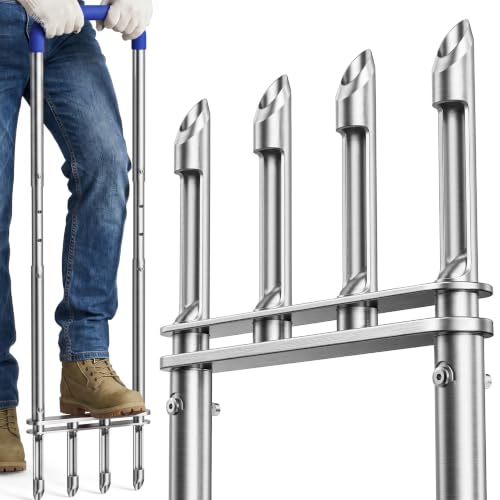
- Adjustable 43.3–48.5-inch height
- Dual-step platform with four hollow tines
- Flow-through design helps reduce clogging
Best For: Targeted aeration on small lawns, edges, and compacted spots
Rolling Spike Aerator
VEVOR 18-Inch Manual Lawn Aerator

- 18-inch rolling spike section
- Supports up to 40 pounds of added weight
- Four wheels and solid, mud-resistant spikes
Best For: Larger lawns, garden paths, and pet areas needing rolling coverage
Self-Cleaning Spike Aerator
RIFPOD Adjustable 15-Spike Aerator

- 15 iron spikes measure 1.74 inches long
- Dual-layer springs help clear soil and leaves
- Height adjusts from 32 to 35 inches
Best For: Manual spike aeration with adjustable handling and reduced debris cleanup
Best Small-Lawn Spike Aerator – Walensee 15-Spike Manual Aerator
If you need a straightforward lawn aerator for spot treatment and routine maintenance, this Walensee model uses 15 iron spikes to create channels for air, water, and nutrients. Its long handle, foot pedal, and cushioned T-handle make it more practical than aerator shoes for small areas.
Best For: Small lawns, lawn edges, bare spots, narrow spaces, and lightly compacted soil.
Pros:
- 15 sharp, 2.8-inch iron spikes provide three-row coverage.
- 34.6-inch handle, foot pedal, and cushioned grip help reduce bending.
- Detachable design supports easier assembly, carrying, and storage.
Cons:
- Not recommended for heavy sticky clay, rocky ground, or large-scale jobs.
- Hard or dry soil should be watered before use.
This is a sensible lawn aerator when you want controlled, localized aeration without wearing spiked shoes. Its manual design is best matched to smaller yards rather than extensive compacted areas.
Best Heavy-Duty Core Aerator – Landzie Rolling Lawn Aerator
For compacted soil that needs actual core removal, this Landzie rolling lawn aerator uses seven hollow stainless steel tines to pull soil plugs as it moves. Its heavy-duty steel frame and rolling design provide a more efficient approach than stationary spike tools.
Best For: Larger lawns and compacted silt, sandy, or loamy soil where core aeration is preferred.
Pros:
- Hollow tines remove soil plugs to improve deep air, water, and nutrient access.
- Rolling operation helps reduce the effort required for repeated passes.
- Replaceable, chamfered tines are designed to eject cores and resist clogging.
- Powder-coated heavy-duty steel offers durability and rust resistance.
Cons:
- At about 50.8 pounds, it is substantially heavier than handheld spike aerators.
- Core aeration leaves removed soil plugs on the lawn.
This is the strongest fit in the group for users who specifically want plug removal and a rolling workflow. Its weight should help penetration, but it also makes maneuverability and storage more demanding.
Best Targeted Coverage – Walensee 20-Spike Lawn Aerator
This four-row Walensee lawn aerator is designed for small yards and precise work around edges, borders, and repair patches. Its 20 steel spikes create multiple holes per press, helping prepare soil for watering, fertilizing, overseeding, or reseeding.
Best For: Small yards, garden borders, lawn edges, spot aeration, and lawn restoration.
Pros:
- 20 sharp, 2.8-inch spikes provide broad coverage per press.
- Four-row layout suits targeted aeration without disturbing large lawn sections.
- Heavy-duty steel construction provides stability during use.
- Manual operation requires no power source or fuel.
Cons:
- Extremely hard, dry soil may require watering first.
- Overly loose sandy soil is not the recommended working condition.
Choose this lawn aerator when coverage per press matters but you still want a compact, manual tool. It is particularly useful for localized preparation before reseeding or lawn repair rather than full-property aeration.
Best Adjustable-Handle Aerator – 3-Height Self-Cleaning Lawn Tool
This manual lawn aerator combines 15 three-inch iron spikes with a three-position adjustable handle. Its built-in dual-layer spring is designed to help clear debris from the spikes, while the mostly assembled design keeps setup quick.
Best For: Users who want adjustable working height, easier spike cleaning, and a sturdy manual tool for lawn care and hard-soil loosening.
Pros:
- Three handle-height settings can accommodate different users.
- Self-cleaning spring structure helps remove attached dirt and debris.
- 15 three-inch steel spikes create channels for air, water, and nutrients.
- Mostly assembled and detachable for convenient setup and storage.
Cons:
- It remains a manual tool, so aeration requires physical effort.
- Spike-based aeration does not remove soil plugs like a core aerator.
This is a practical lawn aerator for households where comfort and maintenance convenience are priorities. The adjustable handle and debris-clearing design distinguish it from simpler fixed-height spike tools.
Best Coring Aerator – Rolling Manual Plug Aerator
For shoppers comparing lawn aerators for compacted soil, this rolling manual coring tool stands out by removing plugs rather than simply poking holes. Its rotary design is intended to improve air, water, and nutrient access across small to medium lawns.
Best For: Homeowners who want a manual core aerator for small to medium lawns and do not mind a hands-on workout.
Pros:
- Pulls soil plugs to help relieve lawn compaction.
- Supports improved air, water, and nutrient absorption.
- Reinforced construction and dual push rods are designed for regular use.
- Balanced manual operation encourages efficient plug removal.
Cons:
- Manual operation can be physically demanding.
- At 43.7 pounds, it is heavier than some simpler lawn aerators.
- Designed primarily for small to medium lawns.
This is a strong choice when true core aeration is the priority. Its heavier build may require more effort to maneuver, but the plug-pulling action directly addresses compacted soil.
Best Adjustable Spike Aerator – Weighted Manual Lawn Roller
This manual roller is a practical option for shoppers seeking lawn aerators with straightforward setup and adjustable weight. Its pre-attached spikes penetrate the soil, while the drum can be filled with water or sand to tailor the rolling pressure.
Best For: Seasonal lawn care and homeowners who want an adjustable, economical spike aerator.
Pros:
- Pre-attached spikes make setup simple.
- Adjustable weight allows water or sand to be added.
- Heavy-duty iron construction is intended for home or professional use.
- Includes a one-year warranty with free replacement for quality issues.
Cons:
- Spike aeration does not remove soil plugs.
- Manual rolling still requires physical effort.
- Adding weight may make transport and handling more difficult.
Choose this model if convenience and adjustable pressure matter more than core extraction. It offers a simple manual approach for seasonal aeration, with the flexibility to change its weight for different conditions.
Best Heavy-Duty Spike Aerator – Rolling Lawn Aerator
For buyers comparing lawn aerators for small to medium yards, this rolling spike model combines a 32-pound base with room for additional sand or stones. Its spiral-spiked tread is designed for controlled rolling, while auxiliary wheels help protect hard surfaces during transport.
Best For: Homeowners who want a heavy-duty manual spike aerator with adjustable loading and easier storage movement.
Pros:
- Can be weighted up to 55 pounds with sand or stones.
- Spiral-spiked tread supports smoother rolling and directional control.
- Main body arrives assembled; only the handle requires attachment.
- Auxiliary TPR wheels make transport quieter and help protect driveways.
Cons:
- Water should not be added to the drum.
- Heavier loading may make pushing more demanding.
- Spike aeration does not extract soil plugs.
This model suits users who want stronger spike penetration without switching to a powered machine. Its loading capacity adds versatility, while the auxiliary wheels make moving it between storage and lawn more convenient.
Knee-Friendly Core Aerator – Adjustable Hollow-Tine Lawn Aerator
This manual lawn aerator is designed for targeted work on compacted soil, narrow strips, lawn edges, and smaller yards. Its adjustable height and dual-step platform help make repeated coring more comfortable, while four hollow tines remove small soil plugs to create pathways for air, water, and nutrients.
Best For: Gardeners who want a height-adjustable, upright tool for focused lawn aeration without powered equipment.
Pros:
- Adjusts from 43.3 to 48.5 inches for a more comfortable working position.
- Dual foot platform helps direct pressure evenly toward all four hollow tines.
- Flow-through tine design ejects soil from the side, reducing frequent cleaning.
- Stainless steel construction is suited to recurring outdoor maintenance.
Cons:
- Manual coring requires repeated stepping and is better suited to targeted areas than broad lawns.
- Four tines cover less ground per step than a rolling aerator.
Choose this model when comfort, soil-core removal, and control matter more than maximum coverage. Its compact design is particularly practical for isolated hard-soil spots and tight lawn areas.
Rolling Spike Aerator – VEVOR 18-Inch Manual Lawn Aerator
For covering more lawn with a push-and-pull motion, this VEVOR rolling lawn aerator uses an 18-inch spike section and four wheels. Its solid spikes are designed to penetrate compacted ground without clogging with mud, while the reinforced frame supports up to 40 pounds of added weight.
Best For: Homeowners who need a rolling manual lawn aerator for larger lawn areas, garden paths, or pet zones.
Pros:
- 18-inch working width helps cover more ground than a handheld or four-tine tool.
- Supports up to 40 pounds of added weight for deeper penetration in firm soil.
- Four-inch wheels and a V-shaped handle support controlled rolling over uneven terrain.
- Solid spikes resist mud clogging and require no fuel or electricity.
Cons:
- At 20.2 pounds, it is heavier to move and store than smaller manual aerators.
- Spike aeration punctures soil rather than removing soil cores.
- Added weight may require more effort to push or pull.
This is a practical choice when coverage and rolling stability are priorities. The pre-assembled spike section and straightforward setup also make it convenient for routine manual lawn care.
Self-Cleaning Spike Aerator – RIFPOD Adjustable 15-Spike Aerator
This manual lawn aerator uses 15 iron spikes measuring 1.74 inches long to loosen lower soil layers and promote airflow around grass roots. Its dual-layer spring design is intended to help clear soil and dried leaves during operation, while the adjustable handle accommodates different users and lawn conditions.
Best For: Users seeking a compact, height-adjustable spike aerator with a feature intended to reduce manual debris removal.
Pros:
- Fifteen spikes provide uniform punctures across the working area.
- Dual-layer spring design helps address soil and dried-leaf buildup after aeration.
- Height adjusts from 32 to 35 inches for improved ergonomic comfort.
- Thickened iron construction is treated for durability and rust resistance.
Cons:
- The 32–35-inch adjustment range is shorter than some upright aerators.
- Spike aeration loosens soil but does not extract cores.
- Manual operation still requires repeated physical effort.
This model suits buyers who value a simple, durable spike tool and want less interruption from debris buildup. Its 15-spike layout favors uniform puncturing, while the adjustable handle can make the working position more manageable.
How We Picked These Lawn Aerators
We focused on the features that make manual aeration more useful in real yards: tine design, working width, adjustability, weight capacity, maneuverability, durability, and ease of clearing soil from the tool. The selection includes spike aerators for quick surface penetration, rolling models for covering larger areas, and hollow-tine tools that remove soil plugs for deeper relief.
Because manual Lawn Aerators vary considerably in effort and coverage, we considered whether each design suits small maintenance jobs, compacted sections, or full seasonal treatment. Adjustable handles, wheels, step bars, self-cleaning features, and compatibility with added weight were also treated as practical advantages rather than universal necessities.
Quick Comparison
| Type | Best For | Main Advantage | Potential Limitation |
|---|---|---|---|
| Handheld spike tool | Small yards and targeted patches | Compact and affordable | Slower over large areas |
| Rolling spike aerator | Routine lawn maintenance | Faster coverage with less bending | May not penetrate very hard soil deeply |
| Weighted roller | Dense or compacted lawns | Added downward pressure | Heavier to push and store |
| Hollow-tine corer | Serious compaction problems | Removes plugs for deeper aeration | Requires more cleanup |
Key Buying Factors for Lawn Aerators
Spike or Hollow Tine?
Spike tools make holes by pressing solid points into the ground and work well for light, regular maintenance. Hollow-tine aerators extract small soil cores, creating more meaningful channels in compacted clay or heavily trafficked areas. They generally require more force and leave plugs on the surface.
Coverage and Maneuverability
A handheld tool can be precise around garden borders, trees, and narrow patches, while a roller is more efficient across open lawn. Check the tool’s width, wheel layout, handle length, and turning radius before choosing. Longer adjustable handles can reduce bending, but they may be less convenient in tight spaces.
Weight, Soil, and Storage
Hard soil often needs additional downward pressure, making a weighted or weight-compatible roller useful. However, extra weight also makes transport and storage more demanding. Look for reinforced frames, strong steel tines, stable wheels, and a design that can be cleaned easily after damp use.
Timing and Lawn Condition
Aerate when grass is actively growing and the soil is slightly moist, not saturated or bone-dry. Avoid using spike tools repeatedly on severely compacted ground if hollow-tine coring would better address the problem.
Who Should Buy Which Lawn Aerators?
Choose a handheld spike aerator if you have a small yard, isolated bare spots, or need a low-storage option. Choose a rolling spike model for faster coverage and routine seasonal maintenance. Choose a weighted roller when you want adjustable pressure across a larger lawn. Choose a hollow-tine aerator for dense clay, heavy foot traffic, or lawns that remain poorly drained after ordinary surface aeration.
Whichever style you select, match the tool to your soil and lawn size first. Consistent passes in the right conditions usually matter more than choosing the largest or heaviest aerator available.