Compacted soil can limit water, air, and nutrients from reaching grass roots, but the right manual aerator can make routine lawn care easier. Spike lawn aerators create channels in the soil without requiring fuel, batteries, or complicated maintenance.
This roundup compares 10 manual options, including rolling models, foot-press tools, adjustable designs, and a core aerator for shoppers who need deeper soil removal. Use the guide below to match the tool to your lawn size, soil condition, and available effort.
Best 10 Spike Lawn Aerators Picks for 2026
Best Small-Lawn Spike Aerator
Walensee 15-Spike Manual Aerator

- 15 iron spikes provide useful coverage for spot aeration.
- Foot pedal and cushioned T-handle improve leverage.
- Detachable design simplifies storage and carrying.
Best For: Small lawns, edges, bare spots, and lightly compacted patches
Best Rolling Spike Aerator for Large Areas

- 21-inch width and 45 spikes cover more ground per pass.
- 75-inch handle helps minimize bending.
- Quick-clip assembly supports a fast setup.
Best For: Wide-area lawn aeration with extended reach
Best Deep-Penetrating Spike Aerator
Colwelt 38-Inch Manual Lawn Tool

- Long, thick steel spikes create larger holes.
- Wide footplate helps apply force and control depth.
- 38-inch height reduces bending and crouching.
Best For: Controlled aeration of compacted patches and narrow areas
Best Heavy-Duty Rolling Spike Aerator

- 42 heat-treated spikes support repeated rolling use.
- Spiral arrangement helps smooth the rolling action.
- Adjustable handle and stone-fill roller add flexibility.
Best For: Stable rolling aeration on suitable, moistened soil
Deep-Plug Pick
Manual Hollow-Tine Lawn Aerator
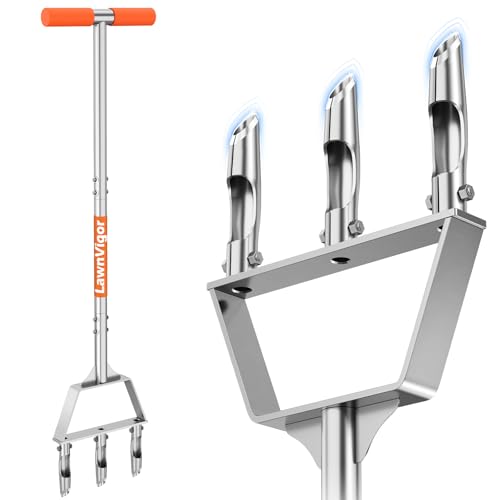
- Removes plugs with three hollow tines
- Built with replaceable, heat-treated tines
- Ergonomic handle and wide foot pedal
Best For: Compacted or clay soil needing deeper plug aeration
Small-Yard Spot Pick

- Creates 20 holes per press
- 2.8-inch steel spikes target compacted areas
- Useful for edges, borders, and reseeding
Best For: Small yards and precise spot aeration
Comfort-Control Pick
Adjustable Self-Cleaning Spike Aerator

- Three height settings improve handling comfort
- Self-cleaning spring design helps clear debris
- Fifteen three-inch iron spikes penetrate deeply
Best For: Users wanting adjustable, lower-maintenance spike aeration
Best Weighted Push Aerator
Suchtale 18-Inch Rolling Spike Aerator

- Five rotating star-tine assemblies
- Weight tray accepts added ballast
- Compact upright rolling design
Best For: Small lawns where extra penetration weight is useful
Best Adjustable-Height Aerator
RIFPOD 15-Spike Manual Lawn Aerator

- 15 iron spikes measure 1.74 inches
- Handle adjusts from 32 to 35 inches
- Dual springs help clear soil and leaves
Best For: Users seeking a more adjustable, cleanup-friendly manual tool
Best Heavy-Duty Rolling Aerator
Heavy-Duty Rolling Spike Aerator

- 32-pound body supports added ballast
- Maximum stated weight is 55 pounds
- Auxiliary wheels simplify transport
Best For: Small to medium lawns needing stronger rolling penetration
Best Small-Lawn Spike Aerator – Walensee 15-Spike Manual Aerator
If you need spike lawn aerators for spot treatment, narrow spaces, or routine care, this Walensee manual model offers a controlled alternative to aerator shoes. Its 15-spike layout covers small areas efficiently, while the foot pedal and cushioned T-handle help improve leverage.
Best For: Small lawns, lawn edges, bare spots, and lightly compacted patches.
Pros:
- 15 sharp iron spikes arranged in three rows for broader coverage per plunge.
- 34.6-inch handle, foot pedal, and cushioned T-handle help reduce bending and improve control.
- Detachable design is convenient for assembly, carrying, and storage.
- Provides a steadier alternative to spiked shoes without straps or shoe-size fitting.
Cons:
- Not recommended for heavy sticky clay, rocky ground, or large-scale aeration.
- Hard or dry soil should be watered first for easier penetration.
This is a practical choice when you want targeted aeration without maneuvering a roller. Its compact, manual design is better suited to manageable areas than an entire large lawn.
Best Rolling Spike Aerator for Large Areas – 21-Inch Rolling Lawn Aerator
Among spike lawn aerators, this 21-inch rolling model is designed to cover more ground with each pass. It arrives with 45 preassembled carburized spikes, a long handle, and fastening features intended to keep the spike assembly stable during use.
Best For: Users who want a wide rolling aerator with extended reach and quick assembly.
Pros:
- 21-inch width and 45 spikes help cover a broad section of lawn per pass.
- Carburized spikes are designed for greater strength and resistance to bending.
- 75-inch handle can reduce bending and back strain while working.
- Quick-clip connections and preassembled components support a fast setup.
Cons:
- At 17.2 pounds, it is substantially heavier than the manual spike tools in this roundup.
- Its rolling format may be less convenient for narrow spaces or spot treatment.
The wide drum and extra-long handle make this a coverage-focused option. Its secure fastening system and protected packaging are useful additions for shoppers prioritizing a stable setup and durable spike assembly.
Best Deep-Penetrating Spike Aerator – Colwelt 38-Inch Manual Lawn Tool
This Colwelt tool stands out among spike lawn aerators for its four long, thick steel spikes and wide footplate. The manual plunge design lets you direct downward force where needed, making it useful for compacted patches, narrow areas, and lawns that a tow-behind aerator cannot easily reach.
Best For: Small lawns and narrow areas where deeper, controlled penetration is useful.
Pros:
- 3.5-inch-long, 2/5-inch-diameter steel spikes are designed to create larger holes.
- Wide anti-slip footplate helps apply body weight and control penetration depth.
- 38-inch overall height reduces the need to bend or crouch.
- Steel construction and cushioned T-handle support repeated manual use.
Cons:
- Four-spike coverage requires repeated plunges across larger lawns.
- The lawn should be watered thoroughly first, especially when soil is hard or dry.
Choose this model when penetration and control matter more than speed. It is a focused manual tool rather than a high-coverage roller, but the longer spikes and broad footplate can be valuable for targeted work.
Best Heavy-Duty Rolling Spike Aerator – Walensee 42-Spike Roller
For shoppers comparing spike lawn aerators with a rolling format, this Walensee model combines 42 heat-treated spikes with a fillable roller. The spiral tine arrangement is designed for smooth, continuous rolling, while adding stones increases weight for deeper penetration.
Best For: Users seeking a stable rolling aerator with adjustable handle height and added weight capacity.
Pros:
- 42 reinforced, heat-treated 2-inch spikes are designed to resist deformation.
- Spiral tine arrangement helps provide smooth rolling and reduce vertical jumping.
- Roller can be filled with stones to improve penetration in suitable soil.
- Four-piece adjustable handle and rubber grip support varied user heights.
Cons:
- Requires thorough watering and stone filling for improved penetration.
- Not recommended for hard ground, clay, root-covered areas, or gravelly soil.
- Sand must not be used as roller filler.
This is a good fit for buyers who prefer rolling coverage and want to adjust working weight. Its soil limitations are important, so it works best when the lawn can be properly moistened and is free of rocky or root-heavy ground.
Deep-Plug Pick – Manual Hollow-Tine Lawn Aerator
This manual core aerator is a strong option when compacted or clay soil needs deeper, more substantial openings. Its three hollow tines remove soil plugs rather than simply poking holes, helping air, water, and nutrients reach the root zone. Water dry soil first and use a straight, controlled motion for best results.
Best For: Homeowners who want plug-style aeration for compacted soil, clay-heavy lawns, or targeted lawn improvement.
Pros:
- Three hollow tines create larger, deeper channels while removing soil plugs.
- Heat-treated tines and a bend-resistant metal frame are designed for repeated use.
- Non-clogging design, replaceable tines, and a wide foot pedal support easier maintenance and operation.
- Ergonomic, non-slip handle helps reduce back strain.
Cons:
- Requires moistening dry soil before use.
- Users should not rock, twist, or pry the tool sideways while it is in the ground.
- Manual core aeration can require more effort than spike-style spot aeration.
Choose this model if removing actual plugs is more important than covering broad areas quickly. The replaceable hollow tines add useful long-term value for routine lawn care.
Small-Yard Spot Pick – Walensee 4-Row Spike Aerator
For small lawns and precise jobs, this spike lawn aerator creates 20 holes per press across four rows. Its 2.8-inch steel spikes are suited to lawn edges, garden borders, reseeding areas, and other spots where broad equipment would be inconvenient.
Best For: Small yards, lawn edges, garden borders, spot aeration, and targeted reseeding or lawn repair.
Pros:
- Twenty sharp steel spikes create multiple air channels with each press.
- Four-row layout and compact foot plate provide targeted coverage in tight areas.
- Helps improve water, fertilizer, and seed access to the root zone.
- Heavy-duty steel construction and simple assembly support regular manual use.
Cons:
- Designed for small areas rather than fast coverage of large lawns.
- Works best when soil is slightly moistened and workable.
- Extremely hard, dry ground may make penetration difficult.
This is a practical choice when precision matters more than maximum coverage. Slightly moistening the soil before use should make pressing the spikes easier and smoother.
Comfort-Control Pick – Adjustable Self-Cleaning Spike Aerator
This manual spike lawn aerator combines 15 three-inch iron spikes with a three-position adjustable handle. The self-cleaning dual-layer spring design helps clear debris from the spike edges during use, while the height adjustment can make longer aeration sessions more comfortable for users of different heights.
Best For: Homeowners seeking adjustable handling, reduced cleanup, and deep spike aeration for firm or compacted soil.
Pros:
- Three-inch spikes create channels for air, water, and nutrients to reach grass roots.
- Built-in spring structure helps remove dirt and debris from the spike edges.
- Three height settings can reduce strain on the knees and waist.
- Heavy-duty all-steel construction and mostly assembled design support convenient use.
Cons:
- Spike aeration does not remove soil plugs like a hollow-tine core aerator.
- Only 15 spikes may provide less coverage per press than a wider multi-row model.
- Still requires manual effort in hard soil.
The adjustable handle and self-cleaning mechanism make this a feature-rich choice for repeated manual aeration. Its detachable design also helps with carrying and storage.
Best Weighted Push Aerator – Suchtale 18-Inch Rolling Spike Aerator
For gardeners comparing spike lawn aerators, the Suchtale offers a practical rolling design with five star-shaped steel tine assemblies. Its independent rotation and optional weight tray are intended to help the spikes reach moist or loosened soil without requiring you to bend over.
Best For: Homeowners who want a manually pushed aerator with adjustable added weight for small lawn and yard projects.
Pros:
- Five star-shaped steel tines have multiple uneven tips and can penetrate up to 2 inches, according to the supplied product details.
- Steel construction, powder coating, nylon spacers, and bearing-supported wheels are designed for durability.
- The tray can hold added weight, including a 16-inch brick, to increase soil penetration.
- Rolling operation keeps the user upright, while the compact design is easier to store and maneuver.
Cons:
- It is not recommended for hard, dry, or heavily compacted ground without first watering or loosening the soil.
- Added blocks or other weight increase the effort required to push the aerator.
- Assembly is required before use.
Choose this model if you want a straightforward spike aerator with a weight tray and a compact rolling footprint. Water the lawn thoroughly first for the intended performance.
Best Adjustable-Height Aerator – RIFPOD 15-Spike Manual Lawn Aerator
Among spike lawn aerators, the RIFPOD stands out for its adjustable handle and automatic dirt-and-leaf-clean design. Its 15 iron spikes are 1.74 inches long, providing a manual option for loosening lower soil layers while keeping the working height more comfortable for different users.
Best For: Users who prioritize adjustable handle height and simpler cleanup after aerating.
Pros:
- Dual-layer spring design is intended to help remove soil and dried leaves after aeration.
- Fifteen iron spikes provide uniform penetration into the lower soil layers.
- Height adjusts from 32 to 35 inches to accommodate different users and lawn conditions.
- Thickened iron construction with sprayed and arc-welded surfaces is designed for durability and rust resistance.
Cons:
- It is a manual tool, so larger lawns will require repeated physical effort.
- The supplied details do not list a weight tray or another method for adding penetration ballast.
- Assembly still requires screws, washers, and the included small wrench.
This is a sensible pick when ergonomic adjustment and reduced post-aeration cleanup matter more than adding substantial weight. Its 15-spike layout is suited to routine manual lawn maintenance.
Best Heavy-Duty Rolling Aerator – Heavy-Duty Rolling Spike Aerator
For shoppers comparing spike lawn aerators for stronger penetration, this rolling model combines a 32-pound body with a fillable drum. Adding sand or stones through the covered opening can raise the total weight to 55 pounds, while the spiral-spiked tread is designed to roll smoothly across small to medium-sized lawns.
Best For: Small to medium-sized lawns where a heavier rolling aerator can reduce the need for repeated passes.
Pros:
- The 32-pound aerator can be weighted with sand or stones up to a stated total of 55 pounds.
- Spiral-spiked tread is designed for smoother rolling and directional control.
- The main body arrives assembled; only the handle needs to be attached.
- Auxiliary TPR wheels make transport between the lawn and storage area easier and help protect driveways from the spikes.
Cons:
- Its 38.3-pound listed item weight may be more difficult to move or store than lighter manual models.
- The drum should not be filled with water; only sand or stones are specified for added weight.
- Extra ballast increases rolling effort.
This model makes the most sense when penetration and rolling efficiency are priorities. Its heavier frame and optional ballast offer more force than a lightweight spike aerator, but transport and pushing require greater effort.
How We Picked These Spike Lawn Aerators
We focused on manual aerators with practical features for residential lawn care, including spike count, working width, handle design, frame strength, assembly requirements, height adjustment, and cleaning convenience. The selection includes both compact press-style tools and rolling models so different yard sizes and user preferences are represented.
Spike aerators puncture the soil to improve air and water movement, while the included core aerator removes small plugs. Neither type replaces proper mowing, watering, or soil testing, but each can be useful when compaction is limiting grass growth.
Quick Comparison
| Best For | Look For | Most Suitable Style |
|---|---|---|
| Small patches and narrow areas | Compact frame and footplate | Manual press aerator |
| Routine treatment of larger lawns | Wide drum and multiple spikes | Rolling spike aerator |
| Hard, compacted soil | Strong frame and stable grip | Heavy-duty rolling or foot model |
| Deeper soil relief | Hollow, non-clogging tines | Manual core aerator |
| Different users or soil conditions | Adjustable height or tine settings | Adjustable aerator |
Key Buying Factors for Spike Lawn Aerators
Spike Count and Working Width
More spikes can create more punctures per pass, while a wider tool can cover ground faster. However, larger models may be harder to control around trees, garden beds, and tight corners. Choose compact equipment for small or segmented lawns and a wider roller for open areas.
Push Design Versus Foot-Press Design
Rolling tools reduce repeated bending and are generally efficient across larger spaces. Foot-press models let you apply direct downward force, which may help in firm soil, but they require more stepping and lifting. A comfortable T-grip, long handle, and stable footplate can make a noticeable difference.
Construction and Maintenance
Look for steel spikes, a rigid frame, secure connections, and a handle that does not flex excessively. Self-cleaning or non-clogging designs are useful when soil is damp. Avoid aerating waterlogged ground, because wet soil can smear and compact rather than open cleanly.
Spike Aeration or Core Aeration
Spike tools make holes without removing soil and work well for light, regular maintenance. Core aerators extract plugs and are better suited to severe compaction, though they usually require more effort and cleanup. If the lawn has dense clay or persistent drainage problems, core aeration may be the more effective choice.
Who Should Buy Which Spike Lawn Aerators?
Choose a compact manual spike aerator if you maintain a small yard, isolated bare spots, or areas near landscaping. Pick a rolling model with a broad working width when you want to cover an open lawn more efficiently. Heavy-duty designs are better for frequent use or firm soil, while adjustable models suit households sharing tools or managing varied ground conditions.
Buy a manual core aerator when improving soil structure is the priority and removing plugs is acceptable. Whichever style you choose, aerate during the lawn’s active growing season when the soil is moist but not saturated, then follow with appropriate watering and overseeding if needed.