Choosing the right log splitter can make preparing a season’s firewood faster, safer, and far less physically demanding. The best option depends on your log size, workload, available power, and whether you value portability or quiet operation.
We compared 10 electric, gas, hydraulic, and manual models for home firewood tasks, focusing on splitting capacity, power, convenience, and practical ownership needs.
Best 10 Log Splitters for Home Firewood Picks for 2026
Best Electric Workhorse
14-Ton BILT HARD Electric Splitter

- 14 tons of hydraulic splitting force
- Handles logs up to 20 inches long
- Uses standard 120V household power
Best For: Homeowners processing seasonal firewood near an electrical outlet
Best for Safe Kindling

- Fixed wedge keeps hands away from the blade
- 9-inch opening handles larger kindling logs
- One-piece cast iron needs no maintenance
Best For: Safe, manual kindling preparation for fireplaces and wood stoves
Best Heavy-Duty Gas Power
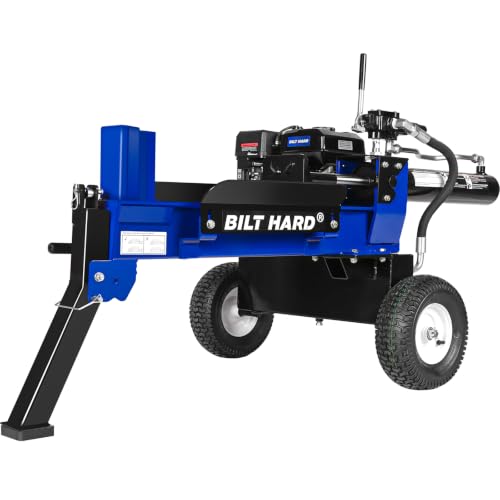
- 22 tons of splitting force
- Handles logs up to 21 inches long
- 13-inch wheels and towing capability
Best For: Large outdoor firewood jobs on properties with hardwood logs
Best Compact Manual Option

- Weighs 7.3 pounds for easy portability
- Can be secured with four mounting screws
- Useful for kindling, camping, and small logs
Best For: Occasional small-log and kindling preparation around the home
Best Electric Value

- 6.5 tons of ram force
- Handles logs up to 20.5 inches long
- Accepts logs up to 10 inches in diameter
Best For: Routine residential firewood splitting
Safest Kindling Choice

- Protective 6.5-inch safety ring
- No axe swing required
- Durable one-piece cast iron
Best For: Small kindling for household fires
Best Fast-Cycle Option
7-Ton Electric Hydraulic Splitter

- 7 tons of hydraulic force
- 17-second cycle with automatic ram return
- Handles logs up to 20.5 inches long
Best For: Efficient residential firewood processing
Best High-Capacity Gas Pick

- 18-ton force with a 7HP 209cc engine
- Splits logs up to 20 inches by 16 inches
- 7.5-second cycle and portable full-beam design
Best For: Large home firewood piles and off-grid splitting
Best Compact Electric Pick
PowerSmart 6.5-Ton Log Splitter

- 15-amp motor with 6.5-ton hydraulic force
- Handles logs up to 20 inches by 10 inches
- Compact design with wheels and two-year warranty
Best For: Light-duty home use and convenient storage
Best Balanced Gas Pick
SuperHandy 20-Ton Log Splitter

- 20-ton force from a 7HP four-stroke engine
- Splits logs up to 20 inches by 16 inches
- 7.5-second cycle with folding handle and wheels
Best For: Portable, recurring home firewood splitting
Best Electric Workhorse – 14-Ton BILT HARD Electric Splitter
For homeowners comparing log splitters for home firewood, the BILT HARD 14-ton electric model offers substantial hydraulic power without gasoline, exhaust, or engine maintenance. Its 20-inch log capacity and household 120V operation suit seasonal firewood preparation for fireplaces, stoves, and backyard wood piles.
Best For: Homeowners who want a powerful electric splitter for hardwood and seasoned logs up to 20 inches long and 16 inches in diameter.
Pros:
- 14 tons of splitting force and a 15-amp, 1800W motor
- Two-stage hydraulic pump supports smooth operation and a fast cycle
- Two-hand operation, overload protection, support leg, and transport wheels
- Runs on standard 120V household power without gas emissions
Cons:
- At 133.3 pounds, it is substantial to move
- Requires access to household electrical power
This is a practical middle-ground choice for regular home firewood processing: stronger than a manual kindling tool while simpler and cleaner to operate than a gas splitter.
Best for Safe Kindling – Kindling Cracker King XL
The Kindling Cracker King XL is a manual option for shoppers seeking log splitters for home firewood without an engine, hydraulic system, or swinging axe. Its fixed wedge and cast-iron safety ring make it especially suited to turning smaller pieces into fireplace kindling.
Best For: Families and homeowners who prioritize controlled, low-maintenance kindling preparation and need a larger 9-inch opening.
Pros:
- Safety ring keeps hands away from the fixed splitting wedge
- 9-inch opening accommodates logs nearly 40% larger than the original model
- No moving parts, fuel, or blade sharpening required
- Can be used with a mallet, hammer, or another piece of wood
Cons:
- Manual operation is intended for kindling rather than high-volume log splitting
- Requires repeated striking with a mallet or similar object
With its 17-inch height and durable one-piece cast-iron construction, the King XL is a strong fit for controlled kindling work, though it is not a replacement for a powered splitter when processing large rounds.
Best Heavy-Duty Gas Power – 22-Ton BILT HARD Gas Splitter
For larger outdoor firewood jobs, the BILT HARD 22-ton gas model provides more force and log capacity than compact electric or manual alternatives. Its 209cc engine, two-stage pump, and horizontal design are aimed at demanding home, farm, and outdoor splitting work.
Best For: Property owners who process hardwood or seasoned logs up to 21 inches long and want a high-powered, towable splitter.
Pros:
- 22 tons of hydraulic splitting force from a 209cc gas engine
- 14 GPM two-stage pump with a stated 7-second cycle time
- Handles logs up to 21 inches long
- 13-inch wheels and towing capability support movement around the property
Cons:
- At 274 pounds, it is considerably heavier than compact models
- Gas operation requires fuel and engine maintenance
- Designed for outdoor use rather than convenient indoor or garage operation
This is the most capable choice in the group for demanding firewood processing, provided you have outdoor space and are comfortable maintaining a gas-powered machine.
Best Compact Manual Option – Cast-Iron Kindling Splitter L
The Kindling Splitter L is a compact manual tool for shoppers looking at log splitters for home firewood on a smaller scale. Its cast-iron construction, open design, and hammer-driven operation make it useful for backyard stacks, camping, fireplaces, pizza ovens, saunas, and barbecues.
Best For: Homeowners who need an inexpensive, portable manual splitter for small logs and kindling rather than high-volume processing.
Pros:
- Compact 7.3-pound cast-iron design is easy to store and transport
- Can be mounted with four screws for added stability
- Open construction accommodates different household log sizes
- Requires no fuel, electricity, or axe
Cons:
- Manual hammering is slower for large quantities of firewood
- Its 9.8-inch height and 6.1-inch blade width are better suited to smaller pieces
This lightweight splitter is a convenient companion tool for producing kindling and handling occasional small logs, but larger rounds or substantial wood piles call for a powered model.
Best Electric Value – YARDMAX 6.5-Ton Log Splitter
For homeowners comparing log splitters for home firewood, the YARDMAX YS0650 offers electric-powered splitting with 6.5 tons of ram force. It accommodates logs up to 20.5 inches long and 10 inches in diameter, making it suited to many routine residential firewood tasks.
Best For: Homeowners who want a substantial electric splitter for standard fireplace, stove, or fire-pit firewood.
Pros:
- 6.5 tons of ram force for efficient splitting.
- Handles logs up to 20.5 inches long.
- Accepts logs up to 10 inches in diameter.
Cons:
- At 104.7 pounds, it is relatively heavy to move.
- The supplied notes do not specify cycle time or transport features.
The YARDMAX is a practical choice when you need meaningful splitting power without stepping up to a larger machine. Its stated log capacity covers common home firewood dimensions, though its weight may make placement and storage more demanding.
Safest Kindling Choice – Kindling Cracker Original
The Kindling Cracker Original takes a different approach to log splitters for home firewood: instead of powered hydraulics or a swinging axe, it uses a fixed wedge inside a protective cast-iron ring. Place a piece of wood in the 6.5-inch opening and strike the top with a mallet, hammer, or another piece of wood.
Best For: Families and homeowners who primarily need smaller kindling for fireplaces, wood stoves, fire pits, and outdoor cooking.
Pros:
- Protective ring keeps hands away from the fixed splitting wedge.
- Requires no axe swing and uses less force than a standard axe.
- One-piece cast-iron construction has no moving parts or blade to sharpen.
- Can be mounted to a stump or workbench or used freestanding.
Cons:
- The 6.5-inch opening is intended for kindling-sized wood rather than large logs.
- Splitting still requires repeated striking with a mallet, hammer, or piece of wood.
- At 4.8 kg, it is not as light as a basic hand tool.
This is a focused kindling tool rather than a replacement for a hydraulic log splitter. Its enclosed design, simple operation, and maintenance-free cast-iron construction make it appealing when safe, repeatable small-wood preparation is the priority.
Best Fast-Cycle Option – 7-Ton Electric Hydraulic Splitter
For homeowners seeking log splitters for home firewood, this 7-ton electric hydraulic model combines a 15A motor with 2,900 PSI splitting pressure. Its 17-second cycle time and automatic ram return are designed to keep residential firewood processing moving efficiently.
Best For: Home users who want a portable electric splitter with a stated fast cycle and capacity for logs up to 20.5 inches long.
Pros:
- 7-ton hydraulic force and 2,900 PSI splitting pressure.
- 17-second cycle time with automatic ram return.
- Handles logs from 2 to 10 inches in diameter and up to 20.5 inches long.
- Electric design produces no gasoline exhaust, and two-hand controls support safer operation.
Cons:
- Requires access to suitable electric power for its 15A motor.
- At 97 pounds, it may still require effort to reposition.
- The supplied notes do not describe performance on logs beyond the stated capacity.
With slightly more stated force than the YARDMAX and a defined 17-second return cycle, this model is a strong fit for repeated home splitting. Its wheels and compact dimensions make storage and movement more manageable, while the electric design avoids fuel handling.
Best High-Capacity Gas Pick – 18-Ton BILT HARD Log Splitter
For homeowners handling substantial firewood piles, the BILT HARD 18-Ton is one of the more capable log splitters for home firewood. Its gas engine, 18-ton force, and full-beam design are suited to larger, tougher logs without requiring an electrical outlet.
Best For: Homeowners who need portable, higher-volume splitting for logs up to 20 inches long and 16 inches in diameter.
Pros:
- 18-ton hydraulic splitting force from a 7HP 209cc OHV engine
- Handles logs up to 20 inches long and 16 inches in diameter
- 7.5-second cycle time and 10-inch tires support efficient, portable use
- Full-beam steel construction with a 10.5 GPM hydraulic system
Cons:
- At 146 pounds, it is substantial to move
- Hydraulic fluid and engine oil are not included
- Gas operation requires outdoor use in a well-ventilated area
This model makes sense when splitting capacity and mobility matter more than compact storage. Its fast cycle and gas-powered design are particularly useful for larger batches, provided you are prepared for fuel, fluids, and heavier equipment.
Best Compact Electric Pick – PowerSmart 6.5-Ton Log Splitter
PowerSmart Electric Log Splitter, 6.5-Ton, 3450 Motor Speed, 15 Amp, Horizontal Full Beam Design
Check Price On AmazonThe PowerSmart 6.5-Ton is a practical choice among log splitters for home firewood when light-duty capacity and easy storage are priorities. Its 15-amp electric motor avoids gas-engine maintenance, while the compact frame and wheels make it convenient for routine household use.
Best For: Homeowners splitting logs up to 20 inches long and 10 inches in diameter for light-duty firewood preparation.
Pros:
- 15-amp induction motor with a 6.5-ton hydraulic system
- Compact 37.4-by-10.6-by-18.1-inch design for storage and transport
- Wide rear wheels and handle help with movement across uneven terrain
- Includes a two-year warranty and dedicated customer support
Cons:
- Designed for light-duty use rather than the largest logs
- 20-second cycle time is slower than the listed gas models
- Electric operation requires access to power
Choose this splitter for convenience and manageable household workloads rather than maximum throughput. Its smaller footprint and electric motor are appealing for homeowners who want a simpler machine for occasional firewood preparation.
Best Balanced Gas Pick – SuperHandy 20-Ton Log Splitter
The SuperHandy 20-Ton combines strong capacity with practical portability, making it a well-rounded option among log splitters for home firewood. Its 7HP gas engine and two-stage hydraulic pump provide consistent force for larger logs, while the folding handle helps with transport.
Best For: Homeowners who want portable gas-powered performance for logs up to 20 inches long and 16 inches in diameter.
Pros:
- 20-ton splitting capacity powered by a 7HP four-stroke OHV engine
- Handles logs up to 20 inches long and 16 inches in diameter
- 7.5-second cycle time supports faster firewood processing
- Folding handle and 10-inch tubeless polyurethane wheels improve portability
Cons:
- Weighs approximately 148.7 pounds
- Hydraulic fluid is not included
- Gas operation requires appropriate outdoor use and safety equipment
This is a strong middle ground for users who need more capacity than a light-duty electric splitter but still want a maneuverable horizontal machine. Its performance-focused design suits recurring seasonal splitting and locations without convenient electrical access.
How We Picked the Best Log Splitters for Home Firewood
We selected models across the main categories used by homeowners: manual kindling splitters, compact electric splitters, heavier-duty electric units, portable gas splitters, and hydraulic machines. We considered stated tonnage, log-length capacity, power source, operating position, portability, return-cycle convenience, and the type of work each model is designed to handle.
Because advertised tonnage does not tell the whole story, we also looked at how each splitter fits realistic home workloads. A small electric model may be ideal for dry, moderate-size rounds, while larger or knotty logs can justify a gas-powered or higher-capacity hydraulic machine.
Quick Comparison
- Manual kindling splitters: Best for small pieces, kindling, quiet operation, and minimal maintenance.
- 6.5- to 7-ton electric splitters: Suitable for many routine home firewood tasks when an outlet is available.
- 14-ton electric splitters: A stronger choice for larger rounds without gas, fumes, or engine maintenance.
- 18- to 22-ton gas splitters: Better for substantial volumes, tougher wood, and outdoor use away from outlets.
- 20-ton hydraulic models: Designed for homeowners who want considerable splitting force and a more capable general-purpose machine.
Key Buying Factors for Home Firewood
Power and Log Size
Match the splitter to the wood you actually burn. Diameter, length, species, moisture level, and knots all affect difficulty. Check the manufacturer’s maximum log length and do not assume the rated tonnage guarantees easy handling of every oversized or twisted round.
Electric, Gas, or Manual Operation
Electric models are quieter, cleaner, and generally simpler to maintain, but they require a suitable outlet and may need a heavy-duty extension cord. Gas models offer freedom from electrical access and typically suit larger workloads, though they require fuel, oil, ventilation, and routine engine care. Manual splitters are inexpensive and dependable for kindling or occasional light work, but they require substantially more effort.
Portability and Working Position
Look for wheels, a stable frame, and a horizontal or vertical configuration that suits your rounds. Horizontal operation is convenient for smaller pieces; vertical capability can reduce lifting when handling heavy logs. Confirm how the unit is moved and whether its weight fits your storage setup.
Safety and Maintenance
Use eye protection, sturdy footwear, gloves suited to handling wood, and a clear work area. Keep hands away from the splitting wedge and never bypass safety features. For hydraulic machines, periodically inspect hoses, fittings, fluid levels, and bolts. Store electric and gas equipment according to the manufacturer’s instructions.
Who Should Buy Which Log Splitters for Home Firewood?
Choose a manual kindling splitter if you mainly prepare small splits for a fireplace, stove, campfire, or fire pit and want the lowest-maintenance solution.
Choose a compact electric model for occasional or moderate home firewood work near an outlet. It is a practical fit for users who prioritize low noise and simple startup.
Choose a higher-tonnage electric splitter when you want more capacity for regular household use but still prefer the convenience of electric power.
Choose a gas splitter for large batches, tougher rounds, or properties where electrical access is limited. Select the larger-capacity option when productivity and challenging wood matter more than quiet operation.
Before buying, measure your typical logs, estimate how many cords you process each year, and confirm storage, power, and transport requirements. The right match is the model that handles your normal workload without paying for capability you will rarely use.