Curved edges, arches, cutouts, and other shaped parts are difficult to smooth with a standard random orbital sander. A spindle sander uses an abrasive sleeve on a rotating drum to follow contours more evenly while reducing hand-sanding time.
We selected 10 options across several sizes and configurations, from compact benchtop machines to combination belt-and-spindle sanders. Use the guide below to compare capacity, control, included accessories, and the features that matter most for your woodworking projects.
Best 10 Spindle Sanders for Curved Wood Picks for 2026
Best Value
WEN 6510T Oscillating Spindle Sander
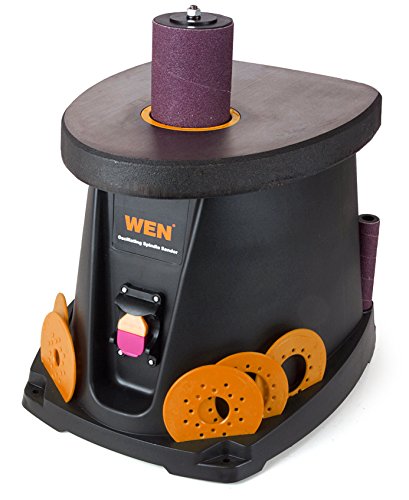
- 3.5-amp motor with 2,000 RPM spindle speed
- 58 oscillations per minute for contour sanding
- Onboard storage and dust-extractor port
Best For: DIY woodworkers seeking a dedicated benchtop spindle sander
Best Accessory Kit
POWERTEC 20-Piece Sanding Drum Kit

- Four drum arbors with 1/4-inch and 1/8-inch shanks
- 16 sanding bands in multiple sizes
- Includes 80- and 120-grit sleeves and a case
Best For: Drill-press and drill users sanding contours and irregular shapes
Best Versatility
WEN 6524 Belt and Spindle Sander
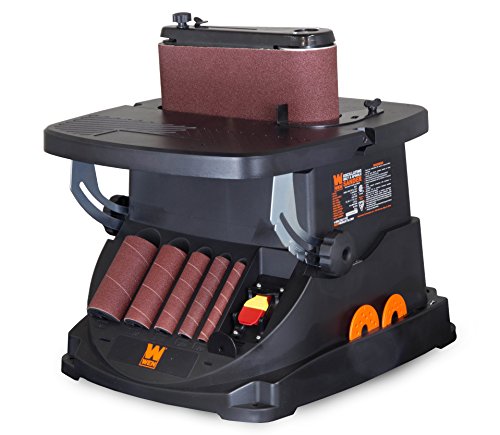
- Five spindle sizes from 1/2 to 2 inches
- Includes a 4-by-24-inch belt attachment
- Beveling table, storage, and included accessories
Best For: Users wanting spindle and belt sanding in one machine
Best Worktable
VEVOR BOSS200 Oscillating Spindle Sander

- 2,400 RPM rotation with a 5/8-inch stroke
- Six sleeves from 1/2 to 3 inches
- Wide cast-iron table and dust-collection port
Best For: Furniture and DIY projects needing stable support for varied curves
Portable Pick
WEN HA5932 Variable-Speed Spindle Sander
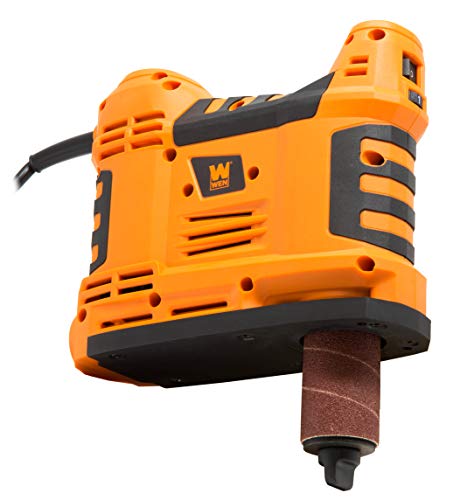
- Handheld or clamp-mounted benchtop use
- Variable 1,800–3,200 RPM motor
- Four spindle sizes and included accessories
Best For: Portable curved-edge sanding and flexible DIY use
Versatile Benchtop Choice
VEVOR Oscillating Belt and Spindle Sander
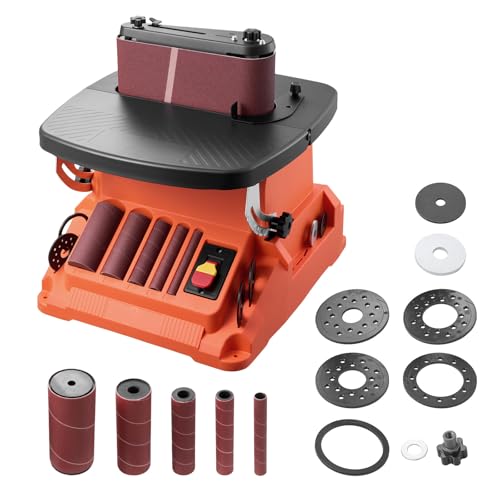
- Combines belt and spindle sanding
- Five sleeves from 1/2 to 2 inches
- Tilting table and vacuum-compatible dust port
Best For: Multi-purpose benchtop sanding and furniture projects
Large-Table Option
WEN AT6535 Oscillating Spindle Sander
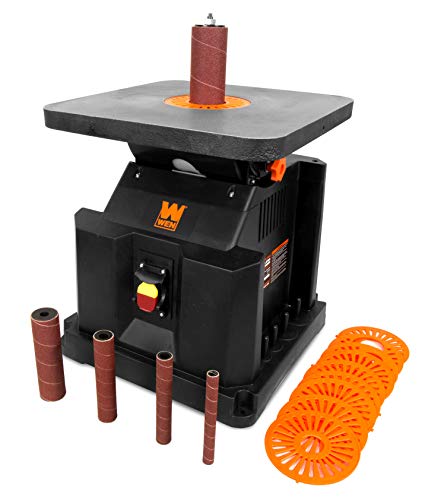
- 14-1/2-inch square beveling table
- Five sleeve sizes up to 2 inches
- Table angles up to 45 degrees
Best For: Stable workshop sanding of curved and angled workpieces
Best All-Around Value
VEVOR Oscillating Spindle Sander

- 2,400 RPM operation for curved and contoured surfaces
- Six sleeves from 1/2 to 3 inches
- Cast-iron table with vacuum-compatible dust port
Best For: DIY woodworkers needing versatile sleeve sizes and stable support
Most Versatile
Woodskil Variable-Speed Belt and Spindle Sander

- Combines spindle and 4 x 24-inch belt sanding
- Variable 1,000–1,800 RPM spindle speed
- Includes five sleeves from 1/2 to 2 inches
Best For: Projects spanning curved edges and large flat surfaces
Simple Benchtop Pick
RIKON Oscillating Spindle Sander

- Large 12-5/8 x 12-inch work surface
- 1/2 HP motor for benchtop sanding
- Includes five spindles and six table inserts
Best For: Dedicated curved-edge sanding with a roomy work surface
Best Value – WEN 6510T Oscillating Spindle Sander
The WEN 6510T is a practical choice for sanding curved wood, with a 3.5-amp motor, 2,000 RPM spindle speed, and 58 oscillations per minute. Its onboard accessory storage and dust port make it suitable for organized workshop use.
Best For: DIY woodworkers who want a dedicated benchtop spindle sander with straightforward dust-collection support.
Pros:
- 3.5-amp motor provides up to 2,000 RPM and 58 OPM.
- Onboard storage keeps accessories together.
- Dust port can connect to a dust extractor to reduce cleanup.
Cons:
- The supplied details identify a single 80-grit setup rather than a broad assortment of grits.
- At 30.2 pounds, it is substantial for a benchtop tool.
For routine curved-edge and contour sanding, the 6510T offers the essential oscillating-spindle features without adding belt-sanding functions. It is a sensible fit when dedicated spindle sanding is the priority.
Best Accessory Kit – POWERTEC 20-Piece Sanding Drum Kit
The POWERTEC 71634 is an accessory kit rather than a standalone spindle sander, but it can expand your options for sanding curved wood. Its assorted drums, shanks, and sleeves are designed for compatible drills or drill presses.
Best For: Woodworkers who need portable or drill-press sanding accessories for holes, contours, and irregular shapes.
Pros:
- Includes four drum arbors, 16 sanding bands, and a molded carrying case.
- Offers 1/4-inch and 1/8-inch shank attachments for compatible tools.
- Includes 80- and 120-grit aluminum-oxide sleeves in several diameters.
Cons:
- Requires a compatible drill or drill press instead of operating as a dedicated sander.
- Its sanding sleeves are limited to coarse and fine options listed in the supplied details.
This kit is useful when flexibility matters more than the stability of a dedicated benchtop spindle sander. The range of drum diameters makes it adaptable for curved and irregular work, provided your tool accepts the included shanks.
Best Versatility – WEN 6524 Belt and Spindle Sander
The WEN 6524 combines spindle and belt sanding, giving you two approaches for curved wood and broader surface work. It includes five spindle sizes, a 4-by-24-inch belt attachment, and a beveling work table.
Best For: Woodworkers who want one machine for curved edges, contours, beveling, and larger flat sanding tasks.
Pros:
- Includes 1/2-, 3/4-, 1-, 1-1/2-, and 2-inch spindle sizes.
- Also provides a 4-by-24-inch belt sanding attachment.
- Features up to 2,000 RPM spindle speed, 58 oscillations per minute, and onboard storage.
- Includes a beveling work table, throat plates, drums, and 80-grit sandpaper.
Cons:
- The supplied abrasive selection is listed as 80 grit.
- Its combination design may be more equipment than needed for spindle-only sanding.
The 6524 is the strongest choice here when versatility is valuable. Its multiple spindle diameters address different curves, while the belt attachment handles work that would be less convenient on a narrow spindle.
Best Worktable – VEVOR BOSS200 Oscillating Spindle Sander
The VEVOR BOSS200 is built for curved wood and contoured surfaces, pairing a 2,400 RPM motor with six sanding sleeve sizes. Its wide cast-iron worktable, 5/8-inch stroke, and dust port support stable, cleaner sanding.
Best For: Furniture finishing, crafts, and DIY woodworking involving varied curves and workpiece thicknesses.
Pros:
- 2,400 RPM rotation supports efficient sanding on flat, curved, and contoured surfaces.
- Includes six sleeves from 1/2 to 3 inches and six table inserts.
- Wide 15.4-by-16.3-inch cast-iron worktable provides stable support.
- Integrated storage and a 2.26-inch ID dust port help organization and cleanup.
Cons:
- The supplied details list 80-grit sleeves rather than multiple abrasive grades.
- At 37.5 pounds, it is the heaviest machine in this selection.
The BOSS200 stands out for its larger worktable and broad sleeve range. Choose it when stable support and the ability to work on different curve sizes matter more than keeping the machine especially light.
Portable Pick – WEN HA5932 Variable-Speed Spindle Sander
For spindle sanders for curved wood that need to move between projects, the WEN HA5932 combines handheld portability with the option to become a benchtop tool. Its variable-speed motor and four spindle diameters provide useful flexibility for sanding curves and hard-to-reach areas.
Best For: DIYers and woodworkers who want a portable sander that can also be clamped to a workbench.
Pros:
- Lightweight design supports handheld sanding in difficult-to-reach places.
- Converts to a stationary benchtop sander with included mounting hardware.
- Variable speed from 1,800 to 3,200 RPM and four spindle diameters suit different curved profiles.
- Includes sanding sleeves, rubber drums, clamps, a guide plate, and a dust port.
Cons:
- Its 80-grit included sleeves are coarse and may require additional grits for finer finishing.
- The 1-1/2-inch maximum spindle diameter offers less coverage than larger benchtop options.
The HA5932 is a practical choice when portability matters as much as control. Its compact format is especially useful for occasional curved-edge work, while the workbench-clamping option adds stability when needed.
Versatile Benchtop Choice – VEVOR Oscillating Belt and Spindle Sander
The VEVOR combines spindle and belt sanding in one benchtop machine, making it a versatile option among spindle sanders for curved wood. Its five sleeves, tilting table, and 5/8-inch oscillating stroke support curved, contoured, and angled sanding tasks.
Best For: Woodworkers who want one benchtop tool for curved profiles, flat surfaces, furniture finishing, and DIY projects.
Pros:
- Handles flat, curved, and contoured surfaces with both belt and spindle sanding.
- Includes five sleeve sizes from 1/2 to 2 inches plus five table inserts.
- 0–45-degree tilting worktable accommodates angled workpieces.
- Dust port connects to vacuum hoses, and integrated storage keeps accessories organized.
Cons:
- At 37.5 pounds, it is less convenient to move than a portable sander.
- The included 80-grit abrasive may not be ideal for fine finishing without replacement abrasives.
- Its larger benchtop footprint requires dedicated workspace.
Choose this model when versatility and table-based control are priorities. The belt attachment expands its usefulness beyond curved edges, while the multiple sleeves and tilting table make it adaptable to varied workpieces.
Large-Table Option – WEN AT6535 Oscillating Spindle Sander
WEN AT6535 3.5-Amp Oscillating Spindle Sander with Extra Large Beveling Table Top
Check Price On AmazonFor stable, table-based work on curved wood, the WEN AT6535 offers a spacious 14-1/2-by-14-1/2-inch beveling table and five sanding sleeve sizes. Its oscillating spindle helps support consistent sanding across curved profiles and angled workpieces.
Best For: Woodworkers who value a large work surface, onboard storage, and support for angled sanding.
Pros:
- Large table provides room to support bigger workpieces.
- Table bevels up to 45 degrees for angled work.
- Five sleeve sizes from 1/2 to 2 inches accommodate different curves.
- Onboard storage keeps accessories and sandpapers organized.
Cons:
- Its 33.2-pound benchtop design is not intended for handheld or highly portable use.
- The 3.5-amp motor and 2,000 RPM speed provide less listed power and speed than the WEN portable model.
- Included abrasive is 80 grit, which may require additional grits for finishing.
The AT6535 is a sensible fit for a dedicated workshop where table size and positioning matter. Its broad beveling surface and range of sleeves make it well suited to repeatable curved and angled sanding tasks.
Best All-Around Value – VEVOR Oscillating Spindle Sander
For shoppers comparing spindle sanders for curved wood, the VEVOR offers a practical benchtop setup with 2,400 RPM operation, six sleeve sizes, and a cast-iron worktable. It is suited to smoothing curved, contoured, and flat surfaces in furniture, craft, and DIY woodworking projects.
Best For: DIY woodworkers who want broad sleeve-size coverage and a spacious, stable work surface.
Pros:
- Six sanding sleeves from 1/2 to 3 inches accommodate different curves and workpiece sizes.
- Its 15.6 x 11.6-inch cast-iron table provides stable support.
- A 5/8-inch stroke handles both thin and thick workpieces.
- The dust port connects to vacuum hoses, and onboard slots organize accessories.
Cons:
- It uses a fixed 2,400 RPM speed rather than variable speed.
- The included sanding sleeves are listed as 80 grit, limiting the supplied grit choice.
The VEVOR is a well-rounded choice when curved-wood work calls for multiple sleeve diameters, steady benchtop support, and straightforward dust-collection compatibility.
Most Versatile – Woodskil Variable-Speed Belt and Spindle Sander
The Woodskil stands out among spindle sanders for curved wood because it combines oscillating spindle sanding with a 4 x 24-inch belt. Variable speed lets you adjust the machine for detailed curved edges, furniture refinishing, and larger flat surfaces.
Best For: Woodworkers who want one machine for curved-edge sanding and broad flat-surface work.
Pros:
- Dual belt-and-spindle modes cover complex curves and large flat areas.
- Variable spindle speed ranges from 1,000 to 1,800 RPM, with 29 to 58 OPM oscillation.
- Five drum sleeves from 1/2 to 2 inches support different shaping tasks.
- Integrated storage and a dust-collection belt cover help with organization and cleanup.
Cons:
- The largest included spindle sleeve is 2 inches, smaller than the VEVOR’s maximum sleeve.
- Its combined belt-and-spindle design may be more machine than users who only need spindle sanding require.
Choose the Woodskil if flexibility matters most. Its adjustable speed and second sanding mode make it especially useful for projects that alternate between curved edges and flat surfaces.
Simple Benchtop Pick – RIKON Oscillating Spindle Sander
For straightforward sanding of curved wood, the RIKON benchtop oscillating spindle sander provides a 1/2 HP motor, a large 12-5/8 x 12-inch work surface, and multiple inserts and spindles. Its compact feature set focuses on core spindle-sanding tasks.
Best For: Woodworkers seeking a dedicated benchtop spindle sander with a roomy work surface and included accessories.
Pros:
- The 12-5/8 x 12-inch work surface offers useful support for curved workpieces.
- A 1/2 HP motor is sized for benchtop sanding applications.
- Five spindles and six table inserts are included.
- Onboard storage keeps accessories close to the machine.
Cons:
- The supplied notes do not specify spindle speed or oscillation rate.
- Only a 1-1/2-inch dust port is listed, with no vacuum-hose details provided.
- The notes do not identify the included spindle diameters.
The RIKON is a sensible option when you prefer a focused spindle-sanding tool and value a large work surface, included inserts, and onboard storage over extensive published specifications.
How We Picked These Spindle Sanders for Curved Wood
We focused on machines and accessory kits suited to contour sanding rather than flat-surface finishing. The selection includes oscillating spindle sanders, combination belt-and-spindle models, portable designs, and a drill-press sanding kit for different workshop setups and budgets.
Our comparison emphasizes practical specifications: motor output, oscillation, available sleeve sizes, table dimensions, variable-speed control, beveling capability, dust-management options, and overall versatility. Because product configurations can vary, confirm the included drums, inserts, sleeves, and warranty details before ordering.
Quick Comparison
| Type | Best For | What to Look For |
|---|---|---|
| Benchtop oscillating spindle sander | General contour work | Stable table, multiple drum sizes, oscillation |
| Belt-and-spindle sander | Curves plus long straight edges | Easy belt conversion, adequate table support |
| Portable variable-speed model | Mobile workspaces and varied materials | Speed adjustment, manageable weight, dust collection |
| Drill-press sanding kit | Occasional sanding on an existing machine | Compatible shank sizes, secure drum fit, suitable speed range |
Key Buying Factors for Spindle Sanders for Curved Wood
Oscillation and Sanding Control
Oscillation moves the sleeve up and down as it rotates, spreading wear across the abrasive and helping reduce grooves or burning. For frequent work, a true oscillating design is generally preferable to a fixed sanding drum. Variable speed can provide more control when working with delicate stock, resinous wood, or smaller parts.
Drum and Sleeve Sizes
Small drums reach tighter inside curves, while larger drums smooth broad arcs more efficiently. A useful set should cover the radii you commonly cut. Check whether the machine includes multiple sleeves and replacement inserts, since accessories can add significantly to the long-term cost.
Table Stability and Capacity
A rigid, reasonably large table makes it easier to keep workpieces flat and maintain consistent edges. Cast-iron tables tend to resist vibration, while extra-large or beveling tables can help with angled work. Look for a clear work area and convenient access to the drum and table inserts.
Power, Dust Collection, and Workspace
Choose enough motor capacity for the thickness and species you typically sand, but do not judge performance by amperage alone. A dust port connected to a shop vacuum can improve visibility and reduce cleanup. Also measure your bench space and check the machine’s weight, footprint, and cord arrangement.
Who Should Buy Which Spindle Sanders for Curved Wood?
For most home woodworkers, a benchtop oscillating spindle sander with several drum sizes offers the best balance of control, stability, and price. Choose a belt-and-spindle model if you also need to smooth long straight edges or want one machine to cover more tasks.
A portable variable-speed option suits makers who move tools between locations or work on varied materials and small parts. If curved sanding is occasional and you already own a compatible drill press, a sanding drum kit can be an economical starting point, though it will not match the convenience or dedicated dust handling of a standalone machine.