A good spindle sander can smooth curves, openings, and irregular edges far more cleanly than a handheld tool. For a small workshop, the challenge is finding a model that delivers useful sanding capacity without consuming too much bench space.
We compared 10 oscillating spindle sanders across motor power, footprint, sanding flexibility, dust collection, and ease of use. The list includes compact benchtop machines, portable options, variable-speed models, and a belt-and-spindle combination for broader woodworking tasks.
Best 10 Spindle Sanders for Small Workshops Picks for 2026
Compact Cast-Iron Workhorse

- Cast-iron top for stable sanding
- Six sleeves and matching drums included
- Supports 1/2- to 3-inch sleeves
Best For: Stable benchtop contour sanding in small workshops
Portable Variable-Speed Pick
- Handheld or clamped benchtop operation
- 5-amp variable-speed motor
- Four spindle diameters included
Best For: Flexible sanding in space-conscious workshops
Heavy-Duty Benchtop Choice
- 75.6-pound stable construction
- 45-degree tilting cast-iron table
- Five spindle sizes included
Best For: Frequent, stationary sanding and bevel work
Simple Workshop Essential
- 3.5-amp motor with 2,000 RPM
- 58 OPM oscillation rate
- Onboard storage and dust port
Best For: Straightforward dedicated benchtop sanding
Best Portable Pick
Triton TSPSP650 Portable Oscillating Spindle Sander

- Portable and bench-mountable design
- 650W variable-speed motor
- Four drum sizes and edge guide included
Best For: Flexible sanding in compact workshops and on work sites
Best Combination Sander
WEN 6524 Oscillating Belt and Spindle Sander
- Combines belt and spindle sanding
- Five spindle sizes plus belt attachment
- Onboard accessory storage
Best For: Workshops needing varied sanding functions in one machine
Best Large-Table Value
VEVOR 2000RPM Benchtop Spindle Sander

- Six sleeve sizes up to 3 inches
- 12.5-by-11.5-inch cast aluminum table
- Dust port and integrated storage
Best For: Stable benchtop sanding for furniture, crafts, and DIY projects
Best All-Around Value
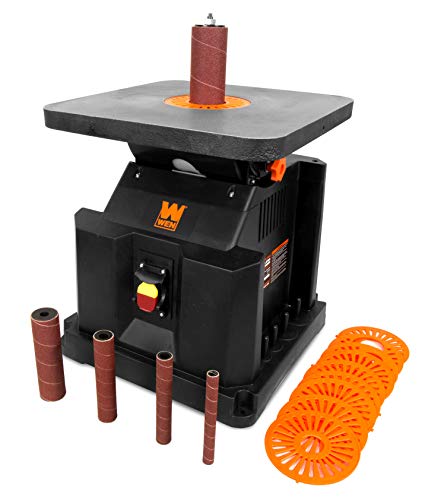
- Five sleeve sizes from 1/2 to 2 inches
- 14-1/2-inch beveling table
- Onboard accessory storage
Best For: Versatile small-workshop sanding and angled workpieces
Best Motor Capacity

- 1/2 HP motor
- Five spindles and six inserts included
- 1-1/2-inch dust port
Best For: Small workshops wanting a capable included accessory package
Best Variable-Speed Pick
Woodskil OSM-1V Spindle Sander

- 1,000-1,800 RPM variable speed
- Six sleeves from 1/2 to 3 inches
- Compact 26-pound design
Best For: Portable, adjustable sanding in space-conscious workshops
Compact Cast-Iron Workhorse – Triton TSPS450
For small workshops that need a stable benchtop option, the Triton TSPS450 combines a cast-iron top with rotating and oscillating action for sanding contours, arcs, curves, and other irregular shapes. Its 3.5-amp motor runs at 2,000 RPM with 58 OPM oscillation.
Best For: Woodworkers who want a sturdy, straightforward spindle sander with broad sleeve-size coverage and organized accessory storage.
Pros:
- Cast-iron top provides a solid sanding platform.
- Includes six sanding sleeves, matching rubber drums, and table inserts.
- Accepts sleeves from 1/2 to 3 inches.
- Onboard storage keeps accessories together.
Cons:
- Its 3.5-amp motor has less rated power than some larger models.
- It is a corded electric tool, so placement depends on outlet access.
The TSPS450 is a practical fit for small workshops prioritizing stability, useful included accessories, and reliable contour-sanding capability over portability or variable speed.
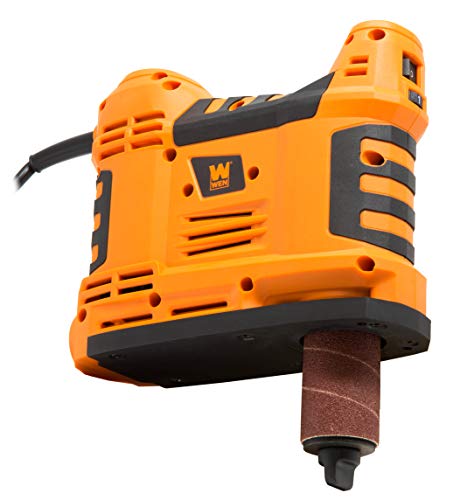
Portable Variable-Speed Pick – WEN HA5932
The WEN HA5932 stands out among spindle sanders for small workshops because it can be used handheld or clamped to a workbench as a stationary sander. Its 5-amp variable-speed motor offers 1,800 to 3,200 RPM and 50 to 90 OPM, helping accommodate different sanding tasks.
Best For: Small-shop users who value portability, variable speed, and the flexibility to switch between handheld and benchtop sanding.
Pros:
- Converts from handheld use to a stationary benchtop setup.
- Variable speed provides 1,800–3,200 RPM and 50–90 OPM ranges.
- Includes four spindle diameters from 1/2 to 1-1/2 inches.
- Includes mounting hardware, guide plate, dust port, and a two-year warranty.
Cons:
- Its included sanding sleeves are all 80 grit.
- The portable format may provide less built-in work-surface stability than a dedicated benchtop unit.
Choose the HA5932 when versatility matters most. It is especially useful where limited space makes a dedicated, permanently positioned sander less convenient.
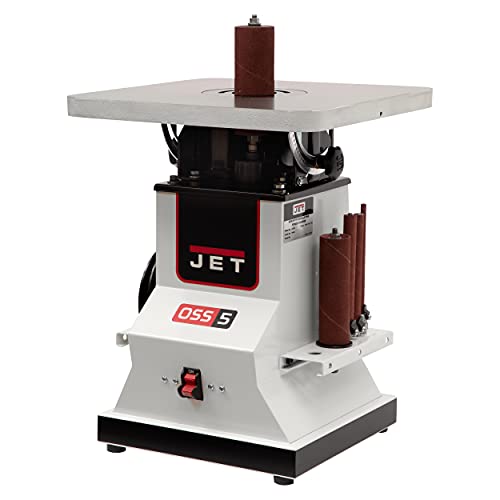
Heavy-Duty Benchtop Choice – JET JBOS-5
The JET JBOS-5 is a substantial benchtop spindle sander for small workshops that need a durable, stable machine. It uses a 1/2 HP motor, a 14-1/2-inch cast-iron table that tilts to 45 degrees, and a sealed lubricated oscillation gear system.
Best For: Serious hobbyists and workshop users who want a heavy, durable machine for regular contour and bevel-sanding work.
Pros:
- Heavy 75.6-pound construction supports a stable work setup.
- Tilting cast-iron table accommodates bevel sanding up to 45 degrees.
- Includes five spindle assemblies from 1/4 to 2 inches.
- Sealed oscillation gears and precision ball bearings support consistent operation.
Cons:
- Its 75.6-pound weight makes it less portable than compact alternatives.
- The larger benchtop footprint may be demanding in a very small workshop.
- Its listed 1,725 RPM speed is lower than some lighter models.
The JBOS-5 favors stability, durability, and table versatility. It makes sense when the sander will stay in one place and receive frequent use.
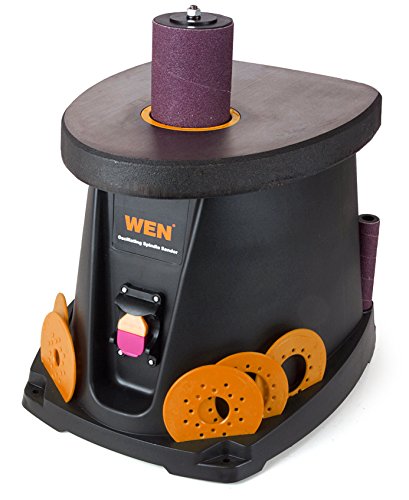
Simple Workshop Essential – WEN 6510T
The WEN 6510T is a straightforward option for small workshops needing a dedicated oscillating spindle sander. Its 3.5-amp, 1/2 HP motor delivers 2,000 RPM and 58 OPM, while onboard storage and a dust-collection port help keep the workspace more manageable.
Best For: Budget-conscious workshop users seeking a dedicated benchtop sander with basic dust-management and accessory-storage features.
Pros:
- 1/2 HP, 3.5-amp motor provides 2,000 RPM and 58 OPM.
- Onboard storage helps organize accessories.
- Dust port can connect to a dust extractor to reduce cleanup.
- Dedicated benchtop format is suited to repeat contour-sanding tasks.
Cons:
- The supplied notes do not specify included sanding sleeves or spindle sizes.
- It does not offer variable-speed control according to the listed specifications.
- Its 30.2-pound weight may limit portability.
The 6510T keeps the feature set focused: steady oscillating performance, accessory storage, and dust-extractor compatibility. It is a sensible choice when simplicity is more important than maximum versatility.
Best Portable Pick – Triton TSPSP650 Portable Oscillating Spindle Sander
For small workshops that need flexibility, the Triton TSPSP650 combines portable handheld edge sanding with bench-mounted spindle sanding. Its 650W motor, variable speed, rotating and vertical oscillating action, and included accessories make it a versatile option among spindle sanders for small workshops.
Best For: Woodworkers who want portable or bench-mounted sanding for cabinetry, sign making, sink openings, and general woodworking.
Pros:
- Portable design can also be used with the included inverted bench-mounting set.
- Variable speed from 1,800 to 3,200 rpm with 50 to 90 oscillations per minute.
- Includes four drum sizes, sanding sleeves, dust-port adaptor, and adjustable edge guide.
Cons:
- Its plastic construction may feel less substantial than a heavier benchtop machine.
- The included 80-grit abrasive is geared toward general-purpose sanding rather than fine finishing.
The TSPSP650 is a strong fit when limited shop space calls for one tool with two setups. Its variable speed and quick-change system add control, while the 4.9-pound weight keeps it practical for moving between work areas.
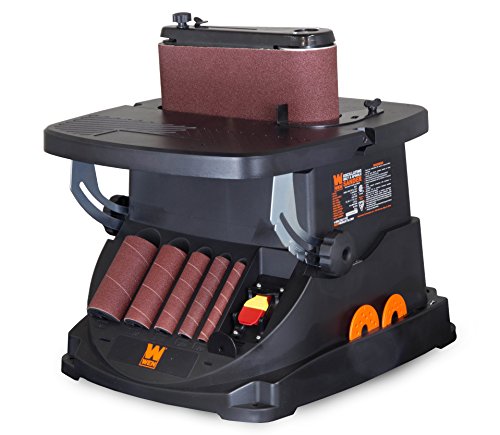
Best Combination Sander – WEN 6524 Oscillating Belt and Spindle Sander
The WEN 6524 expands beyond spindle sanding by combining oscillating belt and spindle functions in one corded machine. With multiple drum sizes, a 4-by-24-inch belt attachment, onboard storage, and a beveling table, it offers broad sanding capability for spindle sanders for small workshops.
Best For: Small-shop users who want one machine for curved edges, contours, and belt-sanding tasks.
Pros:
- Supports five spindle sizes from 1/2 inch to 2 inches plus a 4-by-24-inch sanding belt.
- Provides spindle speeds up to 2,000 rpm and belt speeds up to 1,575 feet per minute.
- Includes onboard storage, beveling work table, throat plates, drums, belt attachment, and six 80-grit abrasives.
Cons:
- At 27 pounds and 18.5 by 16.5 by 18 inches, it requires more bench space than a portable model.
- The supplied abrasives are all 80 grit, limiting finishing options without additional paper.
The WEN 6524 is the most versatile choice of this group if belt sanding is useful in addition to spindle work. Its larger footprint is a trade-off, but the combination design can save space compared with buying separate machines.
Best Large-Table Value – VEVOR 2000RPM Benchtop Spindle Sander
The VEVOR benchtop spindle sander offers a straightforward setup for furniture finishing, crafts, and DIY woodworking. Its 12.5-by-11.5-inch cast aluminum table, six sleeve sizes, 15mm stroke, and dust-connection port make it a practical contender among spindle sanders for small workshops.
Best For: DIY woodworkers who want a stable benchtop machine with broad sleeve-size coverage and vacuum connection.
Pros:
- Includes six sanding sleeves from 1/2 inch through 3 inches and six table inserts.
- Large cast aluminum worktable provides a stable 12.5-by-11.5-inch sanding surface.
- Dust port connects to vacuum hoses, while integrated storage keeps accessories organized.
Cons:
- Its 2,000 rpm maximum speed does not offer variable-speed adjustment.
- The 3.75-amp motor is less powerful on paper than the Triton’s 650W motor.
The VEVOR emphasizes workspace and included size options rather than portability. It is a sensible choice for a fixed bench where a larger table, 3-inch sleeve capability, and dust collection are more important than speed adjustment.
Best All-Around Value – WEN AT6535 Spindle Sander
WEN AT6535 3.5-Amp Oscillating Spindle Sander with Extra Large Beveling Table Top
Check Price On AmazonFor small workshops needing a versatile benchtop machine, the WEN AT6535 is one of the more flexible spindle sanders for small workshops. Its 3.5-amp motor runs at 2,000 RPM, while the oscillating spindle and multiple sleeve sizes support curved edges, contours, and detail work.
Best For: Woodworkers who want broad sleeve-size coverage and an angled work surface.
Pros:
- Includes five sanding sleeve sizes from 1/2 inch to 2 inches.
- Large 14-1/2-by-14-1/2-inch table bevels up to 45 degrees.
- Onboard storage keeps accessories and sandpapers organized.
Cons:
- The 3.5-amp motor has less stated capacity than the 1/2 HP Rikon and 2/3 HP Woodskil.
- It uses a fixed 2,000 RPM speed.
With its spacious beveling table and five sleeve diameters, the AT6535 is a practical choice when workspace flexibility and accessory organization matter more than variable-speed control.
Best Motor Capacity – Rikon Benchtop Spindle Sander
The Rikon Benchtop Oscillating Spindle Sander suits small workshops that want a compact machine with a stated 1/2 HP motor. Its 12-5/8-by-12-inch work surface, included inserts, and onboard storage provide a useful setup for routine contour sanding.
Best For: Users prioritizing motor capacity and a ready-to-use set of inserts and spindles.
Pros:
- Uses a 1/2 HP motor.
- Includes five spindles and six table inserts.
- Built-in 1-1/2-inch dust port supports dust-collection connections.
- Onboard storage helps keep accessories accessible.
Cons:
- Its work surface is smaller than the WEN’s stated table.
- The supplied notes do not specify rotational speed or included sanding sleeves.
The Rikon is a straightforward option for buyers who value its stated motor rating and included spindle-and-insert package, though the available specifications provide less detail about speed control and sanding consumables.
Best Variable-Speed Pick – Woodskil OSM-1V Spindle Sander
The Woodskil OSM-1V stands out among spindle sanders for small workshops with its adjustable 1,000-to-1,800 RPM range and compact 26-pound design. Its 4-amp, 2/3 HP motor and six sleeve sizes give users control for both delicate contours and heavier sanding tasks.
Best For: Small-workshop users who need adjustable speed, portability, and multiple sleeve sizes.
Pros:
- Variable speed from 1,000 to 1,800 RPM provides control across different sanding tasks.
- Includes six sanding sleeves ranging from 1/2 inch to 3 inches.
- Compact 26-pound design is easier to store and move.
- Dust port can connect to a vacuum system.
Cons:
- Its maximum speed is lower than the WEN’s stated 2,000 RPM.
- The supplied notes do not specify table dimensions or beveling capability.
For a crowded shop, the Woodskil combines the lightest stated weight in this group with variable speed and broad sleeve coverage, making it especially adaptable for curved edges, slots, and detail work.
How We Picked the Best Spindle Sanders for Small Workshops
We focused on the features that matter most when space, budget, and workflow efficiency are limited. Each model was evaluated for motor output, oscillating action, table stability, included spindle or sleeve sizes, dust-port compatibility, and portability. We also considered whether a sander is better suited to occasional hobby work, regular furniture building, or a small production shop.
Oscillation is especially important because it helps distribute wear across the abrasive sleeve and reduces grooves in curved workpieces. Models with cast-iron or reinforced tables generally provide a steadier platform, while lighter portable sanders are easier to store and move between work areas.
Quick Comparison
| What to Compare | Best For | Why It Matters |
|---|---|---|
| Motor power | Frequent or demanding sanding | Helps maintain performance under load |
| Variable speed | Mixed woods and delicate work | Offers greater control over material removal |
| Table size and stability | Large or awkward workpieces | Improves control and reduces tipping |
| Portable design | Shared or compact benches | Makes storage and setup easier |
| Extra sleeves or belt sanding | Versatile projects | Expands the shapes and tasks the tool can handle |
Key Buying Factors for Spindle Sanders for Small Workshops
Footprint and Portability
Measure your available bench area before buying. A heavier benchtop unit is usually more stable, but a portable model may be the better choice if you need to clear the bench after each project.
Power and Speed Control
For hardwoods, thick stock, or extended use, prioritize a stronger motor and a solid table. Variable speed is useful when working with different materials, smaller parts, or abrasive grits that require a lighter touch.
Sanding Capacity
Check the included spindle diameters and the maximum workpiece clearance. A broad range of sleeves lets you match the abrasive to tight inside curves, wide arcs, and moderate-radius cutouts. Combination models add flexibility if you also need belt sanding.
Dust Collection and Safety
A dust port can help connect the sander to a shop vacuum, but verify the port size and adapter requirements. Use eye and hearing protection, keep hands clear of the spindle, and secure small workpieces before sanding.
Who Should Buy Which Spindle Sanders for Small Workshops?
Choose a compact benchtop model if you want a dedicated machine for occasional cabinetry, signs, toys, or furniture parts. Choose a portable sander when storage space is limited or the tool must be moved frequently. Variable-speed models suit woodworkers who switch between hardwoods, softwoods, plywood, and delicate edge work. If you want one machine for more than curved-edge sanding, a belt-and-spindle combination can provide greater versatility, provided you have room for its additional functions.
For most small workshops, the best choice balances table stability, useful sleeve sizes, dust collection, and easy storage rather than simply choosing the highest motor rating.