Rough-sawn boards can be unpredictable: they may vary in thickness, carry saw marks, or include difficult grain that demands careful stock removal. The right planer turns that uneven material into consistent, workable boards while helping you control snipe, tear-out, and cleanup time.
We selected 10 wood planers for rough lumber across portable, benchtop, cordless, and stationary categories. The list includes choices for occasional DIY projects, serious furniture building, and high-volume shop work, so you can match capacity, cutterhead design, power, and budget to the way you work.
Best 10 Wood Planers for Rough Lumber Picks for 2026
Best Overall
DEWALT DW735X 13-Inch Two-Speed Planer

- 15-amp motor and 13-inch cutting width
- Three-knife cutterhead with extra knives
- Two feed speeds and automatic carriage lock
Best For: Wide rough boards and frequent benchtop stock preparation
Best Heavy-Duty Capacity
JET JWP-208HH 20-Inch Helical Planer

- 20-inch width for broad rough lumber
- 5-HP motor with two feed rates
- Steel base and cast-iron tables
Best For: Industrial or professional shops processing wide stock
Best Value Spiral Cutterhead
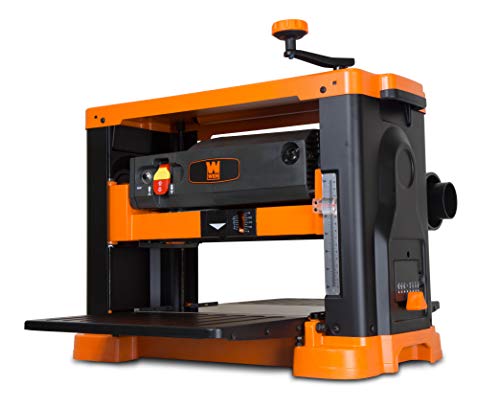
- 26 rotatable HSS spiral blades
- 15-amp motor with 26-feet-per-minute feed
- Handles stock up to 13 inches wide
Best For: Home shops seeking spiral-cutterhead performance
Best Portable Option

- Cordless brushless motor
- 30,000 cuts per minute
- 2-mm depth adjustment and chamfering groove
Best For: Portable trimming and localized rough-lumber fitting work
Best Benchtop Value

- 15-amp motor for hard and soft wood
- 12.25-inch cutting width
- Reversible double-edged knives
Best For: DIY stock preparation on a benchtop
Best for Smoother Finishes

- Six-row spiral cutterhead
- Two-sided tungsten carbide inserts
- Built-in snipe minimizer and board rollers
Best For: Beginners seeking smoother repeat passes
Best Heavy-Duty Option
Makita KP312 12-1/4-Inch Planer

- 15-amp motor at 12,000 RPM
- Cast-iron construction
- Large chip ejection chute
Best For: Powerful planing of rough materials
Best All-Around Pick
DEWALT DW734 12-1/2-Inch Benchtop Planer

- 15-amp motor for hardwood cuts
- Three-knife head delivers 96 cuts per inch
- Long tables and carriage lock help control snipe
Best For: General shop use and hardwood thicknessing
Best Spiral-Head Value
WOODERS 13-Inch Spiral Helical Planer
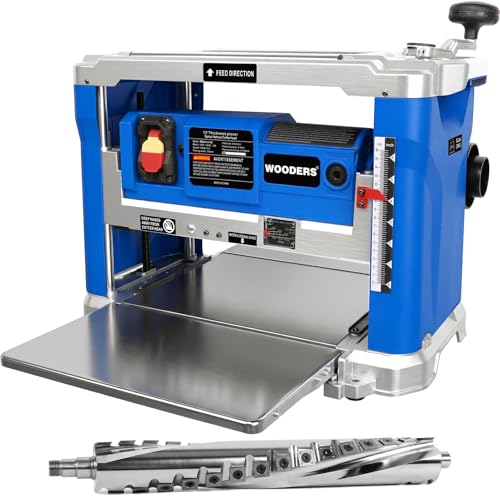
- Carbide spiral inserts help reduce tear-out
- 15-amp, 2000W motor for hardwood work
- 13-inch width with micro-adjustable depth control
Best For: Smooth, repeatable planing on hardwoods
Best Precision Helical Pick
FindBuyTool FB131H 13-Inch Planer

- 40 carbide inserts for smooth, quiet cutting
- Four-column design supports stable thicknessing
- Eight-position stop helps repeat batch cuts
Best For: Accurate tabletop thicknessing and batch work
Best Overall – DEWALT DW735X 13-Inch Two-Speed Planer
For wood planers for rough lumber, the DEWALT DW735X is a strong benchtop choice when you need a wide cutting capacity, substantial motor power, and control over feed speed. Its 13-inch width and 15-amp motor are suited to flattening and sizing larger boards.
Best For: Woodworkers processing wide rough boards who want a powerful benchtop planer with two feed speeds.
Pros:
- 15-amp, 20,000-RPM motor handles larger cuts and wider materials.
- Three-knife cutterhead offers longer knife life and easier knife changes.
- Two-speed gearbox supports 96 or 179 cuts per inch for finish or stock-removal work.
- Includes infeed and outfeed tables, extra knives, a material-removal gauge, and a depth stop.
Cons:
- At 102 pounds, it is heavy for a benchtop planer.
- Its 13-inch capacity may not suit boards wider than the cutting width.
The rigid cast-aluminum base, automatic carriage lock, and fan-assisted chip ejection add practical value for repeatable work. It is a particularly capable option when rough lumber preparation is a regular part of your shop routine.
Best Heavy-Duty Capacity – JET JWP-208HH 20-Inch Helical Planer
Among wood planers for rough lumber, the JET JWP-208HH stands out for its 20-inch capacity and industrial-scale construction. Its 5-HP induction motor, steel base, and cast-iron tables are designed for substantial, stable shop use.
Best For: Professional or serious shop environments that need 20-inch capacity and heavy-duty support.
Pros:
- 20-inch cutting width accommodates broad stock.
- 5-HP TEFC induction motor uses a V-belt transmission.
- Two feed rates, 24 and 31 feet per minute, help match the cut to the work.
- Helical cutterhead and cast-iron infeed and outfeed tables support controlled processing.
Cons:
- At 753 pounds, it is not portable or easy to reposition.
- Requires a 230-volt power supply.
- Its large footprint and industrial capacity may be excessive for occasional hobby use.
The precise 1/16-inch height scale, positive-drive handwheel, and automatic chain tensioner favor repeatable adjustments. This is a dedicated stationary machine for users who need more capacity and stability than a benchtop planer provides.
Best Value Spiral Cutterhead – WEN PL1326 13-Inch Planer
The WEN PL1326 combines a 13-inch cutting width with a spiral cutterhead, making it a practical contender among wood planers for rough lumber. Its 15-amp motor and 26-feet-per-minute feed rate are suited to routine stock sizing in a home workshop.
Best For: Home woodworkers who want a 13-inch benchtop planer with rotatable HSS cutter blades.
Pros:
- Spiral cutterhead uses 26 staggered, rotatable HSS blades.
- 15-amp motor delivers 10,000 RPM at a 26-feet-per-minute feed rate.
- Handles boards up to 13 inches wide and 6 inches thick.
- Onboard material-removal gauge helps monitor each pass.
Cons:
- It has a one-speed feed design rather than selectable feed rates.
- The supplied notes do not specify infeed or outfeed tables.
An adjustable dust port and depth stop add convenience, while the spiral head is intended to produce a clean, smooth finish. It offers useful capacity and cutterhead features without the industrial scale of a floor-standing planer.
Best Portable Option – DEWALT DCP580B 20V MAX Planer
The DEWALT DCP580B takes a different approach to wood planers for rough lumber: it is a compact, cordless hand planer for trimming and leveling work rather than full-width benchtop stock preparation. Its brushless motor and 2-mm maximum cut make it useful where portability matters.
Best For: Portable trimming, fitting, and edge work where a cordless planer is more practical than a stationary machine.
Pros:
- Brushless 20V motor provides cordless operation without a power cord.
- 30,000 cuts per minute support fast material removal.
- Depth adjustment is calibrated to approximately 0.01 mm.
- Aluminum shoes, kickstand, and chamfering groove support controlled handling.
Cons:
- Bare-tool package does not include a battery or charger.
- Its 2-mm maximum depth and handheld format are less suited to processing large quantities of rough lumber.
- It does not provide a stated benchtop cutting width.
At 7.4 pounds, this planer is substantially easier to carry to the work than the stationary alternatives. Choose it for localized material removal and portability, not for dimensioning wide boards in repeated passes.
Best Benchtop Value – CRAFTSMAN CMEW320
For wood planers for rough lumber, the CRAFTSMAN CMEW320 offers a practical benchtop design with a 15-amp motor suited to removing material from both hard and soft wood. Its 12.25-inch cutting width and reversible knives make it a versatile option for general stock preparation.
Best For: DIY woodworkers who need a capable corded benchtop planer for routine rough-lumber preparation.
Pros:
- 15-amp motor handles hard and soft wood material removal.
- Two-knife solid steel cutter head is mounted on ball bearings for smooth operation.
- Reversible, double-edged knives support longer cutting life.
- Vacuum port helps connect dust collection.
Cons:
- Its 0.13-inch cutting depth may require multiple passes for heavier stock removal.
- The corded benchtop format requires access to a power source and a stable setup.
The CMEW320 is a straightforward choice when you want solid power, a useful cutting width, and replaceable reversible knives without moving to a larger stationary machine.
Best for Smoother Finishes – Cutech 40700H Spiral Planer
Among wood planers for rough lumber, the Cutech 40700H stands out for its spiral cutterhead and staggered tungsten carbide inserts. The 12.5-inch benchtop planer also includes features designed to reduce snipe and make repeated passes more convenient.
Best For: Beginners and woodworkers prioritizing smoother finishes, quieter operation, and easier repeat planing.
Pros:
- Six-row spiral cutterhead is designed for smooth finishes and reduced noise.
- Two-sided inserts align with the cutterhead and can be replaced when needed.
- Patented coupling design and four lead screws automatically minimize snipe.
- Board return rollers send boards back toward the front for another pass.
Cons:
- It is a single-speed model, limiting speed-selection flexibility.
- The spiral cutterhead relies on inserts rather than conventional knife blades.
The 40700H is a strong fit when finish quality and user-friendly features matter as much as basic stock removal, especially for repeated work on rough boards.
Best Heavy-Duty Option – Makita KP312 12-1/4-Inch Planer
For demanding wood planers for rough lumber applications, the Makita KP312 combines a 15-amp motor with 12,000 RPM and a wide 12.25-inch cutting capacity. Its cast-iron construction, front roller, and large chip ejection chute are suited to moving material efficiently across rough boards.
Best For: Woodworkers who need a powerful planer for rough materials and efficient chip discharge.
Pros:
- 15-amp motor and 12,000 RPM support high-performance planing.
- Large depth-setting knob makes adjustments convenient.
- Large ejection chute helps discharge wet or dry chips and prevent clogging.
- Front roller helps the planer move over rough materials.
Cons:
- At 40.6 pounds, it is less convenient to move than a lighter benchtop model.
- The supplied notes do not indicate a dust-collection port.
The KP312 emphasizes power and material handling, making it appealing for rough stock when a heavier cast-iron planer and efficient chip discharge are priorities.
Best All-Around Pick – DEWALT DW734 12-1/2-Inch Benchtop Planer
DEWALT Benchtop Planer, 15-Amp, 12-1/2-Inch, 3-Knife Cutter, 20,000 RPM, Corded (DW734)
Check Price On AmazonFor wood planers for rough lumber, the DEWALT DW734 is a practical choice when you want strong cutting power, broad material support, and a finish-ready cut. Its 15-amp motor, three-knife cutter head, and 12-1/2-inch capacity make it well suited to hardwoods and general shop work.
Best For: Woodworkers who want a powerful benchtop planer with long infeed and outfeed support and convenient depth-repeatability features.
Pros:
- 15-amp, 20,000-RPM motor handles larger, deeper cuts in hardwoods.
- Three-knife cutter head provides 96 cuts per inch for a fine finish.
- Four-column carriage lock helps reduce movement that causes snipe.
- Extra-long tables provide 33-1/2 inches of material support.
Cons:
- Uses disposable reversible knives rather than a carbide-insert cutter head.
- Its 12-1/2-inch width is slightly narrower than the 13-inch alternatives.
- The tool is notably heavy at 36.29 kg.
The DW734 balances power, finish quality, and board support particularly well. A turret depth stop, material-removal gauge, and large thickness scale also make repeatable thicknessing easier for routine projects.
Best Spiral-Head Value – WOODERS 13-Inch Spiral Helical Planer
Among wood planers for rough lumber, this 13-inch model stands out for its spiral cutterhead and tungsten carbide inserts. The 15-amp, 2000W motor is designed for continuous hardwood planing, while micro-adjustable controls support repeatable thickness cuts.
Best For: Woodworkers seeking a wide benchtop planer with a carbide spiral cutterhead, lower-noise operation, and fine surface results.
Pros:
- Spiral cutterhead with tungsten carbide inserts is designed to reduce tear-out and noise.
- 15-amp, 2000W motor supports heavy-duty hardwood planing.
- 13-inch width and 1/4- to 6-1/4-inch material-height range handle varied stock.
- Micro-adjustment controls and a high-visibility thickness indicator aid precision.
Cons:
- Maximum cut depth is limited to 1/8 inch per pass.
- At 62 pounds, it is not especially lightweight for a benchtop machine.
- Its 10,000-RPM cutterhead speed is lower than some listed alternatives.
This planer is a compelling fit when surface quality and a wider cutting capacity matter more than portability. Its included spare inserts and dust collector add practical value for regular woodworking use.
Best Precision Helical Pick – FindBuyTool FB131H 13-Inch Planer
For wood planers for rough lumber where consistent thickness matters, the FindBuyTool FB131H combines a 13-inch capacity with a four-row helical cutterhead. Its 40 tungsten carbide inserts, four-column design, and anti-wobble foundation are built around smooth, stable cuts.
Best For: Woodworkers who prioritize accurate batch thicknessing, quieter helical cutting, and integrated chip removal.
Pros:
- Forty tungsten carbide inserts support smooth, tear-free cuts with minimal noise.
- Four-column design and anti-wobble foundation target consistent thickness.
- Eight-position depth stop simplifies repeated cuts on batches of boards.
- Four-row cutterhead produces smaller chips for faster removal without clogging.
Cons:
- Maximum planing depth is limited to 1/8 inch per pass.
- The 13-inch machine is intended for residential tabletop use and smaller quantities.
- Its 70-pound weight may make setup and storage less convenient.
The FB131H is focused on control and repeatability rather than aggressive material removal. Its 27.5 FPM feed rate, pre-installed helical head, and eight-position stop make it a useful option for preparing multiple boards to the same size.
How We Picked the Best Wood Planers for Rough Lumber
We evaluated each planer according to the demands of turning rough stock into usable boards. Key considerations included maximum cutting width and depth, motor power, cutterhead design, feed capacity, portability, dust collection, adjustment controls, and the likelihood of clean results on figured or irregular grain. We also separated portable tools from stationary machines because their strengths—and realistic workloads—are different.
For rough lumber, a reliable depth-adjustment system and stable infeed and outfeed support matter as much as headline motor speed. Helical or spiral cutterheads can reduce tear-out and make insert changes easier, while conventional knives may offer lower operating costs and fast stock removal.
Quick Comparison
| Planer Type | Best For | Main Advantage | Trade-Off |
|---|---|---|---|
| Portable cordless | On-site repairs and small boards | No cord or generator required | Limited runtime and stock capacity |
| Benchtop | Home shops and furniture projects | Good balance of price, capacity, and portability | More snipe and vibration than heavy machines |
| Helical benchtop | Figured grain and quieter operation | Cleaner cuts and replaceable inserts | Higher purchase price |
| Stationary 20-inch | Production shops and wide boards | Greater capacity and feed stability | Requires substantial space and power |
Key Buying Factors for Wood Planers for Rough Lumber
Width, Depth, and Stock Condition
Choose a cutting width that accommodates your usual boards with room to spare. A planer should remove material in several shallow passes rather than forcing one aggressive cut, especially with twisted, wet, or heavily cupped lumber. Check the maximum depth of cut at your intended board width because advertised limits often decrease as the cut gets wider.
Cutterhead and Finish Quality
Two- or three-knife cutterheads can remove material quickly and are straightforward to sharpen or replace. Spiral and helical heads use many small carbide inserts, generally producing quieter cuts and better results in difficult grain. They still require careful feeding and a properly flattened board; no cutterhead can safely correct severe twist by itself.
Feed Rate, Snipe, and Support
Variable or dual feed speeds help balance production with finish quality. Longer tables, board-return rollers, and accurate depth stops make repeated passes easier. To reduce snipe, support long boards level with the planer bed, use consistent feed pressure, and avoid changing your grip as the board enters or exits.
Power, Dust, and Shop Requirements
High-power corded models are better suited to continuous stock removal, but they need a suitable circuit and effective dust collection. Confirm voltage requirements before buying a stationary unit. A portable planer is easier to store, while a heavier machine usually stays steadier and handles wide or dense lumber more confidently.
Who Should Buy Which Wood Planers for Rough Lumber?
Choose a cordless planer if mobility is your priority and you mainly handle trim, doors, or small boards. A standard benchtop model is the practical choice for most DIYers and hobbyist woodworkers. Select a helical or spiral benchtop planer if surface quality, reduced tear-out, and lower noise matter more than the lowest upfront price. For frequent milling, wide stock, or production work, a heavy stationary planer with greater capacity and feed stability is the better long-term investment.
Before purchasing, measure your workspace, verify electrical requirements, budget for dust collection and replacement cutters, and confirm that the planer’s maximum width matches your lumber. The best tool is the one that safely handles your normal stock without forcing every project into the machine’s limits.